When Formula Evolution Outpaced the Tools Designed to Apply It
The complexion category has undergone a quiet but substantive transformation. Foundations now carry barrier-supporting ceramides and SPF actives. Concealers promise skin-recovery benefits. Powders are infused with serums, while balm and stick formats blur the boundary between makeup and skincare entirely. These are not minor reformulations — they represent a category in which the hybrid formula has become the dominant product architecture.
Yet for most of this evolution, the application tools remained largely unchanged. Dense brush heads designed for traditional pigment-heavy powders and classic liquid foundations continued to be used on formulas with fundamentally different rheologies, emolliency levels, and skin-interaction profiles.
Anisa Telwar Kaicker, Founder and CEO of Anisa International, identified this gap directly: "Formulas have evolved faster than the tools designed to apply them. We have developed tools to support how modern formulas are intended to perform — controlled, buildable, skin-like, and adaptable across textures." That realisation became the operational foundation for Anisa International's next-generation fiber expansion.
The Technical Architecture of Next-Generation Fibers
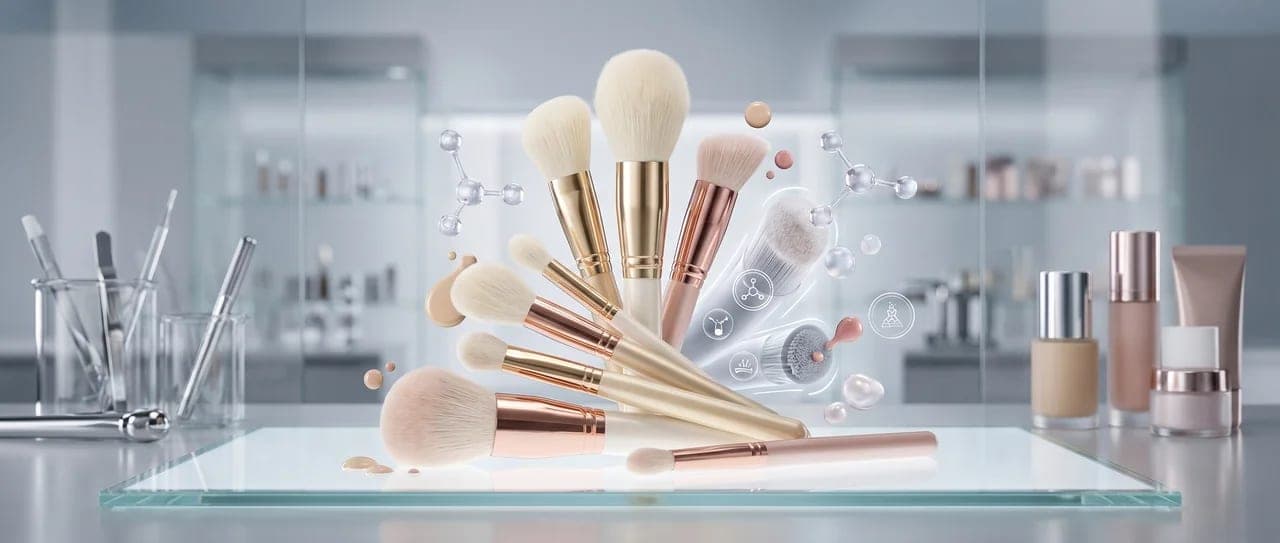
Anisa International's engineering response is built around a regulated pickup-and-release system — a proprietary fiber structure that combines structured makeup fibres with ultra-fine skincare-inspired tips. The system is designed to improve product control, reduce over-application, and deliver a more seamless skin finish.
The functional mechanism is what Anisa International describes as "regulated diffusion." Rather than depositing product in concentrated patches — the tendency of dense traditional brush heads — the hybrid fiber structure creates hundreds of micro-contact points across the skin surface. Product is dispersed more evenly and in finer layers, producing a softer-focus, more skin-like result with controlled buildability.
Internally, the company refers to the underlying philosophy as "blurring is the new airbrushing." This is a direct response to the predominant complexion trend of the past two years: lightweight coverage, soft diffusion, visible skin texture preservation, and natural finish as the aspiration rather than the heavily perfected, full-coverage result that earlier brush generations were optimised to deliver.
The Hybrid Texture Problem in Detail
The scope of hybrid formula diversity is worth understanding precisely, because it shapes the breadth of the tool engineering challenge.
Hybrid makeup now spans multiple texture families, including serum foundations, skin tints, cream-to-powder formulations, gel textures, balms, sticks, and modern low-density powders. While these products differ in viscosity and performance, they share several common characteristics: they are more flexible on skin, more sensitive to application method, and often more prone to streaking, shifting, or over-blending when paired with the wrong tool.
For brands and their contract manufacturing partners, this spectrum creates a new type of quality risk. A serum foundation applied with a brush head engineered for thick liquid coverage will deposit unevenly, potentially disrupting the skincare actives underneath or creating a patchy finish that undermines the product's claim performance. The tool is not separate from the product story — it is part of the formulation performance test.
Sensitive Skin and Textured Skin as Design Drivers
One element of Anisa International's fiber engineering that deserves specific attention is its direct relevance for mature, dry, post-treatment, and textured skin profiles. The elongated wispy fiber tips in the new generation distribute product in lighter micro-layers rather than pressing concentrated deposits into the skin surface. For skin types where heavy product accumulation visibly emphasises texture, this matters.
This design direction aligns with a broader market demographic reality. The Indian premium skincare and colour cosmetics consumer cohort increasingly includes consumers in their late 30s to 50s, post-procedure patients maintaining skin health routines, and younger consumers with active acne or sensitivity concerns. For these users, heavy application tools actively work against the product's intended performance.
The Procurement and Supply Chain Implications
For Indian beauty tool procurement teams and brand packaging heads, several practical considerations emerge from Anisa International's direction.
Formula-tool co-development is becoming a competitive necessity. Brands launching hybrid serum-makeup products without a paired application tool strategy are leaving product performance — and therefore consumer experience — to chance. The risk is not just consumer dissatisfaction; it is that the tool becomes the limiting factor on the formula's clinical and sensory claims.
Cruelty-free, synthetic fiber credentials are no longer optional. Anisa International has built its business on the transition from animal hair to engineered synthetic fibres. The company holds over 78 patents and trademarks and owns its manufacturing facilities, including a LEED-certified facility in Tianjin. For Indian brands entering EU or US export markets, cruelty-free certification is effectively a market access requirement. Procurement specifications for brushes should require written confirmation of fibre composition and origin.
Compact, multifunctional silhouettes reduce per-SKU tooling cost. Anisa International's development philosophy for the new fiber generation emphasises "midi-inspired" brush shapes designed to support multiple application techniques across formula types. For Indian brands managing NPD budgets carefully, a single versatile brush tool that works across a serum-foundation, skin tint, and lightweight powder SKU offers better economics than category-specific tooling.
The Sustainability and Waste Reduction Dimension
An underappreciated commercial argument for regulated-diffusion fiber technology is its reduction of product wastage per application. By regulating pickup at the brush head level and preventing over-saturation, the tool effectively extends the usage life of each product unit.
This carries a compliance dimension as well. India's Plastic Waste Management (Amendment) Rules, 2022 and EPR obligations are focused on packaging materials rather than applicator tools, but the broader sustainability narrative that Indian premium brands are building for export markets increasingly covers the entire application system — not just the primary container. A documented low-waste application tool is a credible and increasingly expected brand attribute in EU-facing product documentation.
Tool lifecycle and material composition are also emerging concerns. Synthetic fibre brushes are generally more recyclable and less ecologically complex at end-of-life than natural hair equivalents, which strengthens the EPR and sustainability positioning for Indian brands building circular credibility.
What Indian Brand and Procurement Teams Should Do Now
Three priorities deserve evaluation.
Audit your current brush specifications against your formula portfolio. If hybrid formulas — serums, skin tints, balm-textures, cream-to-powders — are part of your current or planned portfolio, evaluate whether your existing brush tooling was designed for these textures or for legacy formula types. The application performance gap is real and measurable.
Build fibre type and cruelty-free documentation into procurement specifications. Require written confirmation of synthetic composition, origin, and cruelty-free status for all brush procurements. This is a market access requirement for EU and US export and an increasing consumer expectation in Indian premium retail.
Evaluate formula-tool pairing as a product development input, not a post-launch consideration. The most effective hybrid formula launches are those where the formula and the applicator are developed together. Briefing your tool partner at the formula development stage — rather than after formulation is complete — produces better outcome alignment and faster launch timelines.
The transition from brush-as-accessory to brush-as-precision-system is not a marginal industry development. It is a structural repositioning of the beauty tool category — and the brands and procurement teams that internalise it now will build more coherent, better-performing hybrid product systems than those treating tooling as a downstream afterthought.