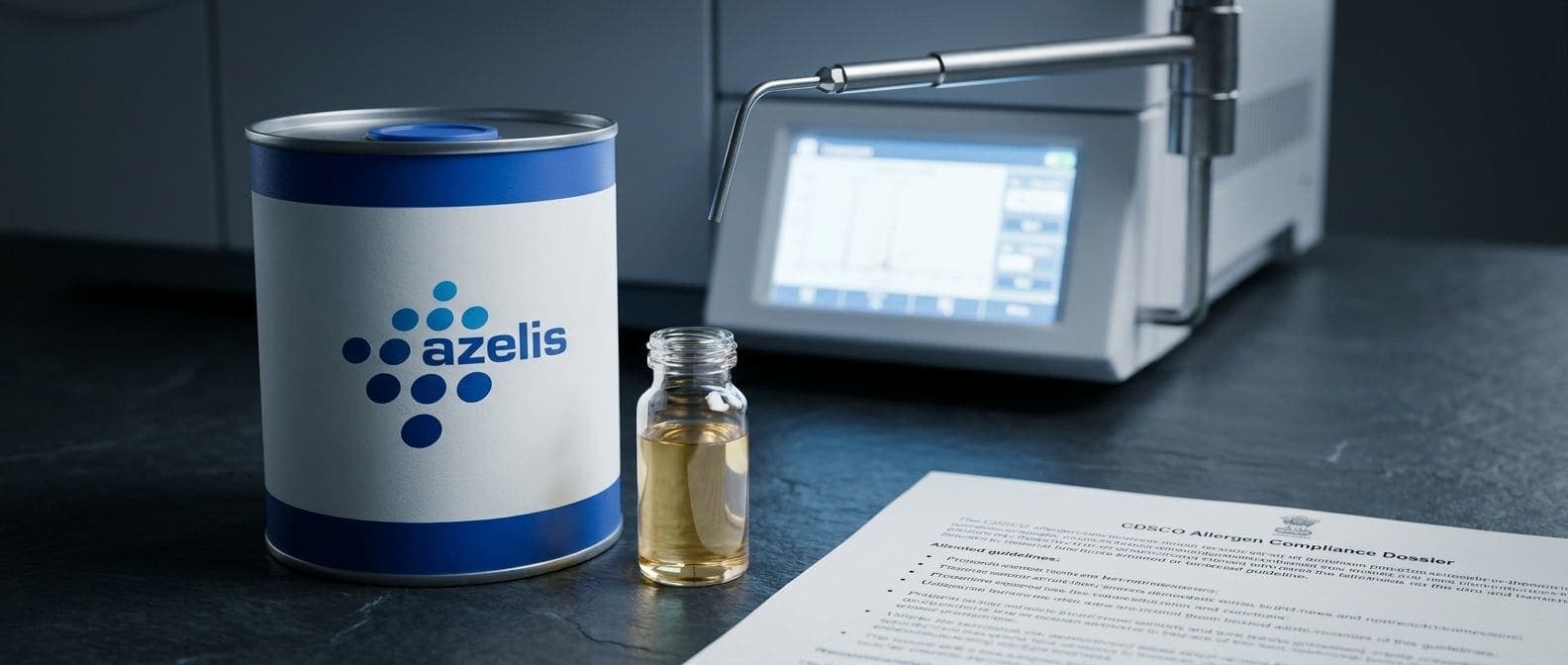
By August 2026, India’s Central Drugs Standard Control Organisation (CDSCO) will enforce mandatory extended labeling for 81 fragrance allergens, aligning directly with the EU 2023/1545 directive. The strict enforcement cutoffs leave no margin for error: any individual fragrance allergen exceeding 0.001% in leave-on products (serums, creams, fine fragrances) or 0.01% in rinse-off formulations (cleansers, shampoos) must appear explicitly on packaging.
For R&D chemists, relying on unrefined botanical extracts makes allergen capping nearly impossible across batches. Natural essential oils carry unacceptably high trace-allergen loads and unpredictable chemical profiles. Swapping raw *Cymbopogon* (lemongrass) oil for pure bio-derived geraniol, for instance, eliminates background citral and linalool spikes that unexpectedly push a formula over the 0.001% threshold. Precision bio-isolates give formulators exact control, satisfying Bureau of Indian Standards (BIS IS 7394) safety limits without sacrificing scent performance.
Preventing Autoxidation: Beyond Enantiomeric Purity
High-purity isolates—such as (R)-Linalool, (R)-(+)-Limonene, and bio-geraniol—deliver pristine olfactory profiles and optical purity. However, a common misconception at the bench is that optical purity alone prevents degradation.
Chirality control does not stop atmospheric autoxidation. Free radicals attack unsaturated double bonds regardless of enantiomeric purity, creating potent pro-allergenic hydroperoxides that trigger allergic contact dermatitis. To prevent hydroperoxide formation, formulators must pair chiral isolates with targeted antioxidant systems—such as alpha-tocopherol stabilization—or utilize structural hydrogenation (e.g., bio-farnesane). This dual strategy stabilizes the double bonds, preserving scent integrity while keeping sensitizing intermediates well below detectable limits.
Natural Fixation Systems
Replacing traditional synthetic fixatives like diethyl phthalate (DEP) or dipropylene glycol (DPG) requires smart green-chemistry substitutes. Bio-hydrogenated farnesene, plant resinoids, and lipophilic polysaccharides effectively lower terpene vapor pressure. These bio-based fixatives extend fragrance longevity across the wear cycle without altering the toxicological profile or adding new reportable allergens to the label.
Supply Chain Integration & Commercial Reality
For Indian beauty brands targeting domestic growth and EU export markets, the commercial risk isn't just regulatory non-compliance—it is consumer perception and supply chain disruption. A back label cluttered with dozens of chemical allergens scares off clean-beauty buyers, while non-compliant shipments face costly batch rejections during audits.
Scaling compliant formulations requires strategic CDMO partnerships equipped with high-resolution gas chromatography-mass spectrometry (GC-MS) testing and pre-validated base systems:
Azelis India (Mumbai): Distributes high-purity bio-terpene fractions and clean aroma isolates paired with application support for low-allergen systems.
Lambent Lab (Delhi): Provides specialized R&D services, focusing on tocopherol-stabilized chiral terpenes and precise GC-MS quantitative allergen mapping.
Stella Formulations (Maharashtra): Offers commercial-scale CDMO manufacturing with pre-screened, 81-allergen compliant personal care platforms.
By swapping volatile natural oils for stabilized bio-isolates today, cosmetic brands safeguard their supply chain, simplify back-label claims, and ensure uninterrupted market access long before the August 2026 deadline hits.