Barrier Repair Is Becoming a Scientific Battleground
Over the past five years, few skincare concepts have gained as much commercial momentum as barrier repair.
Once largely confined to dermatology-focused brands, barrier health has become a central theme across premium skincare, mass-market beauty, sensitive skin care, and even anti-ageing categories.
Consumers increasingly understand concepts such as transepidermal water loss, microbiome balance, skin sensitivity, and lipid depletion. As a result, they are seeking products that do more than temporarily moisturise the skin.
They want formulations that help restore normal skin function.
This shift has placed ceramides at the centre of modern skincare innovation.
However, a new generation of skin-equivalent ceramides is beginning to change how formulators think about barrier repair altogether.
Why Traditional Ceramides Became Essential
Ceramides are naturally occurring lipids found within the skin's stratum corneum.
They form a critical part of the extracellular lipid matrix that helps maintain barrier integrity and regulate moisture retention.
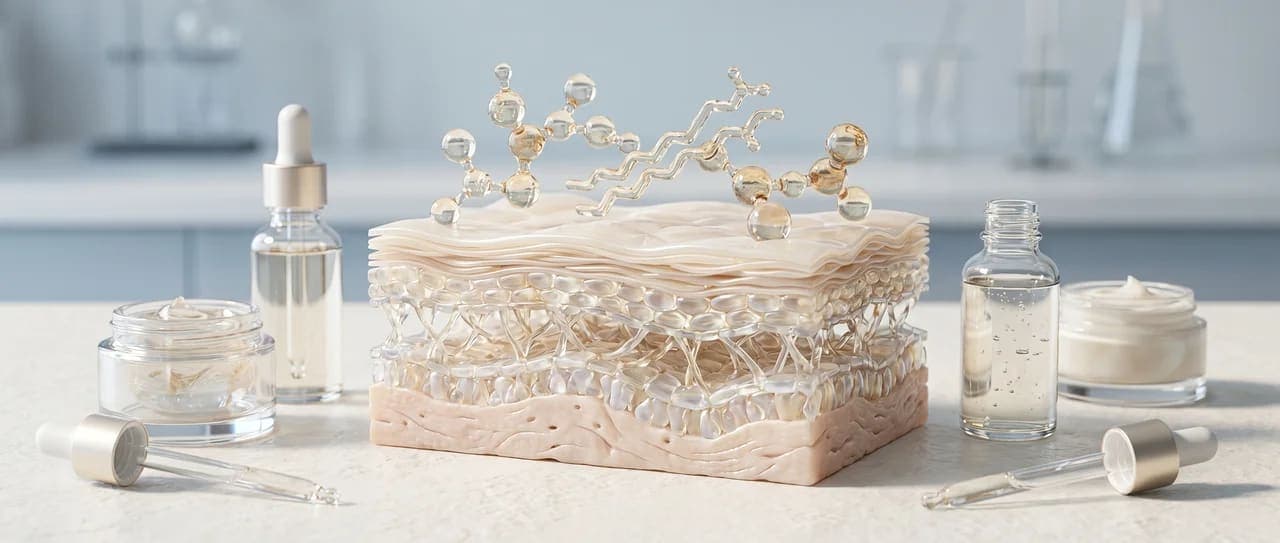
Together with cholesterol and free fatty acids, ceramides create the highly organised lipid structure often compared to mortar holding together skin cells.
When ceramide levels decline, the consequences become visible.
Dryness increases.
Sensitivity rises.
Barrier function weakens.
Skin becomes more vulnerable to irritation and environmental stressors.
These biological realities explain why ceramides became one of the most widely adopted skincare ingredients globally.
Yet not all ceramides behave identically.
The Shift Towards Biomimetic Design
The latest evolution focuses on skin-equivalent or biomimetic ceramides.
Traditional ceramide ingredients often provide moisturisation and barrier support but may not fully replicate the structure and behaviour of naturally occurring skin lipids.
Skin-equivalent ceramides are designed to more closely resemble the ceramides found within human skin.
This distinction matters.
The closer an ingredient mimics the skin's native lipid architecture, the greater its potential compatibility with existing barrier structures.
Rather than simply coating the skin, these ingredients aim to integrate more effectively within the lipid matrix itself.
For formulators, this represents a shift from supplementation towards reconstruction.
Rebuilding the Lipid Matrix
Barrier repair is often discussed in general terms.
From a formulation perspective, however, the process is highly specific.
Healthy skin depends on the precise organisation of multiple lipid components.
Simply adding moisturising ingredients does not automatically restore this structure.
Skin-equivalent ceramides are attracting attention because they seek to support the organisation of lipid lamellae rather than merely increasing hydration levels.
The objective is not just softer skin.
The objective is improved barrier functionality.
This distinction is becoming increasingly important as consumers become more knowledgeable about skin health.
Why Consumers Are Driving Demand
The rise of skin-equivalent ceramides is not occurring in isolation.
Several consumer trends are contributing to growing interest.
Over-exfoliation remains common.
Retinoid use continues to expand.
Professional aesthetic treatments are becoming increasingly accessible.
Environmental stressors, pollution exposure, and climate fluctuations continue to challenge skin resilience.
These factors have increased consumer awareness of barrier damage.
Many consumers now actively seek products designed to repair rather than simply moisturise compromised skin.
As a result, barrier repair has evolved from a dermatology niche into a mainstream skincare category.
Clinical Credibility Is Becoming More Important
One reason skin-equivalent ceramides are gaining attention is their compatibility with efficacy-driven product positioning.
Consumers increasingly expect evidence.
Brands are therefore investing more heavily in barrier function testing, hydration studies, TEWL measurements, and skin recovery assessments.
Skin-equivalent ceramides provide a scientifically credible narrative that aligns well with these substantiation efforts.
The terminology also supports a broader industry movement towards biomimetic skincare.
Consumers increasingly respond to ingredients that work with natural biological processes rather than attempting to override them.
For marketing and R&D teams alike, this creates a compelling platform for product differentiation.
The Formulation Challenges Behind the Opportunity
Despite the excitement surrounding biomimetic ceramides, formulation remains complex.
Ceramides are notoriously challenging ingredients to work with.
They often require careful processing conditions, specific delivery systems, and compatibility considerations.
Performance frequently depends on the presence of complementary lipids.
This is why many advanced barrier repair formulations combine ceramides with cholesterol and free fatty acids in carefully controlled ratios.
The goal is to replicate key elements of the skin's natural lipid composition rather than relying on a single active ingredient.
For formulators, barrier repair increasingly resembles system design rather than ingredient selection.
Beyond Sensitive Skin
Historically, ceramides were primarily associated with dry or sensitive skin.
That positioning is changing.
Barrier health now influences multiple categories, including:
* Anti-ageing skincare
* Acne management
* Post-procedure recovery
* Microbiome-focused products
* Men's grooming
* Scalp care
* Baby care
This expansion significantly increases commercial opportunities.
Barrier repair is no longer a category.
It is becoming a foundational skincare principle.
The brands best positioned for future growth may be those that integrate barrier-support concepts across entire portfolios rather than isolating them within specialist ranges.
What Product Developers Should Consider
The growing interest in skin-equivalent ceramides creates several practical opportunities.
Focus on Lipid Systems
Barrier repair performance often depends on complete lipid architectures rather than individual ingredients.
Strengthen Clinical Validation
TEWL reduction, hydration improvements, and recovery studies can support stronger product claims.
Build Biomimetic Narratives
Consumers increasingly understand the value of ingredients that mimic natural biological structures.
Expand Beyond Moisturisation
Barrier support can enhance positioning across multiple skincare concerns.
Integrate Barrier Health Across Categories
Barrier-focused innovation is increasingly relevant beyond traditional sensitive skin products.
The Future of Barrier Repair
The growing popularity of skin-equivalent ceramides reflects a broader evolution within skincare science.
Consumers are becoming more sophisticated.
Brands are becoming more evidence-driven.
Product development is moving away from simple hydration claims towards deeper biological functionality.
Skin-equivalent ceramides fit naturally within this transition.
They represent a move towards biomimetic formulation strategies that seek to support the skin by working with its natural architecture rather than simply masking symptoms.
For innovation teams, the opportunity extends beyond a single ingredient trend.
Barrier repair is becoming a platform for long-term product development.
The brands that understand this shift early will be better positioned to create formulations that deliver both measurable efficacy and lasting consumer trust.