Formulators targeting India’s heat-styling market face a persistent challenge: modern consumers want clinical-grade thermal protection without relying on heavy, non-biodegradable silicones. As daily blow-drying, flat-ironing, and hard-water exposure strip native lipids from the hair shaft, basic dimethicone coatings no longer satisfy discerning buyers. Product developers require bio-based ingredients that actively repair hair architecture under thermal stress.
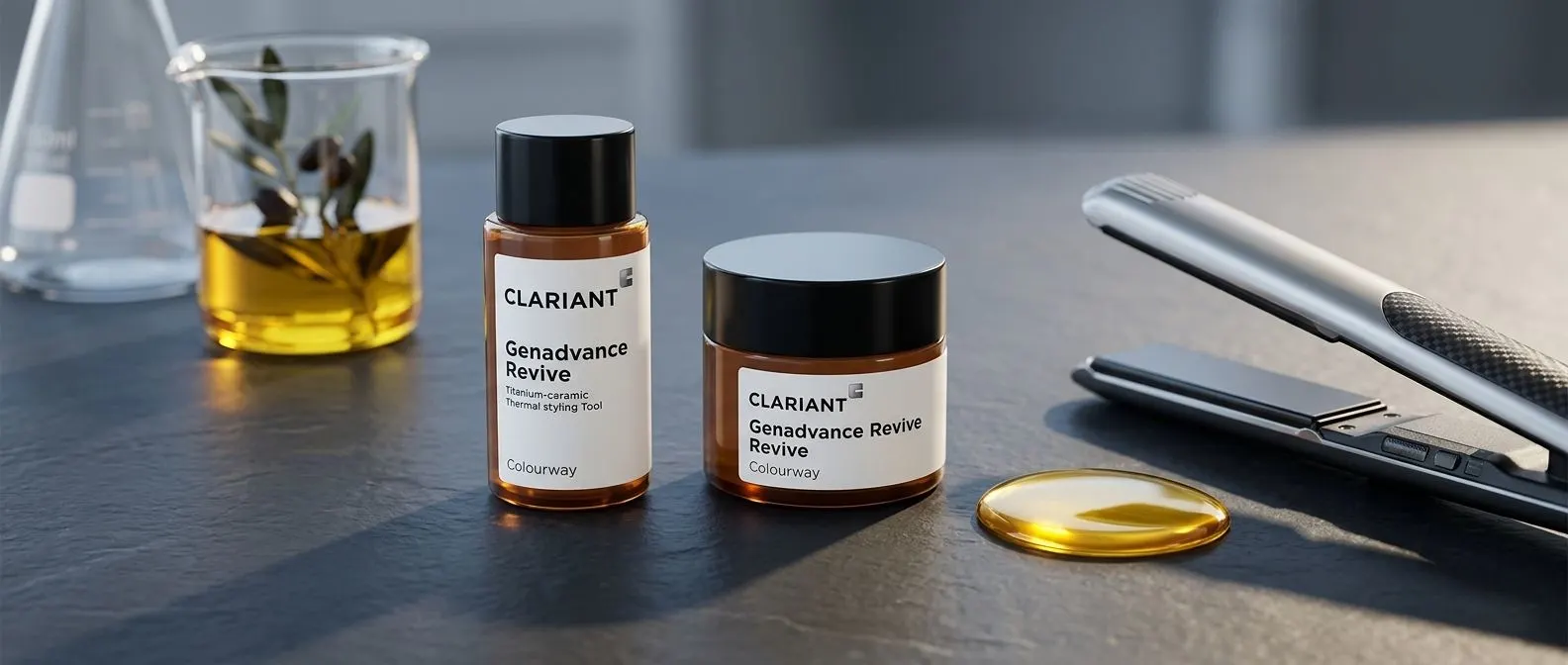
Clariant’s Genadvance™ Revive addresses this formulation trade-off directly. A 100% active, bio-based lipid complex derived from upcycled olive and rapeseed oils, it enables brand owners and contract development and manufacturing organisations (CDMOs) to commercialise heat-activated, silicone-free thermo-repair treatments engineered for the Indian market.
Biomimetic Mechanism and R&D Performance
Healthy hair relies on 18-methyleicosanoic acid (18-MEA), an endogenous lipid layer that coats the cuticle to maintain surface hydrophobicity and structural resilience. High-heat styling tools strip this natural lipid boundary, exposing raw hair keratin to structural degradation, elevated friction, and surface roughness.
When exposed to flat-iron temperatures, Genadvance™ Revive’s lipid complex cross-links directly with damaged, exposed keratin spots. Rather than merely masking the strand, it replicates native 18-MEA via a heat-triggered biomimetic interaction, sealing lifted cuticles flat along the hair shaft.
Bench-level testing confirms substantial performance gains across core structural parameters. The complex drives a 47% reduction in surface friction for immediate alignment and tactile smoothness, while cutting wet and dry combing force by 52%—significantly curbing mechanical breakage during post-wash styling routines. Furthermore, instrumental evaluation shows a 12% improvement in internal cortex integrity across both rinse-off and leave-on applications.
Processing Realism and Formulation Flexibility
On the factory floor, Genadvance™ Revive eliminates energy-intensive heating cycles, reducing operational costs and shortening batch times. The ingredient is fully cold-processable, incorporating smoothly into cold-emulsion phases under standard low-to-medium shear mixing (1,500–2,500 RPM). It demonstrates excellent stability within a pH window of 4.0 to 6.0, making it ideal for quat-free, low-pH hair repair formulas.
Because the active complex integrates seamlessly with both cationic and non-ionic emulsifiers, formulators can easily deploy it across diverse product formats—from crystal-clear bonding serums and weightless mists to rich conditioning masks. Cold-process integration also protects delicate secondary botanicals, proteins, and vitamins in complex leave-in systems from thermal degradation during batch production.
Regulatory Compliance and Claims Strategy
Navigating CDSCO compliance under India’s Cosmetics Rules (2020) and IS 4707 standards is straightforward for this ingredient. The Central Drugs Standard Control Organisation classifies Genadvance™ Revive as a non-restricted cosmetic raw material.
Domestic CDMOs incorporating the ingredient operate under Form COS-2, while finished-goods importers use the Form COS-1 route. Its upcycled botanical origin streamlines safety profiling, passing heavy metal limits (Lead ≤ 20 ppm, Arsenic ≤ 2 ppm) with negligible skin sensitisation risk. To substantiate front-of-pack claims such as "heat-activated thermo-repair" or "internal cortex protection," CDSCO mandates that brands support marketing copy with finished-formula bench data, including wet/dry combability metrics and tensile strength analysis.
Commercial Outlook
By turning thermal styling into an active trigger for keratin restoration, Genadvance™ Revive allows Indian hair care brands to replace synthetic silicones with a high-performance, upcycled alternative. It offers R&D teams a scalable, clean-label pathway to capture the growing demand for clinical heat-repair cosmetics.