Indian contract manufacturers are already getting slammed with R&D briefs asking a simple question: how do we fix "Ozempic Face"? The rapid global adoption of GLP-1 receptor agonists like semaglutide has created an urgent issue in aesthetic dermatology—accelerated facial lipo-atrophy. Swift weight loss depletes subcutaneous fat rapidly, leaving patients with hollowed malar pads, pronounced nasolabial folds, and sagging jawlines.
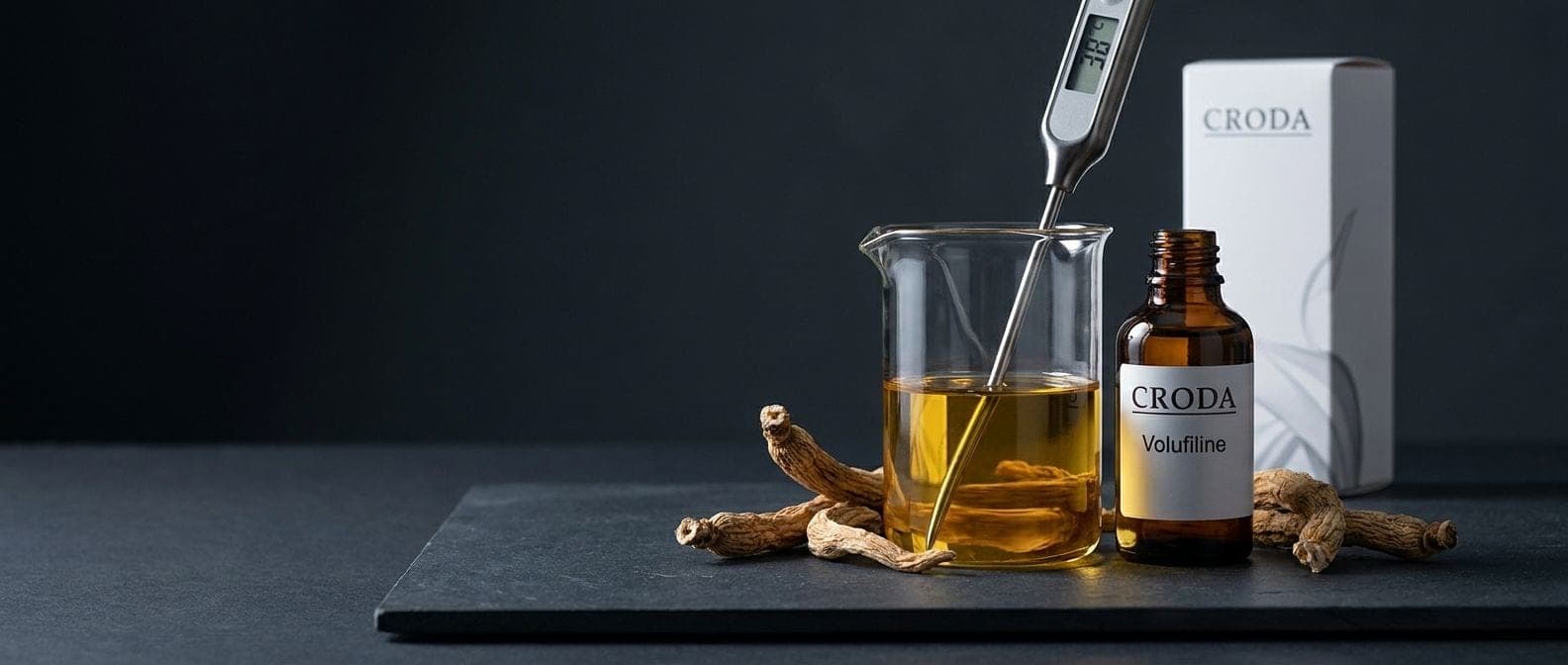
Croda caught this shift early. The specialty chemical giant has strategically repositioned Volufiline™, its established lipo-filling active, to target GLP-1-induced facial volume loss directly. This pivot gives Indian CDMOs an immediate entry point into high-margin skin recovery lines tailored for post-weight-loss consumers.
Biochemical Mechanism: Targeted PPAR-gamma Activation
At the core of Volufiline™ is sarsasapogenin, a phytosterol-free sapogenin derived from *Anemarrhena asphodeloides* roots, solubilised in hydrogenated polyisobutene. Standard moisturizers sit on the stratum corneum. Sarsasapogenin penetrates deeper, reaching the subcutaneous layer where it acts as a localized Peroxisome Proliferator-Activated Receptor Gamma (PPAR-gamma) agonist.
By activating PPAR-gamma, the active triggers pre-adipocyte differentiation and upregulates triglyceride synthesis inside existing adipocytes. This targeted, non-invasive adipogenesis drives localized lipid accumulation, replenishing lost facial adipose tissue without systemic hormonal interference.
Bench-Level Formulation Architecture
Formulating for GLP-1 recovery demands precise processing controls, not vague chemical blending. To prevent thermal degradation of the active sapogenins, chemists must incorporate Volufiline™ strictly during the cool-down phase below 40°C. Adding it during high-temperature emulsification compromises the sarsasapogenin molecule.
To construct a high-performing emulsion, couple the active with specific complementary phases:
Signal Peptides: Direct-couple with acetyl tetrapeptide-2 or palmitoyl tripeptide-38 to reinforce extracellular structural proteins alongside fat-cell expansion.
Multi-Weight Hyaluronic Acid: Disperse low, medium, and high molecular weight sodium hyaluronate in the aqueous phase to lock in multi-depth tissue moisture.
Ceramide Matrices: Incorporate skin-identical ceramides and essential fatty acids to repair thin epidermal barriers caused by rapid metabolic changes.
CDSCO Regulatory & Compliance Framework in India
CDSCO compliance under the Cosmetics Rules, 2020 requires clear boundary lines. While sarsasapogenin triggers genuine physiological adipogenesis, marketing claims must remain strictly cosmetic to avoid falling under the Drugs and Cosmetics Act, 1940.
Claim Boundaries
Prohibited Claims: Avoid therapeutic wording. Phrases like "replaces dermal fillers," "treats pharmaceutical side effects," or "reverses lipodystrophy" will draw regulatory fines.
Compliant Claims: Focus strictly on aesthetic improvements, such as "enhances the appearance of facial fullness," "improves contour volume," or "promotes a plumper, firmer look."
Safety and Quality Testing
Formulations manufactured in or imported into India must comply with Bureau of Indian Standards (BIS) IS 4707 guidelines. CDMOs must complete heavy metal screening (Lead ≤ 20 ppm, Arsenic ≤ 2 ppm), total viable aerobic microbial limits, and a full 3-month accelerated stability trial (at 40°C / 75% RH) before batch release.
By pairing precise lipid-biology formulating with disciplined regulatory compliance, Indian cosmeceutical brands can capture a fast-growing market segment at the intersection of metabolic health and personal care.