The European Commission is officially walking back strict limits previously outlined under Omnibus VIII (Regulation EU 2026/78) for micron-sized silver (CI 77820). Following a comprehensive safety reassessment by the Scientific Committee on Consumer Safety (SCCS/1687/25), Brussels is moving to amend Annex III of EU Regulation (EC) No 1223/2009.
For Indian brand owners, raw material suppliers, and CDMOs supplying European buyers, this regulatory shift gives exporters a clear green light to update antibacterial, anti-acne, and self-preserving formulations without risking regulatory pushback at EU customs.
Barrier Kinetics and the SCCS Toxicological Shift
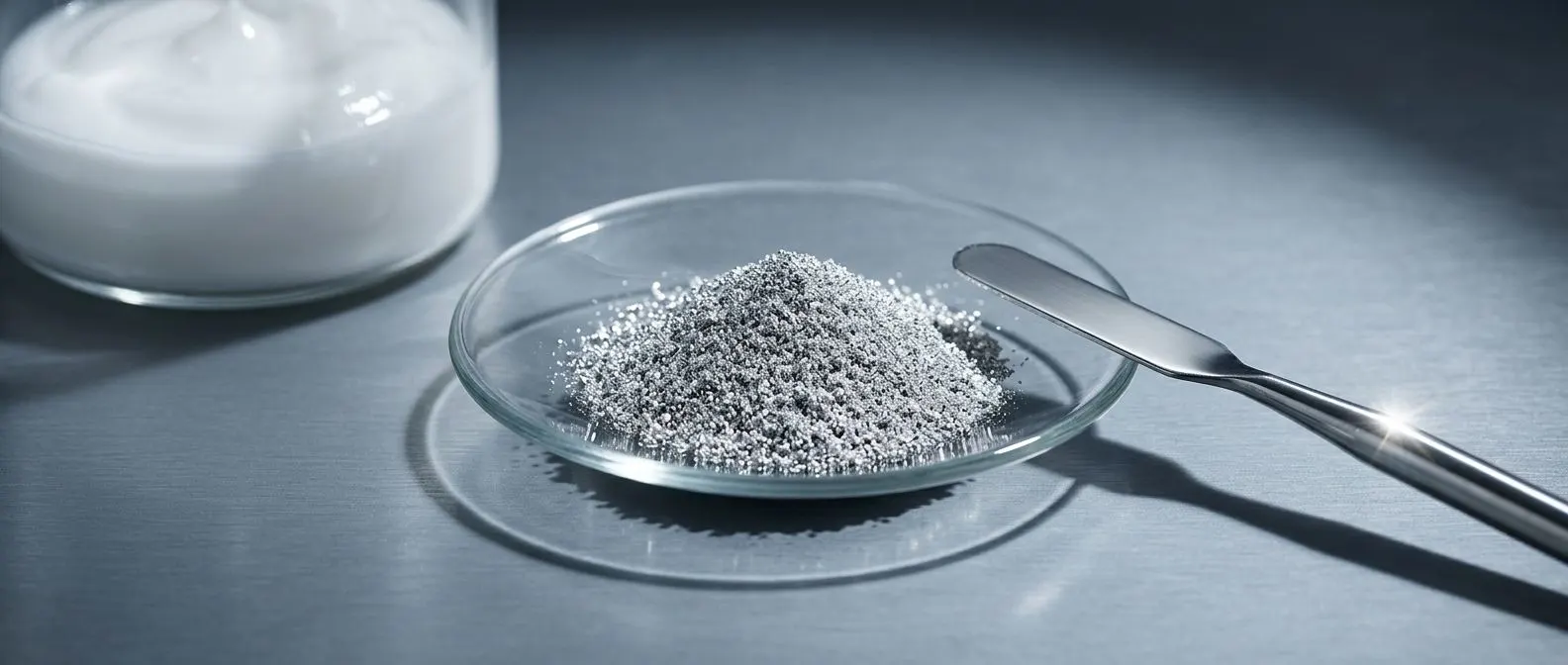
Non-nano particulate silver functions as an inorganic active defined strictly by a particle diameter between 100 nm and 1 µm. Its antimicrobial mechanism relies on the controlled release of silver cations (Ag+). These cations bind aggressively to cellular thiols (-SH groups) across bacterial cell walls, structural enzymes, and transport channels. This reaction neutralizes bacterial load directly on the skin surface without systemic uptake.
The catalyst behind the SCCS’s favorable opinion comes down to stratum corneum barrier kinetics. Solid dermal absorption data confirmed that particles within the 100 nm to 1 µm size range cannot penetrate intact human skin. Because systemic absorption is non-detectable, the safety committee concluded that historical toxicity concerns linked to soluble silver salts simply do not apply to topical micro-silver when formulated within safe thresholds.
New Annex III Concentration Limits
The draft regulation outlines clear, application-specific concentration ceilings for non-nano CI 77820:
Leave-On Skincare and Nail Care: Permitted up to 0.3% w/w.
Rinse-Off Products and Adult Oral Hygiene: Permitted up to 0.2% w/w.
Children’s Mouthwash: Permitted up to 0.05% w/w.
Propellant Sprays: Prohibited entirely to eliminate pulmonary inhalation risks.
Upgrading Compliance Workflows for Indian Manufacturers
Translating this regulatory easing into friction-free EU exports requires immediate adjustments to raw material screening and regulatory dossiers.
If your raw material Certificates of Analysis (CoAs) lack Dynamic Light Scattering (DLS) or laser diffraction data, your EU Safety Assessor will reject the Product Information File (PIF) outright. You must ensure your raw material suppliers explicitly certify zero particles below 100 nm, as nano-silver remains governed by far stricter limits under Annex IV.
Regulatory teams should update PIFs and Cosmetic Product Safety Reports (CPSRs) immediately. Safety assessors need to recalculate the Margin of Safety (MoS) using the updated SCCS toxicological endpoints. Don't forget heavy metal compliance: every batch of CI 77820 must certify Lead (Pb) levels under 20 ppm and Arsenic (As) under 3 ppm. Aligning these updates with domestic CDSCO standards also simplifies dual-market production, allowing exporters to streamline inventory across regions.
Commercial Playbook for CDMOs and Brands
This relaxed framework creates immediate commercial opportunities across several high-growth formulation categories:
Self-Preserving Systems: Micro-silver enables formulators to cut back on traditional synthetic preservatives like parabens or phenoxyethanol, giving clean-beauty claims solid technical backing.
Microbiome-Focused Dermo-Cosmetics: We expect strong B2B demand for micro-silver in anti-acne gels, post-procedure recovery creams, anti-dandruff scalp care, and clean oral hygiene products.
Indian CDMOs that rapidly lock in pre-validated, EU-compliant micro-silver chassis will secure a decisive first-mover edge in global contract manufacturing.