# FAFAI's Push to Make India a Fragrance Powerhouse
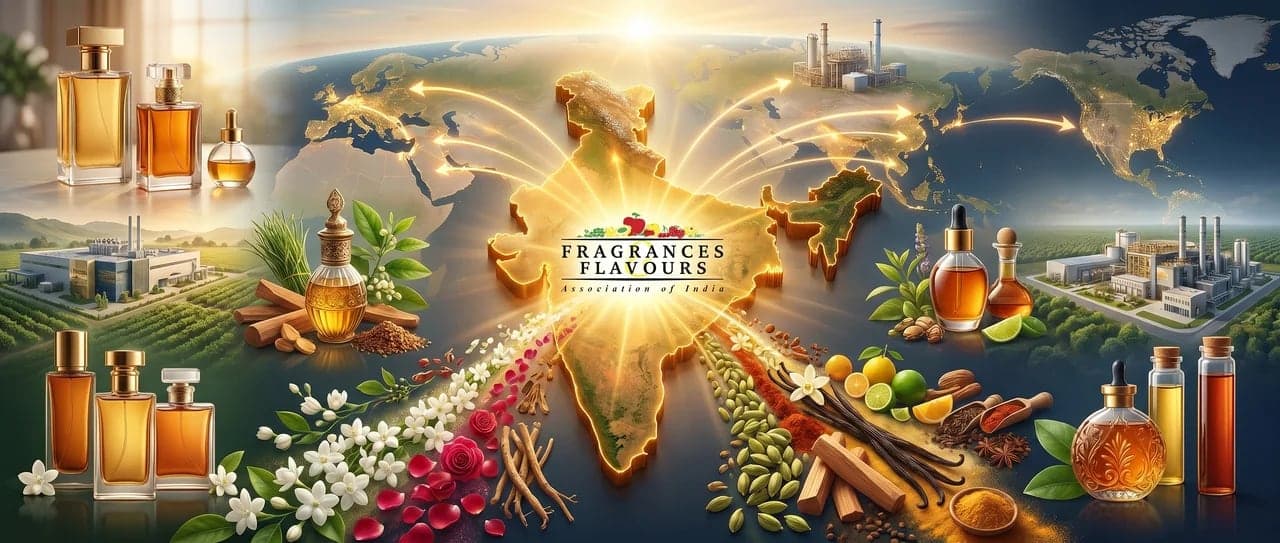
India has long supplied the world's fragrance industry with some of its most irreplaceable raw materials — Madurai jasmine, Karnataka sandalwood, Assam oud, Uttar Pradesh rose. Yet the country has historically punched below its weight as a finished fragrance and flavour supplier, constrained by fragmented standards, limited documentation infrastructure, and a perception gap between Indian and European or American manufacturers. FAFAI, the Fragrances and Flavours Association of India, is executing a structured plan to close that gap — and its implications for procurement managers, perfumers, and brand formulation teams are concrete and immediate.
The Industry Body Behind India's F&F Transformation
FAFAI is India's apex body for the fragrance and flavour sector, representing over 800 member companies spanning multinational corporations, large domestic manufacturers, and the MSME base that collectively accounts for 50–60% of the market. Its strategic mandate in 2025–2026 extends well beyond trade association functions: it is actively engaged in standardisation, regulatory advocacy, green chemistry promotion, and the development of India's ingredient documentation infrastructure.
The Indian F&F market sits at USD 3–3.8 billion as of 2025, with projections pointing toward USD 5 billion in the near term. India already exports 55–70% of its total F&F production, with the UAE, Saudi Arabia, the United States, France, and Germany among its primary destination markets. FAFAI's ambition is to convert this supply position into a leadership position — by raising quality benchmarks, closing compliance gaps, and activating the country's natural ingredient assets more systematically.
The 9,000-Ingredient Reference List: What It Means in Practice
One of FAFAI's most operationally significant contributions is the Indian Fragrances and Flavours Reference List of Ingredients, now in its second edition (2023), cataloguing over 9,000 materials — natural and synthetic — with common names, CAS numbers, and identification codes including FEMA, JECFA, and EU FL references.
For procurement teams, the practical utility of this list is direct. It provides a structured foundation for Safety Data Sheet (SDS) authoring, allergen disclosure, and supplier qualification. For formulators working across domestic and export markets, it reduces the risk of using materials that lack regulatory documentation in the Indian framework — a gap that has historically created friction at customs clearance and market entry. For contract manufacturers, the list functions as a pre-qualification checklist when onboarding new ingredient suppliers.
It is important to draw a clear distinction, however. FAFAI's reference list identifies what is used in India and documents its identity. IFRA (International Fragrance Association) standards — particularly the 51st Amendment — define what concentration is safe in each product category, based on safety data from the Research Institute for Fragrance Materials (RIFM). Both are necessary: FAFAI's list tells you what the ingredient is; IFRA tells you how much of it is permitted in which application. Compliance with one does not substitute for compliance with the other.
The BIS-IFRA Convergence Underway
FAFAI's ongoing collaboration with the Bureau of Indian Standards (BIS) is working to formally integrate IFRA-aligned safety parameters into India's domestic regulatory framework. When this convergence matures, manufacturers will be able to demonstrate both domestic and international compliance through a single documentation pathway — reducing the dual-system burden that currently adds cost and complexity for export-oriented Indian fragrance companies. Procurement teams should treat this as a near-term development to monitor, not a distant aspiration.
India's Natural Ingredient Advantage — and Its Commercial Constraints
The case for India as a global fragrance leader rests significantly on its botanical biodiversity. No regulatory framework can manufacture the aromatic profile of Assam agarwood, the indolic intensity of Madurai jasmine, or the creamy warmth of Karnataka sandalwood. These are genuine supply assets — but each comes with constraints that procurement strategy must account for.
Sandalwood (*Santalum album*) carries protected species designation and strict export controls that limit commercial volume, sustaining price premiums but creating availability risk for large-scale buyers. For formulations requiring sandalwood character, FAFAI-member suppliers increasingly offer certified Indian-origin material alongside compliant synthetic alternatives (such as Javanol or Ebanol) that carry none of the regulatory exposure.
Jasmine (*Jasminum sambac*) from Madurai is subject to seasonal yield variation of 20–30% driven by monsoon variability, making multi-supplier sourcing a practical necessity rather than a preference. Its presence in formulations for Dior, Guerlain, and other luxury houses establishes its global commercial credential — but the volumes those houses consume place real pressure on what is available for domestic and mid-tier international brands.
Oud (agarwood) from Assam, which FAFAI has specifically highlighted through its work with India's Ministry of Development of North Eastern Region, commands extraordinary pricing in the Middle Eastern and international niche fragrance markets. The challenge is cultivation lead time and regulated harvesting — factors that make spot sourcing unreliable and forward contracting with established producers the more defensible approach.
Green Chemistry as Competitive Advantage
FAFAI's endorsement of green chemistry — specifically solvent-free extraction, enzymatic synthesis routes, and supercritical CO₂ extraction — is not positioned as environmental branding. It is framed as a pathway to produce higher-quality, higher-margin, internationally credible ingredients.
Supercritical CO₂ extraction preserves thermally sensitive aromatic compounds that steam distillation degrades, producing isolates with greater olfactory fidelity that command price premiums in niche and luxury fragrance markets. For manufacturers investing in this technology, the return case is simultaneously commercial and regulatory — as VOC emission regulations tighten across the EU and GCC, solvent-free extraction becomes a compliance asset as well as a quality one. Indian manufacturers who invest in this infrastructure now are building towards a supply position that will be difficult for lower-technology competitors to replicate.
Actionable Priorities for Procurement and Formulation Teams
- Cross-reference FAFAI's ingredient list against your current formulation inventory. Any material lacking documentation in the Indian regulatory context creates a potential clearance or compliance issue as domestic standards tighten.
- Audit IFRA certificate vintage across your supplier portfolio. The 51st Amendment introduced changes affecting commonly used musks and citrus materials. Certificates issued against earlier amendments require updating before export-bound product launch.
- Establish direct sourcing relationships in Madurai, Assam, and Karnataka for jasmine, oud, and sandalwood respectively — ideally through FAFAI member suppliers who can provide traceability documentation and extraction method certification.
- Evaluate supercritical CO₂ extraction as a procurement specification for natural isolates where ingredient fidelity and regulatory documentation are both business-critical — particularly for formulations targeting EU or GCC markets.
- Monitor the BIS-IFRA convergence timeline through FAFAI's regulatory publications and conventions. Being ahead of formal domestic adoption of IFRA parameters will substantially reduce compliance cost when the change is formalised.
India's fragrance industry is not positioning itself as a cost-competitive alternative to established supply chains. It is positioning itself as a source of irreplaceable botanical assets, improving regulatory credibility, and — with FAFAI's standardisation and green chemistry push — a peer-level supplier to the world's most demanding fragrance buyers. For procurement teams, the question is whether your sourcing strategy reflects that trajectory yet.