A Data-Backed Brief From Retail and Fragrance House Together
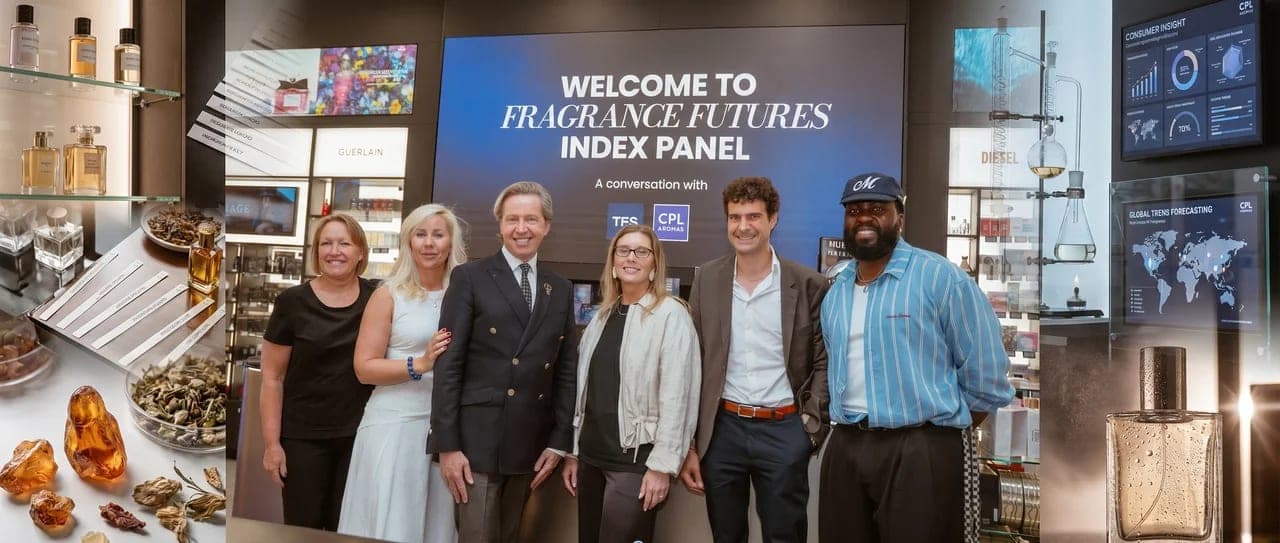
The Fragrance Futures Index 2026 — produced jointly by UK fragrance retailer The Fragrance Shop and the world's largest fragrance-only house CPL Aromas — is one of the more practically useful industry documents published this year. Unlike generic trend forecasts, it combines CPL Aromas' formulation intelligence with The Fragrance Shop's direct consumer behaviour data from over 200 retail locations.
The report revealed a significant shift in consumer behaviour, with fragrance lovers moving away from the idea of a single signature scent and instead building fragrance wardrobes tailored to different moods, occasions and identities. It was presented at an exclusive event at The Fragrance Shop's Oxford Street flagship, with a panel that included senior CPL Aromas perfumers, Parfums Christian Dior training leadership, and fragrance creators — giving it credibility across both formulation and retail dimensions.
The report is underpinned by wider industry momentum, with prestige beauty sales growing by 4% to $24.1 billion. For formulators, procurement managers, and brand teams, the Index functions as a consumer-to-lab translation document — and the formulation directions it signals deserve specific attention.
Fragrance Wardrobing and Its Sourcing Consequences
The shift from single signature scent to fragrance wardrobing — building a personal collection of complementary fragrances for different contexts — is the structural consumer behaviour change that shapes almost every other formulation signal in the Index.
When a consumer owns four to six fragrances rather than one, she develops olfactive literacy over time. She learns to identify notes, to distinguish between aromatic families, and to evaluate whether a new fragrance adds genuine incremental value to her wardrobe. This elevated consumer sophistication is the direct driver of two other signals in the Index: ingredient literacy and the demand for more nuanced performance.
The report identifies a new generation of consumers who are increasingly interested in understanding ingredients such as oud, saffron, and similar materials. For formulators and procurement teams, this is both an opportunity and a standard. A consumer who can identify oud by name will notice if the oud in a formulation is thin, synthetic, or poorly substantiated. The quality bar for materials that have entered consumer vocabulary has risen.
For Indian fragrance brands and procurement teams, this development aligns directly with domestic strengths. India produces some of the world's most desirable oud (Assam agarwood, GI-certified in the northeast), saffron (Kashmir, GI-certified), and several other high-demand naturals. The ingredient literacy trend is a commercial invitation to build sourcing narratives around these materials that consumers are now primed to receive.
Gourmand 2.0: The Formulation Shift From Sweet to Complex
The findings highlighted the rise of "Gourmand 2.0", where creamy, toasted and textured notes are replacing overt sweetness. This is a nuanced but commercially important formulation shift. The first generation of gourmand fragrances — vanilla-heavy, caramel-forward, unambiguously sweet — dominated the early 2020s and is now showing saturation signals. Gourmand 2.0 retains the comfort and approachability of the category but replaces confectionery sweetness with more complex, layered, and texturally interesting profiles.
The olfactive direction — toasted, creamy, textured rather than simply sweet — maps onto a specific set of ingredient families. Tonka absolute, benzoin resinoid, labdanum, smoked amber, salted caramel accords constructed through synthetic aroma chemicals, and coffee and cocoa derivatives are the building blocks of Gourmand 2.0. Formulators working in this territory should note that several of these materials carry IFRA usage limits — particularly tonka (coumarin content), benzoin, and certain synthetic amber compounds — that require careful calculation at the formulation stage.
Indian aroma chemical suppliers are well-positioned in several Gourmand 2.0 ingredient categories. Privi Speciality Chemicals, S H Kelkar (Keva), and Oriental Aromatics produce relevant synthetic accords and aroma chemicals in this family. For Indian brands building accessible-luxury gourmand compositions domestically, partial sourcing from Indian suppliers can both compress lead times and improve unit economics without sacrificing formulation quality.
Alcohol-Free Innovation: The Formulation Challenge Worth Taking Seriously
The Index also highlighted a rise in water-based formulations and more nuanced approaches to fragrance performance. The alcohol-free fragrance segment is growing for several converging reasons: consumer skin sensitivity concerns, the halal market (where ethanol is restricted), travel regulation compatibility, and a broader wellness positioning that associates reduced alcohol content with gentler personal care.
For formulators, alcohol-free fragrance is a genuinely difficult technical challenge, not merely a label change. Ethanol performs multiple functions in conventional fine fragrance: it acts as a solvent for hydrophobic aroma chemicals, it assists projection and sillage by promoting evaporation, and it produces the initial top-note burst that characterises the opening of most contemporary fragrances. Replacing it while maintaining performance requires careful reformulation.
Dipropylene glycol (DPG), isopropyl myristate (IPM), cyclopentasiloxane, ethylhexyl hydroxystearate, and various ester-based carrier systems are among the alternatives used in alcohol-free formats. Each carrier has a different solubilisation profile and evaporation behaviour, which affects how the fragrance performs on skin over time. Water-based and oil-based alcohol-free formats each require fundamentally different formulation approaches and testing protocols.
IFRA compliance under alcohol-free formats also requires recalculation. Usage limits for specific sensitising materials are set as percentages of the finished product — and carrier choice changes the finished product composition in ways that affect these calculations. Formulators switching from alcohol-based to alcohol-free should conduct IFRA compliance verification against the new carrier composition, not simply transfer the existing calculation.
The Middle Eastern Fragrance Culture Signal
The Index also identified the growing influence of Middle Eastern fragrance culture as a defining driver of current trends — a signal that resonates strongly for Indian formulation teams given the geographic and cultural proximity between India and the Gulf.
Heavy, resinous, oud-forward, bakhoor-adjacent compositions that were once positioned as niche or specialist in Western markets are now mainstream consumer reference points globally. For Indian brands formulating for domestic premium markets or export to GCC, this direction validates ingredient choices that India's own attar tradition has maintained for centuries — oud, rose, amber, mukhallat structures — and gives them contemporary global commercial context.
The India-GCC fragrance corridor is one of the most commercially underexplored opportunities for Indian fragrance houses. Gulf consumers are among the world's highest per-capita fragrance spenders, they have a deep cultural affinity for South Asian fragrance ingredients, and several Indian fragrance export routes to the region are already functional. The Fragrance Futures Index's identification of Middle Eastern fragrance culture as a macro driver is a commercial invitation for Indian brands to formalise this corridor.
What Indian Formulators and Procurement Teams Should Do Now
Three priorities deserve immediate evaluation.
Build oud and saffron into formulation briefs with documentary sourcing rigour. Consumer literacy about these materials means quality will be evaluated. Assam agarwood and Kashmiri saffron, sourced with GI documentation and traceability, provide both formulation quality and a credible consumer-facing provenance story.
Develop an alcohol-free formulation competency. The halal market, wellness positioning, and travel compatibility together make alcohol-free a significant formulation direction for the Indian market and for GCC export. Invest in carrier system evaluation and IFRA compliance recalculation before a brand brief arrives requiring it.
Evaluate Gourmand 2.0 as a near-term NPD direction. Toasted, creamy, textured rather than sweet — this is a commercially proven direction globally that has not yet been fully exploited in Indian mid-premium fragrance. Indian aroma chemical suppliers can support relevant ingredient sourcing domestically.