From Before-and-After Photos to AI-Simulated Skin Futures
On 10 June 2026, Haut.AI announced its collaboration with OLAY to introduce a new Virtual Companion Technology to the OLAY Skin Advisor experience. The new technology uses generative AI and clinical data modelling to simulate how a recommended skincare routine is expected to perform over time. The Virtual Companion experience helps shoppers gain confidence before they buy by providing a more personalised projection of potential product benefits backed by OLAY's clinical science.
For cosmetics manufacturers, R&D heads, and brand teams, this collaboration is worth examining closely — not because OLAY's specific implementation needs replicating, but because it signals where claims communication technology is heading across the entire industry. The shift from static before-and-after photography to AI-generated, clinically-anchored projection is a meaningful evolution in how brands will be expected to substantiate and visualise efficacy claims going forward.
How the Technology Actually Works
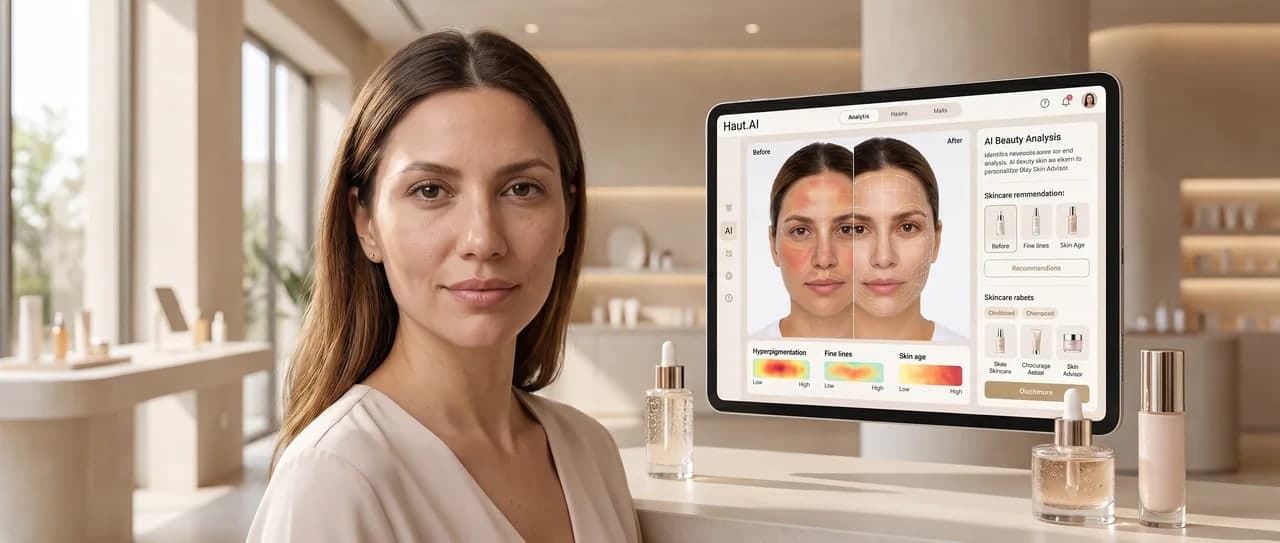
Within the OLAY Skin Advisor experience, users first complete a skin analysis by taking a guided selfie using Haut.AI's LIQA™ (Live Image Quality Assessment) technology. The system detects key skin concerns and provides personalised insights, including education and ingredient benefits, along with a recommended skincare routine.
The initial scan detects skin concerns — such as wrinkles, pigmentation, or texture — and develops a "before" image that best matches the user. Users can have their skin analysed in the system, which then matches them to an AI-generated skin profile. Their unique skin characteristics are then mapped into the Virtual Companion, allowing product effects to be simulated in a controlled manner.
The critical technical detail for manufacturers to understand: the system draws on a dataset of over 10,000 AI-generated face profiles, representing a wide range of ages and facial features. Rather than mapping the simulation directly onto the user's actual uploaded photo — which would raise both privacy and authenticity concerns — the system matches the user to a synthetic face profile from this dataset, and the simulated product effects are projected onto that synthetic match. The technology analyses users' skin to create an AI-generated profile and shows projections of product use over 4-8 weeks based on OLAY's clinical data.
This architecture is deliberate. As Anastasia Georgievskaya, CEO and co-founder of Haut.AI, explained: "Together with OLAY, we've applied SkinGPT in a completely new way — expanding how generative AI can be used to showcase skincare results in a way that is tailored to the user's skin characteristics, without relying on generic before-and-after examples."
Why "Without Relying on Generic Before-and-After Examples" Matters
This is the phrase manufacturers should pay closest attention to. The beauty industry's traditional efficacy communication tool — the before-and-after photograph, typically of a clinical trial participant — has well-known limitations: it represents one individual's response, raises questions about lighting, retouching, and selection bias, and does not personalise to the viewer's own skin characteristics.
The Virtual Companion approach attempts to solve this by mapping clinical trial outcome data onto a synthetic profile matched to the individual viewer's actual skin characteristics. This requires the underlying clinical data to be robust enough to model — not just a headline percentage improvement, but data granular enough to project differentiated outcomes across different skin types, ages, and starting conditions. OLAY positions this as drawing on its "70+ year legacy of proven science and trusted results across skin types."
For manufacturers without decades of accumulated clinical data at this scale, this raises a direct question: can your brand's clinical substantiation support this level of personalised projection, or does your current efficacy data only support a single aggregate claim?
The Broader Haut.AI Ecosystem and Where This Is Heading
Haut.AI collaborates with leading beauty and wellness brands, including Neutrogena, Beiersdorf, Ulta Beauty, and Grupo Boticário. This is not a one-off OLAY project — it is one application of a broader generative AI skin simulation platform that Haut.AI is deploying across multiple brand relationships and use cases.
A parallel example illustrates the direction clearly. At In-cosmetics Global 2026 in Paris, Givaudan Active Beauty and Haut.AI partnered to create a virtual try-on experience powered by AI, allowing users to visualise the effects of Givaudan's ingredients on their skin via photorealistic simulation. The experience is powered by Haut.AI's SkinGPT simulation technology and is built around Givaudan's recently launched active ingredient targeting skin rejuvenation, PrimalHyal NeuroYouth.
This is strategically significant: visitors can take a selfie, digitally apply the ingredient, and visualise how the ingredient may influence visible skin parameters such as wrinkles and fine lines over time, with the technology providing ingredient-level precision in its predictive visualisation. An ingredient supplier — not just a finished-product brand — is now using generative AI simulation as a B2B sales tool to demonstrate active ingredient performance to formulators and brand customers before they commit to using it.
For Indian formulators evaluating active ingredients, this signals that ingredient suppliers are increasingly willing to invest in sophisticated, AI-powered demonstration tools to support sourcing decisions — a development that should raise expectations for what supplier technical support looks like going forward.
What This Means for Manufacturers and Brand Teams
Several concrete implications follow from this technology direction.
Clinical data quality and granularity become a competitive differentiator beyond the claim itself. A brand with clinical data sufficient to support personalised, AI-driven projection has a communication capability that a brand with only aggregate trial results cannot replicate. This elevates the strategic value of investing in more granular, segmented clinical study design — by skin type, age cohort, and baseline condition — rather than single-population studies aimed at a headline statistic.
Generative AI simulation tools are becoming accessible through technology partners, not requiring in-house build. Haut.AI's model — partnering with multiple brands (Neutrogena, Beiersdorf, Ulta Beauty, OLAY, Grupo Boticário) and ingredient suppliers (Givaudan) — demonstrates that this capability is available as a licensed technology partnership, not solely as a proprietary in-house investment limited to the largest conglomerates. This materially lowers the barrier for mid-sized brands and even Indian D2C players to access comparable capability.
Consumer expectations for pre-purchase confidence tools will rise. As major brands like OLAY normalise AI-projected outcome visualisation, consumers across markets — including India's increasingly digitally sophisticated skincare buyers — will begin expecting equivalent confidence-building tools from competing brands, even smaller ones.
What Indian Manufacturers and Brand Teams Should Do Now
Three priorities deserve evaluation.
Audit your clinical data for granularity, not just headline results. If your brand's substantiation supports only a single aggregate efficacy claim, evaluate whether your next clinical study design could capture segmented data — by skin type, age, or baseline severity — that would support more personalised digital communication tools in future.
Evaluate AI simulation technology partnerships rather than in-house build. Haut.AI's multi-brand partnership model demonstrates this technology is accessible without proprietary AI development. Indian brands and even mid-sized D2C players should explore whether comparable partnership-based tools are available or emerging for the Indian market.
Watch the ingredient-supplier application closely. Givaudan's use of this technology as a B2B sales and demonstration tool for active ingredients is a template Indian formulators should expect from their own ingredient suppliers in the coming 12-24 months — and a capability Indian aroma chemical and active ingredient manufacturers should consider building toward themselves.
The shift from static before-and-after imagery to AI-generated, clinically-anchored projection is not a single brand's marketing innovation — it is a developing industry standard for efficacy communication. Manufacturers that build the clinical data foundation to support it now will be positioned advantageously as the technology becomes more widely expected.