A Packaging Decision That Split a Fan Base — and Reveals a Supplier Challenge
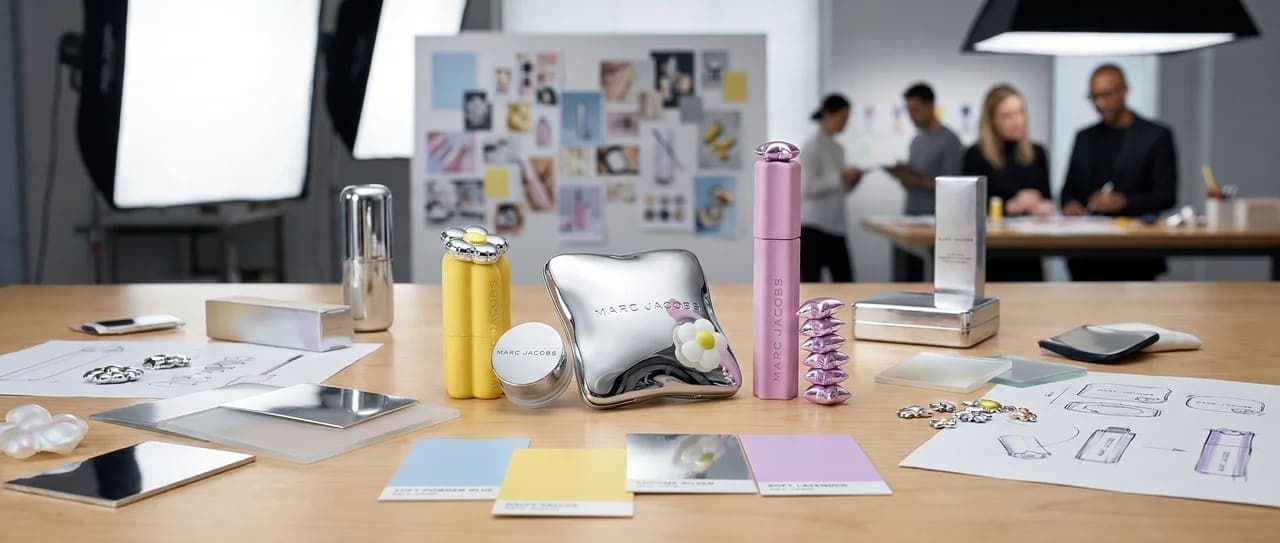
Marc Jacobs Beauty's revamped make-up range has pivoted from the sleek black compacts of the discontinued OG range, leaning heavily into the whimsical, collectable beauty packaging trend instead. This decision has divided opinion. The brand's playful new packaging — eyeshadows that look like mini star-shaped metallic balloons, daisy-shaped blush, lavender tubes of mascara, and eyeliner adorned with a star charm — is already winning over fans.
For procurement managers and packaging engineering teams, the consumer debate over aesthetics is interesting but secondary. The more relevant question is structural: what does it actually take to manufacture cosmetic packaging in non-standard, sculptural shapes at commercial scale, and what compliance and cost implications follow from that choice — questions directly applicable to Indian brands considering similar novelty-packaging strategies.
The Strategic Reasoning Behind the Packaging Pivot
Javier Zotez Ciancas, Global SVP of Marc Jacobs Beauty, told Cosmetics Business that this pivot is part of a much larger reimagining of the beauty brand, which will deliver a more clear, creative vision that spans across its makeup and fragrance. The packaging is designed by Marc Jacobs himself, and reflects his distinctive creative language, rooted in creativity, fun, and self-expression. It combines bold colour, contrasting textures, and exaggerated shapes.
"We saw an opportunity to offer something deliberately different: bold colour, unexpected textures, and a sensorial, fashion-led experience," Jean Holtzmann, chief brands officer at Coty, told Fast Company. Coty is betting that cute packaging and bold colour cosmetics can redirect attention from years of corporate turmoil.
This commercial framing matters for Indian packaging suppliers and brand teams: a major licensed beauty brand under significant corporate pressure to perform is treating packaging shape and material innovation as a primary differentiation lever, not a secondary design afterthought — a signal worth registering for any brand evaluating its own packaging investment priorities.
The Manufacturing Reality Behind "Trinket-Style" Shapes
Star-shaped compacts, daisy-shaped blush pans, and charm-adorned eyeliner closures are categorically different manufacturing challenges from the rectangular and cylindrical forms that dominate cosmetic packaging globally. Each non-standard geometry requires bespoke injection mould tooling, with development costs and lead times that scale with shape complexity rather than product volume.
For Indian contract packagers and converters evaluating whether to pursue this category of work, several technical realities deserve attention. Tooling investment is front-loaded and shape-specific — a star-shaped compact mould cannot be repurposed for a daisy-shaped blush pan, meaning each new SKU shape in a collectable-style range requires independent capital investment, unlike standard round or square compacts where a single tooling platform can serve multiple SKUs through minor dimensional variation.
Wall thickness consistency becomes harder to control in complex geometries. Star points, petal shapes, and charm attachments create variable wall thickness across a single component, increasing the risk of weak points, warping, or inconsistent fill during injection moulding — a quality control challenge that standard geometric shapes largely avoid.
The EPR and Recyclability Implications Indian Procurement Teams Should Weigh
This is the area where novelty packaging shapes create genuine compliance friction, directly relevant to Indian brands operating under the Plastic Waste Management (Amendment) Rules, 2022 and EPR obligations.
Complex shapes typically require multi-material or multi-component assembly, which complicates recyclability. A star-shaped compact with a metallic finish, a charm attachment, and a separate mirror or applicator component is structurally harder to design for mono-material recyclability than a standard compact — exactly the design principle that India's and the EU's tightening packaging regulations increasingly reward.
Material reduction goals can directly conflict with sculptural shape ambitions. Star points, petal contours, and decorative charms generally require more material per unit of product-holding volume than a standard geometric form, working against the material-efficiency direction that EPR recycled-content and reduction targets are pushing the broader industry toward — a tension Indian brands pursuing this packaging direction will need to navigate explicitly, not avoid.
Decorative metallic finishes and charm attachments often use materials and adhesives that complicate end-of-life sorting. Indian procurement specifications for any comparable novelty packaging direction should explicitly evaluate whether decorative elements (metallic coatings, attached charms, embossing) can be designed for separability at end-of-life, or whether they permanently compromise the base component's recyclability.
The Consumer Reception Data Worth Understanding
On Marc Jacobs Beauty's Instagram post on 21 May, which revealed the new packaging for the first time, the comments highlight this mix of excitement and disappointment from the fan base. Instagram user Ksha commented: "Where's the OG classic packaging? It was like half the appeal for me?" Kay Zinn shared a similar sentiment: "I think there was a better way to make fun, colourful and whimsical packaging, while managing to be chic and reflect the price. This was not it." Meanwhile, user Kailey Waskall was in favour: "Literally so obsessed with how inclusive the packaging looks."
While some love the collectable, pop art-style nature of the new packaging, others argue that it is slightly bulky and potentially too young-looking for the luxury price point. This divided reception is a useful data point for Indian brand teams considering similar packaging directions: novelty and collectability packaging generates strong engagement and conversation but does not guarantee universal approval, and brands should expect — and plan for — a polarised reception rather than treating whimsical packaging as a risk-free engagement strategy.
What Indian Procurement and Brand Teams Should Do Now
Cost-model novelty packaging shapes against EPR compliance from the outset. Before committing to a collectable, non-standard packaging direction, Indian brand teams should request supplier quotes that explicitly itemise tooling cost per SKU shape, projected material usage per unit, and recyclability assessment — not just unit production cost. The trade-off between sculptural distinctiveness and material efficiency should be a deliberate, costed decision rather than discovered after launch.
Evaluate Indian supplier capability for complex-geometry injection moulding specifically. Not every cosmetic packaging converter with standard compact and tube capability has the tooling precision and quality control systems for sculptural, multi-component decorative packaging. Brands pursuing this direction should audit supplier capability specifically for complex mould tolerances, not assume standard supplier relationships transfer directly.
Design decorative and structural elements for separability where possible. If pursuing charm attachments, metallic finishes, or multi-material decorative elements, specify designs that allow these components to be removed or separated at end-of-life, preserving the base packaging's recyclability rather than compromising it permanently.
Treat the divided consumer reception as a planning input, not a deterrent. Marc Jacobs Beauty's mixed but high-engagement response suggests novelty packaging succeeds on attention and conversation generation even when aesthetic approval is contested. Indian brands evaluating similar directions should plan marketing and community management resourcing for genuine debate, not assume universal positive reception.
The Marc Jacobs Beauty packaging relaunch is, at its core, a test of whether sculptural distinctiveness can coexist with the material efficiency and recyclability priorities reshaping cosmetic packaging regulation globally. Indian brands and suppliers evaluating comparable directions should treat that tension as the central design and compliance question, not an afterthought to be resolved post-launch.