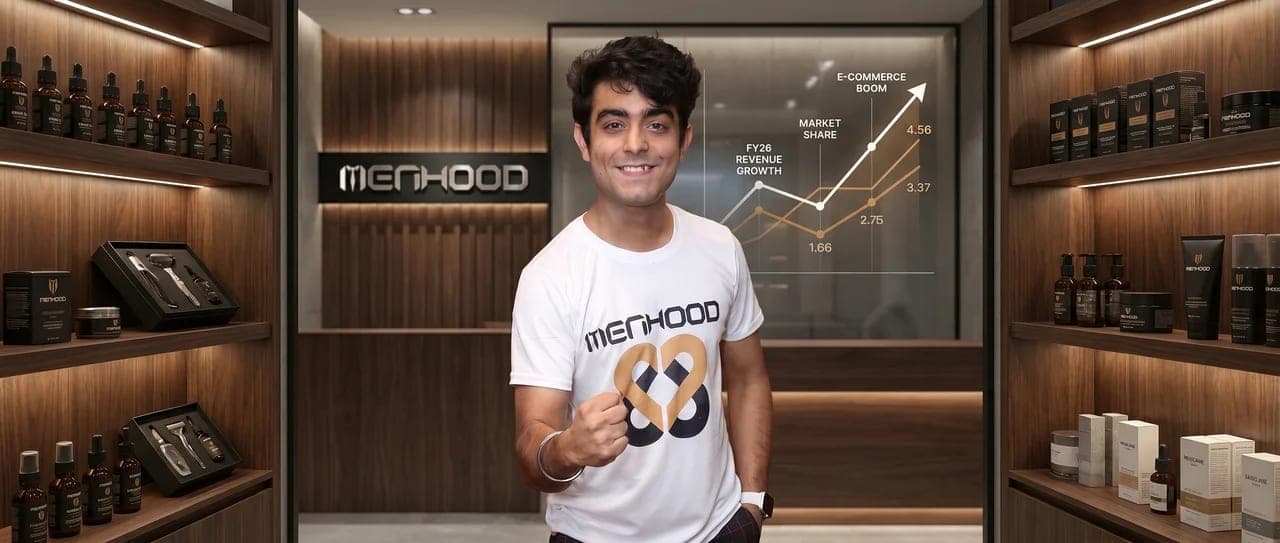
Menhood's 75% Revenue Surge Signals Men's Grooming Boom
A Jaipur-based startup that built its business around a product category Indian men rarely discussed openly has just posted its strongest financial results to date. Menhood, the direct-to-consumer men's grooming and intimate hygiene brand operated by Macobs Technologies Limited, recorded an operating revenue of ₹41.4 crore in FY26 — a 75.2% increase on the ₹23.6 crore it reported in FY25. Net profit for the year came in at ₹3.1 crore, up 20.1% year-on-year.
These numbers are notable not just as a startup milestone, but as a signal about the pace and depth of India's men's personal care market transformation.
From Taboo to Transaction: The Destigmatisation Dividend
The category in which Menhood primarily operates — men's intimate hygiene — has historically been one of the most underdeveloped segments in Indian personal care. Social inhibition, limited product availability, and the absence of vocabulary to discuss the category in mainstream retail kept it structurally small for decades.
What Menhood and its cohort of specialist D2C brands have achieved is a category creation exercise as much as a sales one. By leading with education — normalising conversations about hygiene, grooming, and below-the-belt care through digital content — these brands have converted latent demand into active purchasing behaviour. The 75% revenue growth suggests that once the educational barrier is removed, conversion rates in this category can be substantial.
For B2B stakeholders, this matters because category destigmatisation typically precedes a broadening of distribution. Brands that began online-only, selling to early adopters, begin to see offline demand materialise as the category enters mainstream consciousness. Menhood's growth trajectory suggests it is approaching this inflection point.
Inside the Numbers: What FY26 Reveals
The headline revenue figure is striking, but the cost structure deserves equal attention. Total expenses for the year rose 88.3% to ₹38.4 crore, with the primary driver being the purchase of stock-in-trade, which climbed 82.1% to ₹20.2 crore. This reflects the reality of a company scaling procurement rapidly to meet demand — a challenge that requires robust supplier relationships and supply chain agility.
H2 FY26 performance is particularly instructive: revenue of ₹22.2 crore and profit of ₹1.7 crore in the second half represent 124% profit growth versus the same period in the prior year. This back-half acceleration suggests improving operating leverage — a positive signal that the cost base is beginning to scale more efficiently than revenue.
The company also reported total income of ₹42.6 crore when including other income of ₹1.3 crore, underscoring a diversified income base even at this stage of growth.
The Macobs Technologies Portfolio Play
Menhood does not operate in isolation. Its parent, Macobs Technologies, has been deliberate about portfolio construction. The company has already launched Womenhood, a female-focused wellness and personal care brand that mirrors the Menhood positioning strategy in a complementary segment. In 2026, Macobs acquired a majority stake (50.01%) in Getmymettle, a D2C health and wellness brand — signalling a move toward a broader wellness holding company model.
This multi-brand architecture is strategically significant. For contract manufacturers and ingredient suppliers, a holding company with multiple active brands under one procurement roof represents consolidated volume across SKUs, categories, and potentially product formats — from grooming tools to topical formulations to wellness consumables.
India's Male Grooming Market: The B2B Landscape
The broader market context amplifies what Menhood's results are pointing to. India's men's grooming market is valued at approximately ₹18,165 crore as of 2025, with a projected CAGR of 6.6–7.2% through 2034–35. Within this, the premium and specialist segments — skincare, intimate care, multifunctional formulations — are growing materially faster than the broader average, driven by Gen Z and millennial spending behaviour.
The D2C channel has been structurally important in unlocking this growth. Brands like Bombay Shaving Company, The Man Company, Man Matters, Beardo, and Menhood have collectively built a credible mid-premium men's grooming ecosystem, with distribution primarily through owned websites and e-commerce marketplaces. Tier-2 and Tier-3 cities are emerging as the next growth frontier as digital penetration and e-commerce accessibility deepen.
For formulators and manufacturers, the product requirements in this segment have evolved significantly. The category has moved well beyond shaving gels and basic moisturisers into intimate washes with pH-balanced formulations, deodorant sprays with microbiome-compatible compositions, precision skin-care serums, and multifunctional grooming tools. Each of these has distinct formulation, regulatory, and packaging requirements — creating meaningful B2B opportunity for specialists.
Regulatory Considerations for Intimate Care Products
Intimate hygiene products occupy a specific regulatory position in India. Under the Cosmetics Rules, 2020 and the Drugs and Cosmetics Act, 1940, intimate washes for topical use fall within the cosmetics framework, requiring appropriate licensing, ingredient compliance, and labelling. Claims must be carefully calibrated — CDSCO's enforcement posture on therapeutic claims applied to cosmetic products has become more active, and brands operating in this category need to ensure their product dossiers and claim substantiation are in order.
For contract manufacturers supplying into this space, holding current Good Manufacturing Practice (GMP) certification and being able to provide complete regulatory documentation is increasingly a prerequisite, not a differentiator.
Opportunities for B2B Supply Partners
- Formulation development for intimate hygiene: pH-balanced, fragrance-minimised, dermatologically tested formulations are in active demand. Formulators with expertise in gentle surfactant systems and microbiome-compatible actives are well positioned.
- Contract manufacturing at scale: As Menhood and its peers move toward offline distribution, volume requirements will increase. Manufacturers with flexible MOQs and fast-turnaround capabilities for growing brands will find this a productive segment to target.
- Packaging innovation: Men's grooming packaging has a distinct aesthetic brief — functional, minimal, premium. Suppliers able to offer dark matte finishes, ergonomic dispensers, and travel-ready formats are in line with where the market is heading.
- Ingredient specialisation: The shift toward skin-friendly, pH-appropriate, and clean-label formulations in intimate care creates demand for specialist ingredients — mild surfactants, prebiotic complexes, and natural antimicrobial actives — that go beyond commodity sourcing.
Menhood's FY26 results are not just a single brand story. They are evidence that India's men's personal care segment has crossed a commercial threshold. The next phase of growth will depend on supply chain depth, formulation credibility, and the ability of B2B partners to scale alongside the brands that are driving this category forward.