Formulating high-payload, ethanol-free fine fragrances usually forces a compromise between thermodynamic stability and skin-feel. Drop ethanol from a formula, and chemists typically face a grim choice: accept cloudy emulsions that split over time, or load up on high-HLB surfactants that leave a tacky residue on the skin.
Givaudan’s partnership with Swiss deep-tech firm Microcaps bypasses classic physical instability. By deploying microfluidic step-emulsification to craft uniform hydrogel micro-shells, the technology enables water-based fine fragrances with high scent payloads. For Indian brand owners, formulation chemists, and contract manufacturers, this innovation offers a direct route to compliance and premium clean-label delivery.
Technical Mechanism: Precision Hydrogel Micro-Shells
Microfluidic step-emulsification relies on custom micro-channel geometries that process fluids at high throughput, producing uniform, monodisperse droplets. Unlike high-shear homogenisation—which yields uneven droplet sizes prone to Ostwald ripening and phase separation—step-emulsification guarantees tight, predictable particle sizing every single run.
Encapsulation Architecture and Mechanics
Core Payload: Hydrophobic fragrance oils, shielding volatile top notes, reactive aldehydes, and fragile floral terpenes from premature evaporation.
Shell Architecture: Natural, algae-derived sodium alginate crosslinked with calcium ions, creating a flexible hydrogel barrier around each oil droplet.
Continuous Phase: An aqueous carrier fluid that physically isolates volatile aroma compounds, preventing thermal degradation and oxidation inside the bottle.
Release Dynamics: Standard spray actuators generate enough mechanical shear during pumping to break the alginate shell, releasing clean oil onto skin without requiring high-HLB solubilisers like PEG-40 Hydrogenated Castor Oil or Polysorbate-20.
This engineered structure removes sticky surfactants altogether, eliminating the heavy, wet skin-feel that has historically plagued alcohol-free fine fragrances.
CDSCO and Global Regulatory Alignment
As regulatory standards tighten globally and across India, alginate micro-encapsulation gives manufacturers immediate regulatory advantages:
1. ECHA Annex XV and BIS Microplastic Exemptions
Synthetic polymer micro-encapsulants—such as polyurethane or melamine-formaldehyde resins—face sweeping bans under European Chemicals Agency (ECHA) Annex XV microplastic restrictions. Calcium-crosslinked sodium alginate is a naturally derived biopolymer, rendering it fully exempt from these restrictions. It similarly clears Bureau of Indian Standards (BIS) non-synthetic polymer criteria, protecting global supply chain continuity.
2. Streamlined CDSCO Plant Compliance
Replacing ethanol with an aqueous matrix changes factory economics. Eliminating flammable solvents allows CDMOs to avoid expensive Class 3 flammable liquid storage infrastructure, while simplifying factory fire-safety permitting and bulk storage compliance under India's Cosmetics Rules, 2020 (enforced by the CDSCO).
3. Superior Dermal Compatibility
Stripping out ethanol prevents solvent-induced Transepidermal Water Loss (TEWL) and localized cutaneous irritation. This allows brands to position high-concentration perfumes directly toward sensitive skin, clean-beauty, and alcohol-free consumer segments.
Strategic Value for Indian CDMOs and D2C Brands
For Indian OEM/ODMs and D2C brands looking to capture premium market share, microfluidic step-emulsification gives manufacturers immediate production efficiencies:
Thermodynamic Stability: Physical isolation of fragrance oil within uniform micro-shells prevents phase separation, sedimentation, and discoloration over extended shelf-life cycles without relying on complex surfactant networks.
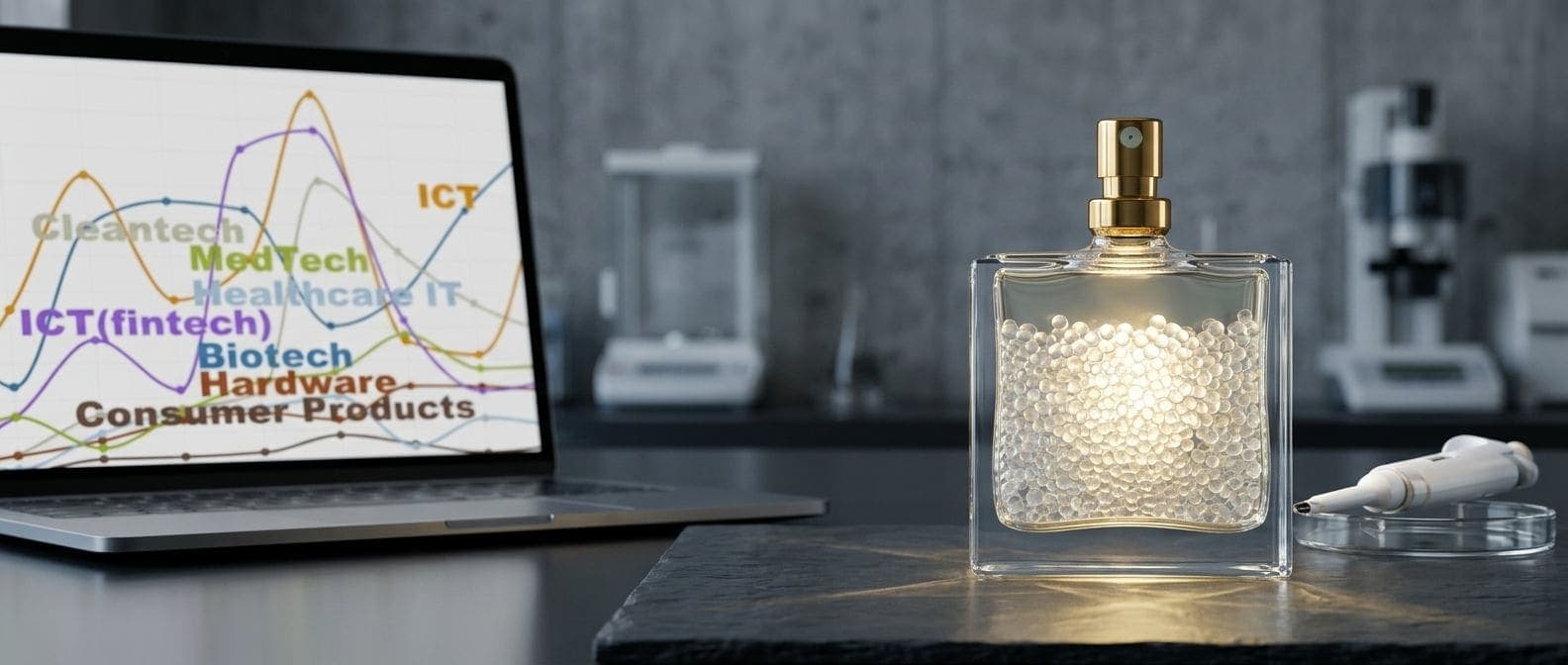
Visual Distinction: Suspending uniform "Perfume Pearls" inside transparent aqueous bases creates a striking, high-end visual on retail shelves and digital storefronts.
Clean-Label Positioning: Gives Indian brand owners an immediate bridge to tap growing domestic and export demand for alcohol-free, clean-label, and Halal-compliant fine fragrances.
By embracing biopolymer step-emulsification, cosmetics manufacturers can finally deliver high-impact fine fragrance performance anchored in green chemistry.