Osmo Brings AI-Designed Molecules Into Commercial Fragrance Development
The fragrance industry has traditionally relied on a combination of chemistry, creativity, sensory expertise, and decades of accumulated knowledge.
While technology has supported formulation development for years, ingredient discovery has largely remained a human-driven process.
That dynamic is beginning to change.
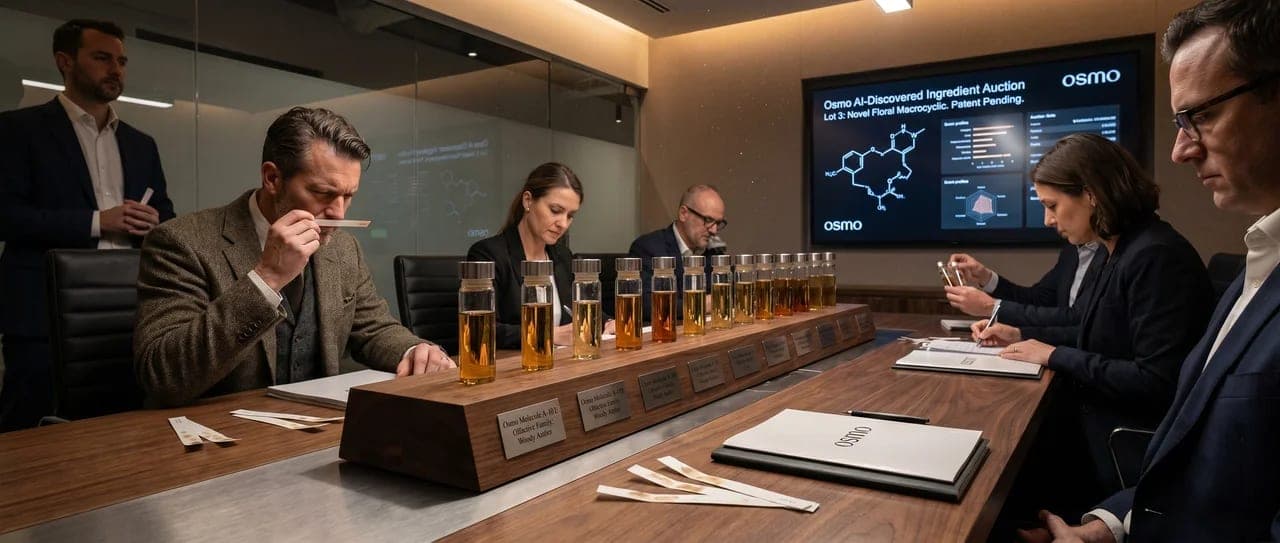
Osmo's decision to auction ten AI-developed fragrance ingredients represents one of the clearest signals yet that artificial intelligence is moving beyond analytical support and entering the core of fragrance innovation.
For fragrance manufacturers, ingredient suppliers, brand owners, and R&D teams, the development highlights how AI is increasingly becoming a tool for creating entirely new commercial opportunities.
More importantly, it demonstrates that machine learning is now influencing one of the industry's most valuable assets: novel scent ingredients.
The Fragrance Industry's Data Revolution
Artificial intelligence has already transformed industries such as healthcare, finance, and software development.
Fragrance innovation presents a unique challenge because scent is inherently subjective.
Unlike visual or numerical information, odours are difficult to quantify and predict.
Historically, discovering new aroma molecules required extensive laboratory experimentation, chemical synthesis, and sensory evaluation.
The process could take years.
Advances in machine learning are changing that equation.
Companies such as Osmo are building AI systems capable of analysing relationships between molecular structures and olfactory characteristics.
These models learn patterns from large datasets linking chemistry and scent perception.
As computational capabilities improve, AI can increasingly predict how novel molecules may smell before they are physically produced.
Why The Auction Matters
The auction itself may appear symbolic.
However, its significance extends far beyond the sale of individual ingredients.
For decades, ingredient innovation has been dominated by large fragrance houses with extensive R&D resources.
The introduction of AI-designed ingredients suggests a new pathway for discovery.
Rather than relying solely on traditional screening approaches, companies can use machine learning to identify promising candidates faster and potentially at lower cost.
The auction demonstrates confidence that AI-generated ingredients possess genuine commercial value.
It moves AI-created fragrance materials from theoretical possibility into market reality.
That transition could accelerate industry adoption.
From Molecule Prediction to Ingredient Discovery
At the heart of Osmo's technology is predictive chemistry.
AI models analyse molecular structures and estimate potential olfactory characteristics.
This capability allows researchers to explore chemical spaces that may never have been investigated through conventional methods.
The opportunity is significant.
The number of theoretically possible fragrance molecules is enormous.
Only a small fraction have been explored commercially.
AI expands the industry's ability to navigate this vast landscape.
Instead of relying on trial-and-error discovery, researchers can focus resources on candidates with higher probabilities of success.
For manufacturers, this could improve innovation efficiency while reducing development costs.
What It Means for Fragrance Manufacturers
The emergence of AI-designed ingredients has several implications for fragrance manufacturers.
First, innovation timelines may become shorter.
Computational screening can help identify promising molecules before expensive laboratory work begins.
Second, ingredient portfolios may become more diverse.
AI can uncover novel scent profiles that are difficult to identify through traditional methods.
Third, manufacturers may gain access to ingredients specifically optimised for performance characteristics such as stability, longevity, volatility, or sustainability.
Over time, AI could become an essential component of ingredient development pipelines.
Companies that adopt these tools early may gain competitive advantages in product differentiation and speed-to-market.
New Opportunities for Brand Teams
For beauty and personal care brands, AI-generated fragrance ingredients create exciting possibilities.
Fragrance remains one of the most powerful emotional drivers within consumer products.
Unique scent profiles can strengthen brand identity and product recognition.
Access to novel ingredients allows brands to create more distinctive olfactory signatures.
In highly competitive categories such as skincare, haircare, body care, and fine fragrance, differentiation is increasingly important.
AI-driven ingredient innovation may therefore become a valuable branding tool.
The ability to incorporate exclusive or first-to-market aroma materials could strengthen premium positioning and storytelling.
Sustainability Could Become a Major Advantage
One of the most promising aspects of AI-enabled fragrance development involves sustainability.
Many traditional fragrance ingredients face sourcing challenges linked to agriculture, biodiversity, climate variability, or supply chain constraints.
AI may help identify alternative molecules capable of delivering similar olfactory experiences with improved sustainability profiles.
Future models could optimise ingredients based not only on scent characteristics but also on environmental impact, production efficiency, and raw material availability.
This aligns closely with growing sustainability expectations across the beauty industry.
Manufacturers increasingly need ingredients that balance performance with responsible sourcing.
Challenges Still Remain
Despite its potential, AI fragrance development is not without challenges.
Predictions must still be validated through laboratory testing and sensory evaluation.
Human perfumers remain essential.
Fragrance creation involves emotional interpretation, cultural understanding, artistic judgement, and consumer insight.
AI enhances these capabilities rather than replacing them.
Regulatory considerations also remain important.
New molecules must undergo safety assessments, toxicological reviews, and regulatory evaluations before commercial deployment.
The path from prediction to market remains rigorous.
Strategic Actions for Beauty Businesses
As AI becomes more integrated into fragrance innovation, several strategic priorities emerge.
Monitor Emerging Ingredient Platforms
AI-powered discovery companies are becoming important innovation partners.
Strengthen Digital R&D Capabilities
Computational tools are increasingly influencing ingredient development.
Explore AI-Enabled Ingredient Partnerships
Collaborations may provide early access to novel materials.
Evaluate Sustainability Potential
AI-discovered ingredients could support future environmental objectives.
Prepare for Faster Innovation Cycles
Product development processes may need to adapt to shorter discovery timelines.
The Future of Computational Perfumery
The auction of ten AI-developed fragrance ingredients represents more than a technology milestone.
It signals a broader transformation within the fragrance industry.
Artificial intelligence is increasingly moving from support functions into the creative and scientific core of product innovation.
While human expertise remains central to fragrance creation, AI is expanding the industry's ability to discover, evaluate, and commercialise new ingredients.
For manufacturers, suppliers, and beauty brands, the message is becoming increasingly clear.
The future of fragrance innovation may be shaped as much by algorithms and data models as by traditional laboratory experimentation.
Osmo's auction suggests that future has already begun.