Systems Biology Rewrites the Anti-Ageing Playbook
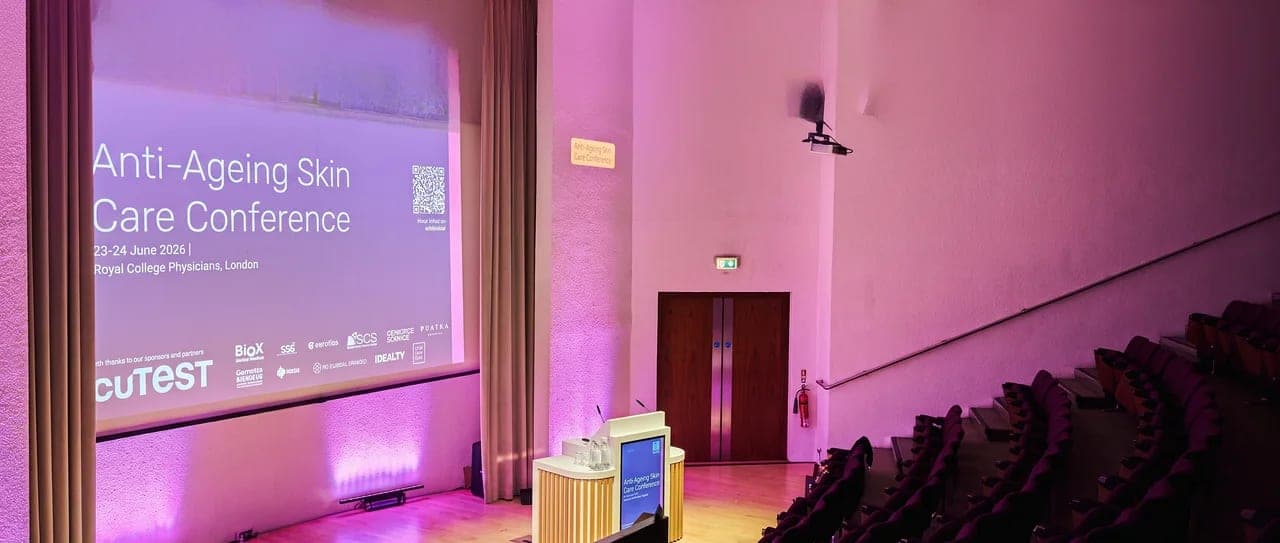
The 10th edition of the Anti-Ageing Skin Care Conference, held on 23–24 June 2026 at the Royal College of Physicians in London, brought together scientists from L'Oréal, Unilever, and Procter & Gamble, alongside academic researchers, clinicians, and independent experts, for two days of intensive science. Day one was structured around a single, ambitious theme: Systems Biology and Skin Ageing — and what it demands of both research teams and the formulators who must translate it into product.
The message from the opening session was precise: studying isolated biological pathways is no longer sufficient to understand how skin ages. The field must move toward a holistic, interconnected view — one that considers the simultaneous influence of genetics, environment, microbiome, metabolism, and behaviour on skin function over time.
Beyond the Single Pathway: What Systems Biology Means for Formulation
In her opening address, Dr. Katerina Steventon, Scientific Programme Director of the conference, set the frame clearly. "Healthy skin ageing is shaped by all the interactions between the biology, the environment, and our behaviour," she said. "Ageing cannot be understood through individual pathways alone — we must consider the complex interactions between biological systems that influence how our skin functions, adapts, and ages over time."
Prof. Rachel Watson, Executive Director of A*Star Skin Research Labs, reinforced this with a critique of how skin research has historically been conducted. Referencing the Hallmarks of Ageing framework — which was expanded from 9 to 12 hallmarks in a landmark 2023 update — she noted a persistent tendency to focus on niche areas in isolation. The updated hallmarks now include dysbiosis and disabled macroautophagy alongside established markers such as genomic instability, epigenetic alterations, and mitochondrial dysfunction. "What we need to do is think about our ability to interact better with each other, to have a more holistic view of skin health and ageing," Watson said.
For R&D teams, this is not abstract. It has direct implications for how ingredient dossiers are assembled, how efficacy claims are structured, and which biological endpoints are selected for clinical substantiation.
The Microbiome-Metabolome Network as a Formulation Target
One of the most technically significant threads of the day came from Dr. Georgios Stamatas, Global Scientific Director at SGS, who examined the microbiome-metabolome network as a target system for skin intervention. The skin microbiome does not function in isolation from its metabolic outputs — crosstalk between microbial communities and the skin's own metabolic activity influences barrier integrity, inflammatory tone, and cellular senescence.
For formulators, this points toward a new generation of ingredient briefs: rather than simply "probiotic" or "prebiotic" label claims, the question becomes how a formulation modulates the full microbiome-metabolome axis. Actives designed to support microbial diversity while reducing pro-inflammatory metabolite production represent a more scientifically defensible positioning than single-organism claims.
Translating Longevity Science Into Actives
The afternoon session, 'Intervening in the System — From Actives to Holistic Strategies', examined how longevity science reaches the bench. Several themes emerged with clear product development relevance.
Fermentation Technology and Bioengineered Actives
Fermentation-derived actives received significant attention as a technology platform with the structural sophistication to address systems-level targets. Post-biotic metabolites, fermented botanical complexes, and precision-fermented peptides offer molecular specificity that conventional plant extracts cannot reliably deliver. For brands, this provides a credible bridge between the "natural" positioning expected by consumers and the mechanistic rigour demanded by clinical evidence.
AI-engineered peptides were highlighted as an emerging category — molecules designed computationally to interact with specific receptor systems or enzymatic pathways implicated in the hallmarks of ageing. As this technology matures, it will increasingly allow R&D teams to specify what a peptide should do at a systems level, rather than selecting from a catalogue of established actives.
Fascia as a Target Tissue
One of the more novel concepts raised during the day was fascia — the connective tissue network that underlies the skin — as an emerging target for longevity and well-being formulations. Fascia plays a role in structural support, mechanotransduction, and hydration gradients, and its function degrades with age in ways that influence skin surface topography. While this area remains early-stage in cosmetics science, it signals a direction for claims around firmness and structural resilience that goes beyond conventional dermal matrix targets such as collagen or hyaluronic acid.
Computational Skin Modelling and Evidence-Based Claims
Across both sessions, a consistent secondary theme was the use of cross-omics data and computational skin models to translate complex systems-level science into evidence that holds up under regulatory and consumer scrutiny. Tools such as Raman spectroscopy and LC-OCT (line-field confocal optical coherence tomography) were cited as non-invasive imaging approaches capable of generating quantifiable, publication-quality data on skin structure and composition.
For product development and claims teams, this matters for two reasons. First, the sophistication of the science being presented at conferences like this sets a de facto standard for what "evidence-based" means in the premium skincare space. Second, as regulators in multiple markets sharpen their attention to cosmetic claims substantiation, methodologies grounded in cross-omics and validated imaging offer defensible evidence architectures that standard consumer perception studies cannot provide alone.
What Product Development Teams Should Do Next
The 2026 conference signals a clear direction for where anti-ageing R&D is heading over the next product cycle. For teams working on formulation strategy and ingredient sourcing, several actions are immediately relevant:
- Audit your active ingredient portfolio against the 12 Hallmarks of Ageing. Identify which hallmarks your current actives address, and where gaps exist. This creates a structured basis for ingredient selection and claim positioning.
- Engage with fermentation and bioengineered peptide suppliers now. These are no longer niche categories — they represent a growing share of premium active ingredient launches and will increasingly anchor efficacy narratives at brand level.
- Invest in advanced measurement methods. If your clinical programmes rely solely on self-assessment or basic instrumental measures, begin scoping how cross-omics sampling, computational skin models, or LC-OCT could be integrated into future studies to future-proof claims.
- Build a systems-level narrative. Brands that position their anti-ageing products around a single mechanism (one peptide, one growth factor) are increasingly out of step with where the science — and the consumer — are moving. Multi-target, multi-pathway positioning is becoming the standard.
The Anti-Ageing Skin Care Conference has, for a decade, functioned as a reliable leading indicator of where formulation science is heading. Day one of the 2026 edition made clear that the industry is not just updating its ingredient lists — it is updating its entire conceptual model of what skin ageing is and how it can be addressed.