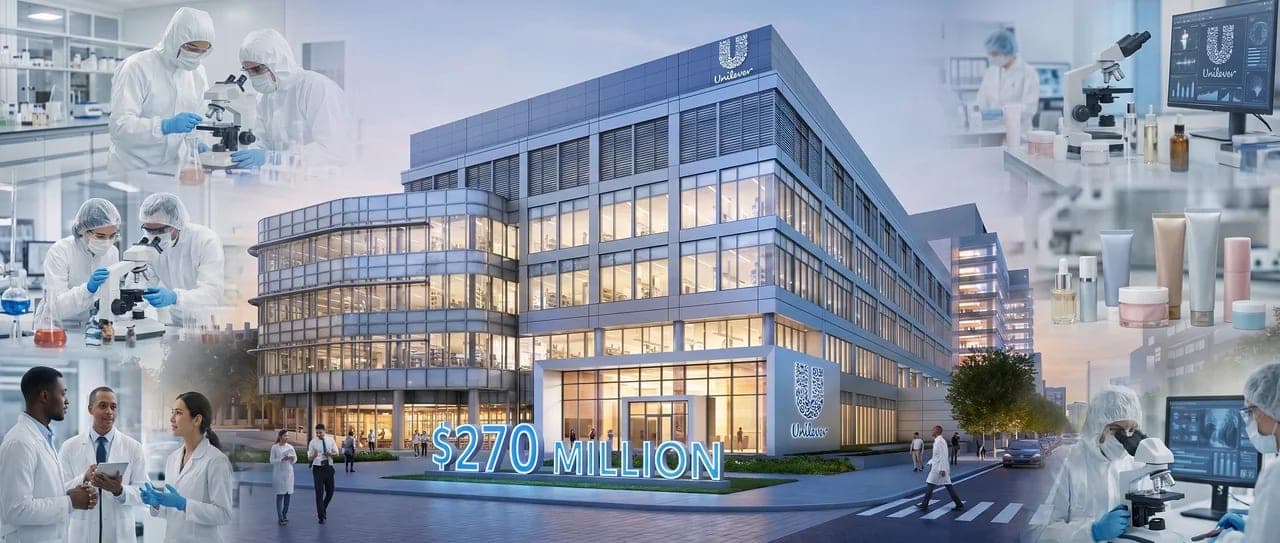
Unilever's $270M R&D Lab: What It Signals for Beauty Science
When Unilever announced in May 2026 that it would invest $270 million in a new Global Innovation Centre in New Haven, Connecticut — its largest R&D capital expenditure in the United States in 40 years — the announcement circulated primarily as a business news story. For R&D directors and innovation managers in the beauty industry, it deserves to be read as something more precise: a detailed specification of what best-in-class cosmetic science infrastructure looks like in 2026, and a benchmark against which every organisation's R&D model can be assessed.
The facility, scheduled to open by spring 2029, will house formulation development, fragrance creation, packaging design, consumer insights, skin biology, microbiome research, and neuroscience applications under one roof. It replaces Unilever's existing Trumbull, Connecticut site and will operate with approximately 300 scientists and product developers. Total project value, including public and private contributions, is expected to exceed $300 million.
How AI Is Restructuring the Formulation Cycle
The most consequential element of the new centre is not the physical facility — it is the AI infrastructure that will operate within it. Unilever has been transparent about the operational impact of AI integration in its existing R&D pipeline, and the New Haven centre is designed to scale and formalise what the company has already demonstrated is achievable.
Unilever's R&D teams currently analyse consumer insights 60% faster than in pre-AI workflows, drawing on over 1,000 external data sources — social media, retail trend data, competitor monitoring, and clinical literature. The practical implication is that the lag between identifying a consumer need and generating a scientifically grounded formulation brief has been compressed from months to days in some categories.
More significantly for formulators: AI has reduced formulation iteration cycles from six rounds of testing to one or two in documented cases. This is not achieved by bypassing rigorous testing; it is achieved by generating higher-quality initial hypotheses. Rather than beginning with a broad experimental space and narrowing through physical trials, AI-assisted formulation starts with a computationally filtered candidate set — ingredients, ratios, pH ranges, stability predictors — that is already constrained by historical performance data from Unilever's repository of over 150,000 internal research documents.
The R&D Assistant and Virtual Cohorts
Two specific tools within Unilever's current AI stack are directly relevant for R&D professionals thinking about their own infrastructure priorities.
The R&D Assistant is an AI-powered interface that connects scientists to the company's internal research archive in real time. Rather than conducting manual literature reviews or relying on institutional memory, formulators can query the system for prior work on specific ingredient combinations, stability failure modes, or clinical outcomes — and receive synthesised, contextualised responses. The operational benefit is reduced duplication of effort and faster access to institutional knowledge that would otherwise atrophy or be lost with personnel turnover.
Virtual Cohorts is a separate system that assesses predicted consumer group responses to a formulation before any physical product is produced. By modelling how different skin types, demographics, or regional populations might respond to a candidate formula, the system allows formulation decisions to be informed by predicted efficacy and tolerability data at a stage when no physical material has been consumed. This is particularly relevant for brands developing products across markets with different skin biology, climate exposure, or usage behaviours — a challenge that every globally distributed beauty company faces.
Quantum Computing and Materials Discovery
The New Haven centre will integrate quantum computing ecosystems for materials discovery — the process of identifying new molecular candidates with specific functional properties. This application of quantum computing is where the technology offers genuinely measurable advantage over classical computation: quantum systems can model molecular behaviour and interaction at a level of precision that classical computers cannot achieve within commercially useful timeframes.
For cosmetic science, this matters at the ingredient identification stage. If a formulation team is searching for a new film-former with specific skin-feel characteristics, a surfactant system with a particular irritation profile, or a UV filter with improved photostability, quantum-assisted materials modelling can generate candidate molecules — including novel synthetic structures — that would not emerge from conventional screening programmes.
This is not yet widely accessible outside organisations with significant capital resources. But the trajectory is clear: within a five-to-ten year window, quantum-assisted ingredient discovery will transition from the exclusive infrastructure of large multinationals to commercially available computational services that mid-size brands and contract research organisations can access.
Translating Unilever's Model Into Real Formulations
Unilever's own product pipeline illustrates where the current AI-assisted model is already yielding scientifically documented results — not as proof-of-concept, but as commercialised products.
Pond's Hydra Miracle incorporates Cera-Hyamino technology, developed through digital analysis of microbiome data to identify ingredient combinations that specifically support skin barrier function. The formulation approach began not with a laboratory screen but with computational analysis of microbiome datasets — a workflow that identified the relevant molecular targets before physical experimentation began.
Dove Damage Therapy used AI to analyse over 100,000 data points on hair fibre properties, leading to the development of Bio-Protein Care technology — a system targeting specific damage mechanisms identified through that large-scale data analysis. The hypothesis space was defined computationally; the physical chemistry was then optimised to meet it.
Vaseline Gluta-Hya represents a different application: using regional consumer insight data to develop climate-responsive formulations specifically for hot and humid markets. The formulation brief was derived from AI-synthesised analysis of how product performance varies by climate zone — a capability that is directly relevant for brands developing products for Indian markets and other tropical-climate consumer bases.
What R&D Teams Should Take From This
- Audit your formulation iteration infrastructure. If your team is completing six or more rounds of physical formulation testing before arriving at a stable candidate, AI-assisted hypothesis generation tools — even at a basic level — can compress this cycle. Several commercially available platforms now offer AI-assisted formulation screening for teams without Unilever-scale resources.
- Prioritise internal data capture. The leverage Unilever has built comes significantly from its archive of 150,000 research documents. Organisations that are not systematically capturing formulation performance data, stability failure modes, and clinical outcomes in a searchable, structured format are forgoing future AI leverage.
- Design formulations with regional performance data, not universal assumptions. The Vaseline Gluta-Hya model — where regional climate and consumer behaviour data shaped the formulation brief — is an accessible methodology for any team with access to structured consumer insight data, regardless of whether AI is used to process it.
- Monitor quantum computing accessibility timelines. The materials discovery application is not yet open-access, but cloud-based quantum computing services are expanding. R&D innovation roadmaps with a five-year horizon should include an assessment of when this capability becomes commercially viable for the organisation's scale.
Unilever's investment is a specific, detailed blueprint — not merely an aspiration. For R&D directors benchmarking their own teams, the question is not whether this level of AI and computational integration is coming to the industry. It already has.