

India and Global Cosmetic Labeling Standards: A Regulatory Brief
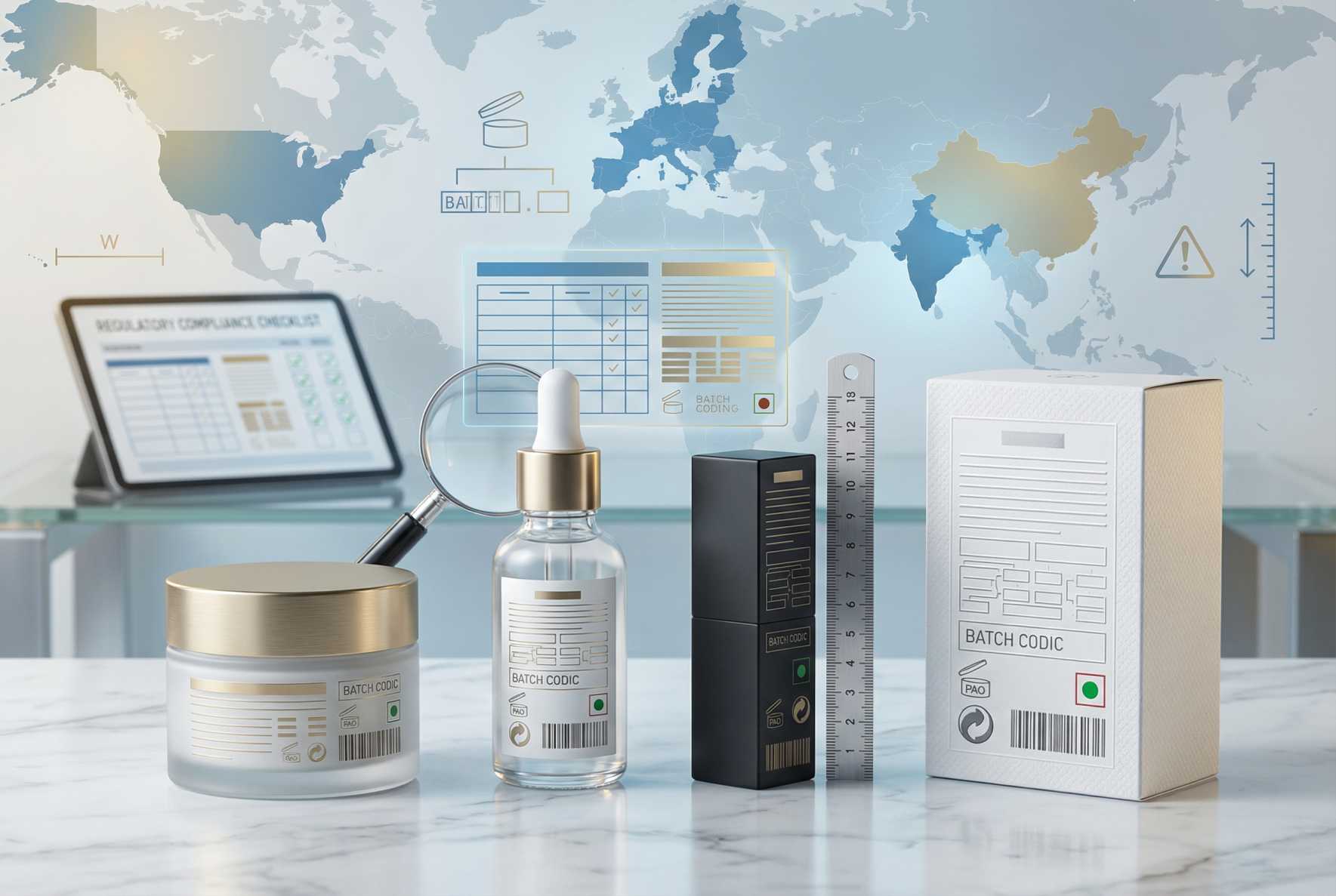
Regulatory declarations don’t get as much attention as the claims and design of cosmetic products, but they are still important. If they are missing from a product package, the company could be held responsible.
Labelling products is an important aspect for manufacturers and exporters aiming to sell products within India.
When a consumer buys something, they probably check the label first, that’s because labels give important information about a product.
However, product labelling not only ensures compliance with regulatory standards but also directly influences consumer satisfaction and trust.
So, it is important to understand that labelling requirements and packaging specifications are integral for manufacturers seeking to enter the Indian market successfully.
What is Product Labelling?
Product Labelling is creating and displaying product information on product packaging.
In simple words, on the label, a consumer can find all the information they want to know about the product before they consume it.
To make the product packaging easier for consumers, the product label must include the brand colours, the logo, the material, and the package shape.
In addition to the labelling mentioned above, the product label should include product information and a written part.
Importance of Product Labelling
In India, product labelling serves as the primary medium through which consumers obtain crucial information about a product.
it’s the composition, manufacturing date, expiry date, or handling instructions, the label communicates vital details that influence a consumer’s purchasing decision.
Labelling Compliance for Various Industries
In India, the term labelling compliance describes the rules and regulations that regulate the information and details that a product packaging must contain.
This will guarantee the safety of consumers, the quality of the product, and the fair-trade practices of the manufacturer.
Moreover, product labelling standards differ between industries depending on the nature of the product.
Labeling requirements for cosmetics in India
According to D&C act in India the labeling requirements for cosmetics are:
- Name of cosmetics , and manufacturing address should carry on the both inner and outer labels.
Understanding inner label and outer label
Usually, a cosmetic product would have an “inner label” on the container, and “outer label” on the box or wrapper, and sometimes a “leaflet” with instructions or more information. The Cosmetics Rules not only say what should be written on the label, but they also say what should be written on the label. The Cosmetics Rules say that the following must be written on the label or labels that are specified. If there is only one label on the product, all declarations must be on that label. Under the Cosmetics Rules, 2020, there are certain things that all cosmetics made in India must say.
Labelling of Cosmetics in India is also governed by Legal Metrology (Packaged Commodities) Rules, 2011
Inner and Outer labels (Elaborately)
- The following information needs to be on the container’s label and any other outside packaging:
–Name of the product
-Name of the manufacturer
-Full address of the place where the cosmetic was made.
– Net quantity
– Batch Number
-MRP (inclusive of all taxes)
– USP/ml or USP/g
– Manufacturing Date
-Use before date/expiration date.
-country of origin
-Ingredients with a concentration of more than 1% must be listed in descending order of weight or volume at the time they are added, followed by ingredients with a concentration of less than or equal to 1%, which can be listed in any order, and the word “INGREDIENTS” must come first.
And also, any relevant product claims, all in legible and indelible text.
Either the inside or outside label needs to have the following information:
-Unique batch/lot code* [“Batch No.,” “B. No.,” “Batch,” “Lot No.,” or “Lot”]
-Manufacturing License Number* [“M”, “M.L. No.,” or “Mfg. Lic. No.” comes before it]
It’s best to put the license number and batch code on both the outside and inside labels
- Claim/ certification must be declared if any.
- Every package containing the product as our case may be shall bear at top of display panel a green dot product of vegetarian origin and red/brown dot for non-vegetarian origin.
- In All kinds of soaps, lotions, Cream- “when packed” declaration has to be given.
Just on the outside label:
Only the outside label needs to have the following information:
- Net contents (weight for solids, fluid measure for liquids, and either for semi-solids)*
- Number of items, if there are more than one.
Just on the inner labels:
If a cosmetic product has any risks, the following should show up:
-How to use it correctly
-Any warnings, special instructions, or words of caution
-The names and amounts of dangerous or poisonous ingredients
If not, the container only needs to say the declarations that need to be on both the inside and outside labels.
Again, if any of the required declarations are left out, the Drugs and Cosmetics Act of 1940 says that the product is “misbranded,” and the manufacturer or importer could lose their manufacturing license or import registration or even be charged with a crime. It could even have effects on wholesalers and retailers, since mislabeled goods will be taken away without compensation.
Manner in which declaration shall be made as according to Legal Metrology Packed Commodities Rule, 2011(9). –
(1) Every declaration which is required to be made on a package under these rules shall be —
(a) legible and prominent;
(b) numerals of the retail sale price and net quantity declaration shall be printed, painted or inscribed on the package in a color that contrasts conspicuously with the background of the label;
2) The particulars of the declarations required to be specified under this rule on a package shall either be in Hindi in Devnagari script or in English.
Exemptions for small-size cosmetic packages under Cosmetics Rules, 2020:
Some rules aren’t as strict about small containers of cosmetics. When a cosmetic’s container is less than or equal to 60 ml of liquid or 30g of solids or semisolids, only the main place of manufacture and the pin code need to be listed as the manufacturer’s address. Batch code doesn’t have to be written on cosmetics that are up to 10 grams or 25 ml if they are solid or semi-solid. If the net content of a package of perfume, toilet water, or something similar is less than 60 ml or if the net content of a package of solid or semi-solid cosmetics is less than 30 grams, the net content does not have to be listed. For cosmetics with less than or equal to 60 ml of liquid and less than or equal to 30g of solids and semi-solids, the list of ingredients doesn’t have to be shown.
EU Labelling Requirement:
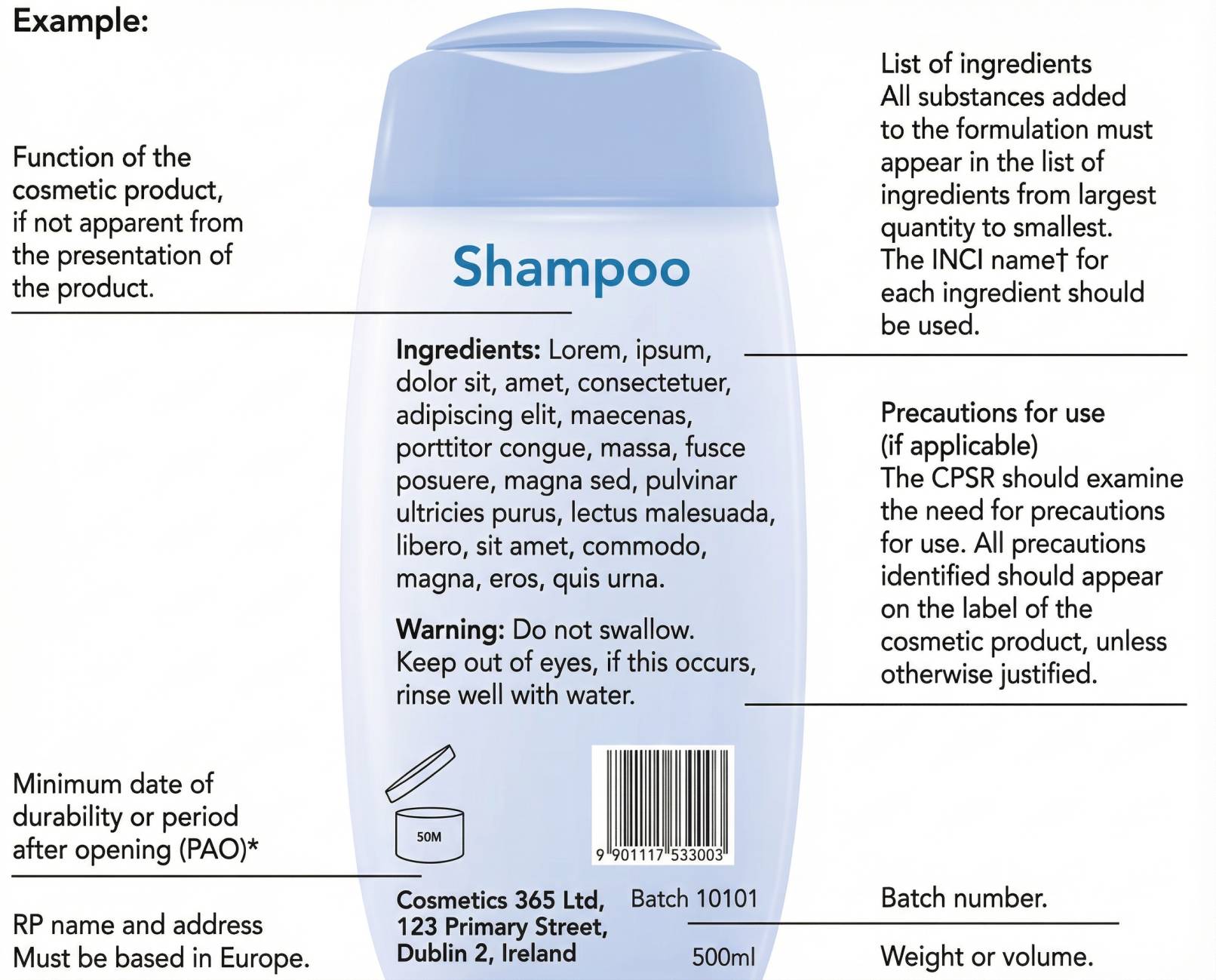
The requirements of cosmetic labeling under EU Regulation (EC) No 1223/2009, cosmetic products must adhere to specific labeling requirements to ensure consumer safety and transparency. Here are the key mandatory elements:
- Product Identity and Function
- The name and intended use of the product must be clearly stated unless it is evident from its presentation.
- Ingredients List
- A complete list of ingredients in descending order of concentration, using INCI (International Nomenclature of Cosmetic Ingredients) names, must be included.
- Manufacturer’s or Distributor’s Information
- Name and address of the responsible person or company within the EU must be printed for traceability.
- Nominal Content
- The weight or volume at the time of packaging, expressed in metric units (e.g., grams or milliliters).
- Durability
- The “best before” date or a Period After Opening (PAO) symbol to indicate product shelf life if under 30 months; if longer, only the PAO is required (e.g., open jar symbol with time in months).
- Batch Number
- A reference number for identifying the product batch for tracking purposes.
- Warnings and Precautions
- Specific usage precautions must be clearly indicated, such as “avoid contact with eyes,” to ensure safe use
- Country of Origin
- For products manufactured outside the EU, the country of origin must be labeled.
- Label Language
- The information must be provided in the official language(s) of the country where the product is sold.
- Allergens to be mentioned in fragrance product except the prohibited one, eg : Ingredients with allergens as given below :
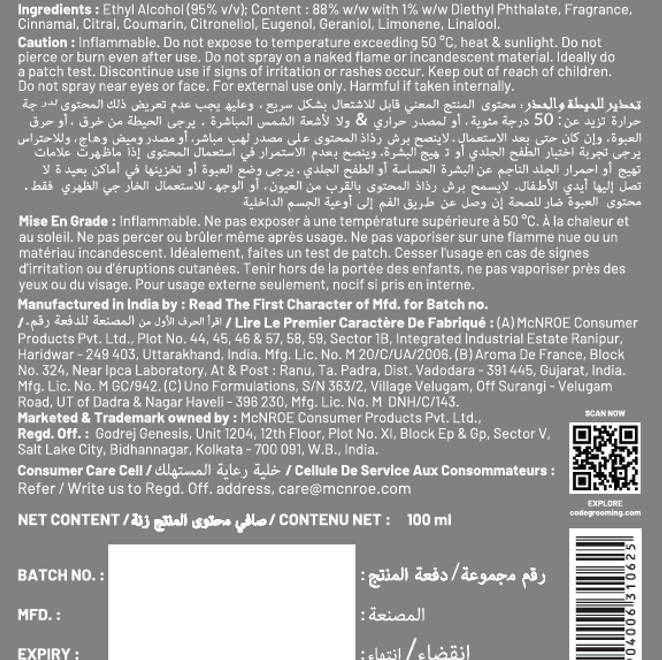
Allergen Disclosure:
The EU mandates that 26 specific fragrance allergens must be listed on the product label if they are present at a concentration greater than:
0.001% (10 ppm) in leave-on products.
0.01% (100 ppm) in rinse-off products.
These allergens must be listed in the ingredient list by their standard names as per the International Nomenclature of Cosmetic Ingredients (INCI).
Purpose: This requirement helps consumers who have known sensitivities to specific allergens avoid those products, enhancing safety and reducing the risk of allergic reactions.
USA Labelling Requirement:
In USA, the labeling requirements for cosmetic products are regulated by the Food and Drug Administration (FDA) under the Federal Food, Drug, and Cosmetic Act (FD&C Act). Key requirements include:
- Principal Display Panel (PDP)
- Identity of the Product: The name or descriptive phrase indicating the nature and use of the product must be on the front label.
- Net Quantity of Contents: The amount of product, in weight, volume, or numerical count, must be displayed in both metric and U.S. customary units.
- Information Panel
- Ingredients List: All ingredients must be listed in descending order of predominance by their common or usual names.
- Declaration of Color Additives: Any color additives used must be FDA-approved and listed with specific naming conventions.
- Warnings and Precautions: If applicable, products must include specific safety warnings (e.g., “keep out of reach of children”).
- Name and Address of Manufacturer or Distributor
- The label must include the name and location (city, state, and ZIP code) of the business responsible for the product.
- If the distributor’s name is listed instead of the manufacturer, the label must include a statement such as “Distributed by.”
- Product Claims
- Any claims made (e.g., “hypoallergenic” or “dermatologist tested”) must be substantiated. Claims suggesting treatment or prevention of diseases may categorize the product as a drug and subject it to additional regulations.
- Country of Origin
- Imported products must indicate the country of origin on the label.
- Warnings for Specific Products
- Products like aerosols or items containing hazardous ingredients require specific cautionary statements.
- Language Requirements
- All mandatory information must be in English. If marketed in a region where another language is prevalent, bilingual labels may be required.
- Allergen Disclosure
- Unlike the EU, the FDA does not have specific requirements for labeling individual fragrance allergens, but if a cosmetic product includes an ingredient that is a common allergen, it should be declared in the ingredient list.
China Labelling Requirement:
- Regulatory Authority: National Medical Products Administration (NMPA).
- Labeling Requirements:
- Product Name and Function: Clearly displayed.
- Ingredient List: Must include all components using their Chinese names.
- Net Content: Displayed in metric units.
- Manufacturer Details: Name and address of the manufacturer or the responsible entity.
- Shelf Life and Batch Number: Expiration date and batch number for traceability.
- Warnings and Safety Instructions: Included for products that require them.
- Country of Origin: For imported products, the country of origin must be stated.
- Language: Chinese is mandatory for all labels
CONCLUSION:
Lot of differences in cosmetic regulations in India when compare to USA and EU. According to Indian regulations the manufacturer for sale of cosmetics should get the pre-marketing approval before entering to market but not required in USA and EU. In the statement of labeling the expression of expiry date is different in the three regions. In the EU its depend on durability of product in 30 months, but in the USA, there is no legislations for expiration date. However, the stringent regulations governing cosmetics in each country or jurisdiction have one common goal: To protect the consumer by ensuring safe ingredients and finished products. And there is need to enhance the regulations of safety information and control standards of cosmetics in India.

Author : Souvik Roy
He can be reached at : 9804862116 / souvik619@gmail.com
The author Souvik Roy works with McNROE Consumer Products Pvt Ltd as the Manager Technology Transfer.
Subscribe to our free newsletter to read the latest news and articles before they are published.












Subscribe To Our Newsletter
Join our mailing list to receive the latest news and updates from The Cosmetics industry
You have Successfully Subscribed!