$70 Million Later, Robotic Manicures Are No Longer a Concept
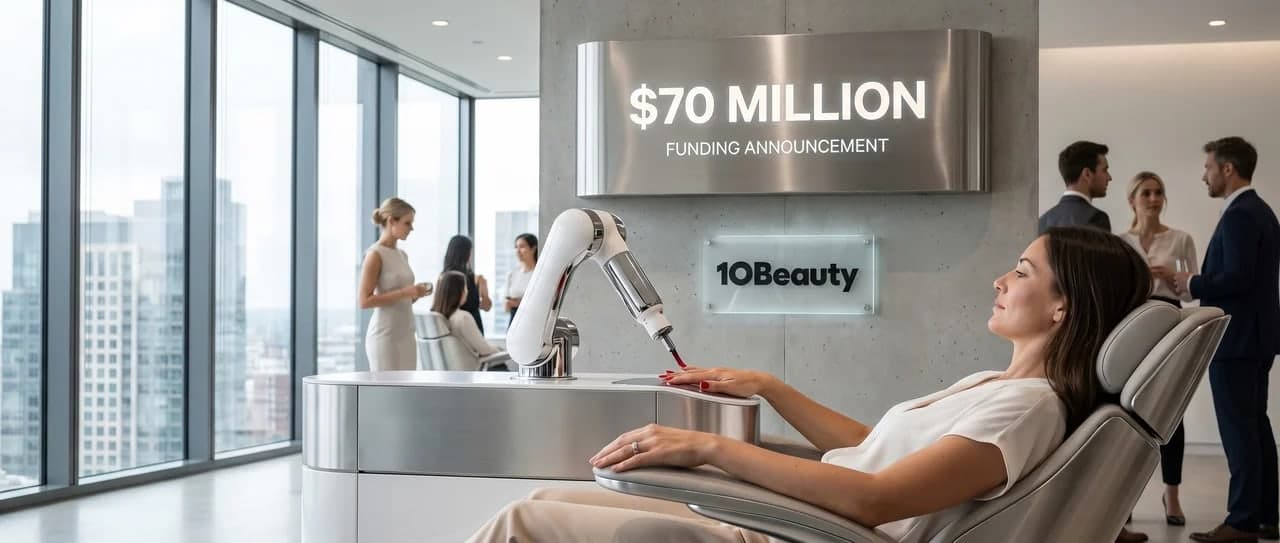
10Beauty has secured US$23.5 million in new funding to support the rollout of its automated nail care technology across retail, hospitality, and wellness channels. The round was led by early-stage venture capital firm Story Ventures, and brings the Boston-based company's total funding to nearly $70 million. Previous investors include Victoria Beckham, Imaginary Ventures, and Lerer Hippeau — a cap table that combines fashion-industry credibility with technology venture conviction.
10Beauty recently launched its five-step robotic manicure machine at an Ulta Beauty location in Boston and is preparing to expand into Chicago. The company said it has agreements in place for the deployment of its first 850 machines across multiple sectors, including beauty retail, department stores, hotels, fitness centres, nail salons and hair salons. Partners include Ulta Beauty and Nordstrom.
The transition from pilot to a confirmed 850-machine rollout across Ulta Beauty and Nordstrom is the signal worth focusing on. This is no longer a proof-of-concept story. It is a commercial infrastructure story — and one that carries direct implications for nail care brands, product formulators, and beauty service operators across the industry.
How the Machine Actually Works
10Beauty's full-service, autonomous robotic manicure machines offer consumers a complete five-step manicure. The innovation uses a pod-based system to deliver services, with each pod holding everything needed for one service: polish-removal sponges, nourishing cuticle serum, brushes, colours and top coat.
The machines take 25 to 45 minutes to do a single-session manicure, with prices around US$30. The unit economics of $30 per session, at a 25-45 minute service time, in a retail or hospitality environment with high foot traffic, are significantly more attractive than the labour economics of a traditional nail salon at the same price point.
The company acquired Clockwork — creator of what it describes as the world's first AI-powered nail-painting robot — in 2025, absorbing the competitive landscape rather than fighting it. The combined entity now holds a dominant position in what is, commercially, a nascent but rapidly accelerating category.
Co-founder and co-CEO Alexander Shashou has articulated the vision directly: "Imagine if one day changing your nails was as easy as a cup of coffee. Imagine how big it could be if you could get a manicure everywhere you already are, and then one day in your home."
The Pod System as a Supply Chain Architecture
The pod-based delivery system is the most strategically important technical element for B2B players to understand. Each pod is a pre-loaded, single-service consumable containing everything the machine needs to deliver one manicure: removal, cuticle care, colour application, and top coat.
This architecture creates a fundamentally different supply chain relationship than the traditional nail salon model. In a conventional salon, a nail technician selects products from the backbar — a brand choice that sits with the salon owner and varies by operator. In the 10Beauty system, the pod supplier is effectively the sole brand with access to the consumer at the point of service. The pod manufacturer and the brand within the pod are one — or are operating under a structured supply agreement with 10Beauty.
This is a procurement relationship closer to an institutional supply contract than a traditional professional channel. At 850 machines planned, each running multiple sessions per day, the aggregate consumable volume is commercially significant and will only scale as deployment expands.
Formulation Requirements for Robotic Application
Automated robotic application imposes specific technical constraints on nail care formulations that differ meaningfully from manual application requirements.
Viscosity consistency is the most critical parameter. A human nail technician adjusts brush pressure and stroke speed to compensate for viscosity variation within a batch. A robotic system applies at consistent mechanical speed and pressure — and is therefore more sensitive to batch-to-batch viscosity variation. Formulators supplying to automated application systems must maintain tighter batch tolerance specifications than are typically required for salon-supply products.
Cure time and dry time consistency matters for throughput management. A robotic system that produces a service in 25 minutes cannot accommodate polish that requires 35 minutes to reach a non-tacky state. Formulation briefs for robotic nail applications need explicit cure-time specifications aligned to the machine's service time parameters.
Film formation uniformity — the even distribution of colour pigment and polymer across the nail surface at consistent thickness — must be achievable by mechanical brush or applicator without the manual compensation that skilled technicians provide. This is a brush design and formulation co-optimisation challenge, not purely a formulation one.
What This Means for Indian Salon Operators and Nail Care Brands
India's professional nail care market is growing rapidly, driven by the expanding premium salon sector in urban centres and the same on-demand at-home services dynamics (Snabbit, Urban Company, Yes Madam) that are accelerating across the beauty services category. The 10Beauty technology is not currently deployed in India and is not an immediate operational concern for Indian salon chains. However, it carries two medium-term strategic signals worth monitoring.
The premium retail adjacency model is a template. 10Beauty's rollout within Ulta Beauty and Nordstrom positions automated nail care as an *in-store experience at a mass-accessible premium price point* — not a clinical luxury service. Indian premium retail operators (Nykaa Luxe, Tira, Shoppers Stop) should be evaluating whether an equivalent experience model can be localised before international players bring it to Indian metros directly.
Nail care formulation for automated systems is a future brief. Indian contract manufacturers and nail care product formulators that build technical capability around automated-application specification — viscosity tolerance, cure time standardisation, film formation uniformity — will be positioned to supply to this category as it scales, whether domestically adapted versions or export supply to 10Beauty's global procurement pipeline.
What Brand and Manufacturing Teams Should Do Now
Three practical priorities deserve attention.
Nail care brands should evaluate whether their current formulation tolerances meet automated application specifications. Batch-to-batch viscosity consistency, standardised cure times, and film formation uniformity are the technical minima. Identifying the gap between current specification and automated-application requirement is the first step toward becoming a viable pod-supply candidate.
Salon operators in India's premium segment should monitor the competitive arrival timeline. The 10Beauty rollout sequence — Boston debut, Chicago expansion, then broader US retail, hospitality, and fitness — provides a 12-24 month window before the model plausibly reaches Indian metros through direct or licensed deployment.
Retail and hospitality operators evaluating experience differentiation should track this category closely. A $30, 25-45 minute automated manicure that requires no appointment and no staff scheduling is a compelling incremental revenue and consumer experience proposition for any high-footfall premium retail environment.
The $70 million invested in 10Beauty represents one of the most concentrated bets in beauty technology on record. The commercial architecture — pod supply, retail embedding, hospitality extension — is scalable and channel-agnostic. The brands and operators that engage with it now, before it reaches their markets, will have more strategic options than those who respond after it arrives.