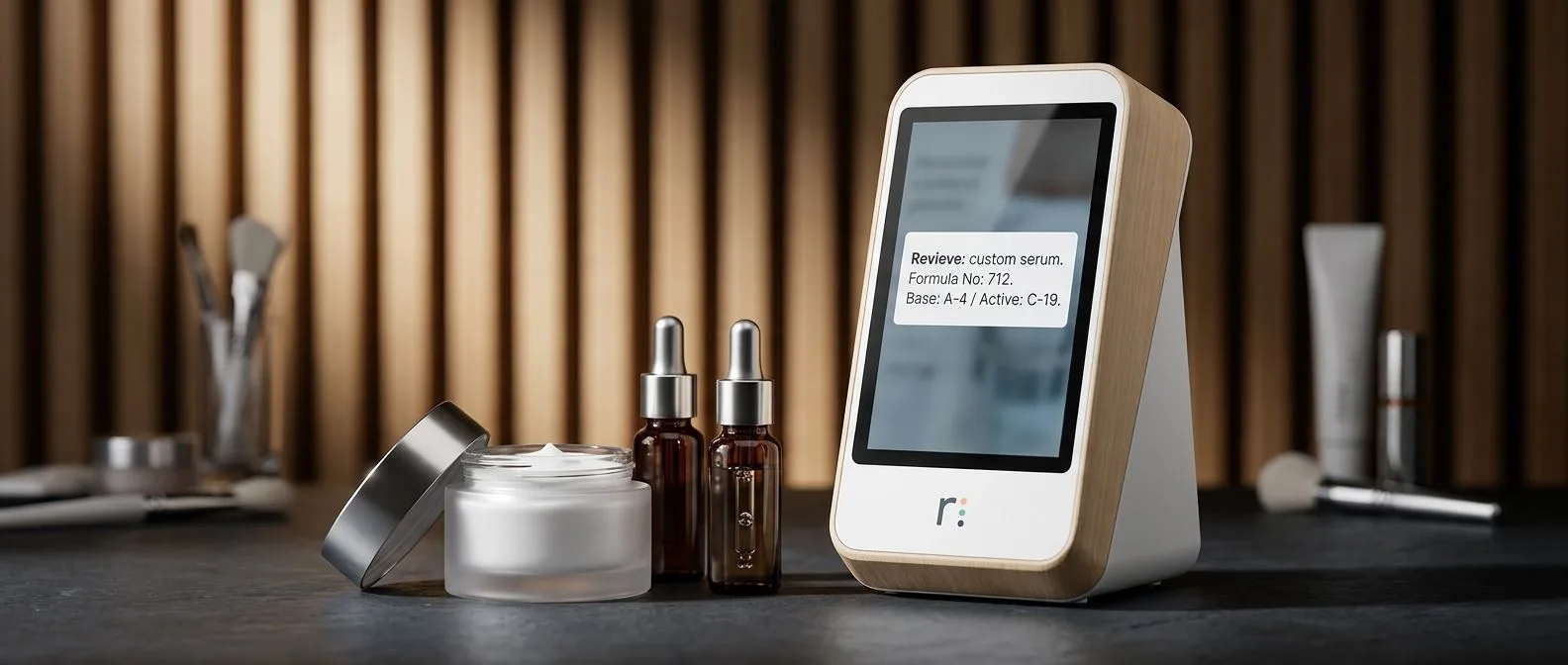
MakeMe Salon’s nationwide Japanese rollout pairs Revieve’s AI skin diagnostic engine with palplat Inc.’s digital enterprise infrastructure. On the surface, it looks like a sleek aesthetic upgrade. For Indian cosmetic brand owners, R&D labs, and contract development and manufacturing organisations (CDMOs), however, it provides something far more valuable: a practical operational blueprint for monetising data-backed personal care.
Hardware to Active Dosing: The Technical Workflow
The hardware setup bypasses subjective client guesswork entirely. Multi-spectral facial imaging combines standard RGB, cross-polarized, and UV light channels to map surface epidermal conditions alongside deeper dermal structures in seconds.
Instead of relying on self-reported skin types, the engine calculates real-time biophysical metrics. It measures chromophore dynamics—tracking melanin index variations and hemoglobin distribution to evaluate hyperpigmentation and vascular redness before they fully surface. It also maps spatial sebum density, pore geometry, and topographical micro-relief wrinkle depth.
For formulation chemists, this optical data transforms into a direct active-dosing sheet. High sebum scores auto-trigger formulas rich in Niacinamide or Zinc PCA for targeted lipid regulation. Deep micro-relief readings demand biomimetic signal peptides like Acetyl Hexapeptide-8 for expression lines. Elevated transepidermal water loss (TEWL) indicators mandate precise ratios of barrier-repair ceramides paired with ultra-low molecular weight Hyaluronic Acid—specifically under 10 kilodaltons (10 kDa)—to penetrate the stratum corneum effectively.
Navigating India's CDSCO SaMD and DPDP Act Frameworks
Deploying this diagnostic architecture in India requires balancing technical performance against strict regulatory parameters.
The second an algorithm moves from suggesting over-the-counter cosmetic SKUs to evaluating clinical pathologies like Grade III Acne, Melasma, Rosacea, or Atopic Dermatitis, it triggers SaMD (Software as a Medical Device) classification under India's Medical Device Rules (MDR) 2017. Cosmetic brand owners must strictly calibrate diagnostic nomenclature and UI copy to remain squarely within non-therapeutic boundaries.
Simultaneously, capturing high-resolution facial images brings India’s Digital Personal Data Protection (DPDP) Act 2023 into direct focus. Facial parameters constitute sensitive biometric personal data. Deploying diagnostic kiosks or mobile web apps demands localized consent architectures, encrypted cloud storage protocols, and explicit data-erasure mechanisms to ensure compliance.
The CDMO Blueprint: Three High-Margin B2B Opportunities
For Indian contract manufacturers and product development teams, diagnostic integration creates immediate commercial upside:
1. Modular Formulation Architectures: Market demand is shifting toward "Base Emulsion + Active Booster" product formats. CDMOs can manufacture standardized, high-stability base creams at scale, supported by concentrated active ampoules that salons blend on the spot based on diagnostic readouts.
2. Image-Backed Efficacy Validation: Contract manufacturers can embed multi-spectral diagnostic imaging directly into clinical testing protocols. Replacing qualitative consumer perception surveys with objective, biophysical imaging provides rock-solid efficacy claims for high-performance SKUs.
3. Conversion Acceleration: Objective diagnostic data removes ambiguity from the sales process. Establishing a quantifiable need for specific actives raises product conversion rates and average ticket size across professional channels.
Revieve and palplat demonstrate that AI skin diagnostics are no longer digital novelties—they are essential operational components driving modern cosmetic formulation and B2B growth.