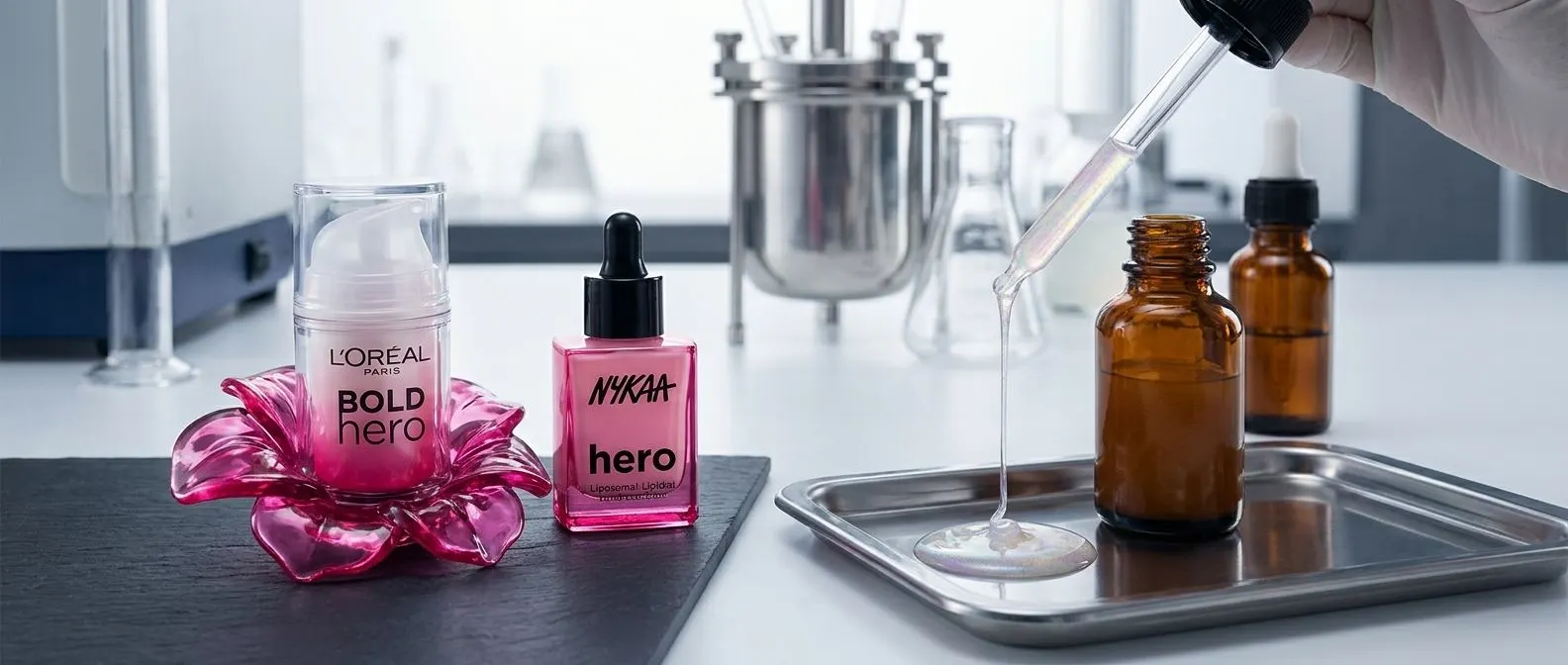
When L'Oréal’s venture arm, BOLD, teamed up with Nykaa to launch a joint co-investment initiative for Indian beauty brands, it wasn't just another corporate PR headline. It is a massive liquidity signal for the domestic market. But getting institutional checks from global industry leaders comes with a sharp reality check: off-the-shelf white-label formulas won't cut it anymore. Winning in this next market cycle forces brands to rethink their core formulas and adopt clinical-grade engineering.
Technical Formulation: Upgrading the R&D Stack
To pass technical due diligence from L'Oréal BOLD and handle Nykaa’s retail distribution scale, funded D2C brands are upgrading their formulas across three main chemical and biophysical pillars:
Encapsulated Phyto-Actives
Raw botanical extracts degrade fast when exposed to light and air. That's why forward-thinking formulators are turning to Lipid Nanoparticle (LNP) and liposomal carrier platforms. These microscopic lipid matrices protect volatile actives—such as L-Ascorbic Acid, Tetrahydrocurcumin, and Bakuchiol. The result is controlled epidermal release, higher bio-availability, and significantly lower cutaneous irritation.
Biomimetic Barrier Repair
Formulators are also ditching heavy petrolatum bases in favor of physiological lipid matrices. By blending Ceramide NP, Free Fatty Acids, and Cholesterol in a precise 3:1:1 molar ratio, modern formulations match human stratum corneum lipids. This exact biomimetic orientation speeds up skin barrier recovery at a cellular level.
Bio-Fermentation and Signal Peptides
To back up functional anti-ageing claims, labs are blending postbiotic ferment lysates with biomimetic signal peptides like Palmitoyl Tripeptide-5. This bio-fermented approach actively triggers dermal fibroblasts, driving endogenous collagen synthesis and true structural remodeling of the extracellular matrix.
Regulatory Compliance and Analytical Claim Substantiation
Here's the catch for funded brands: scale brings heavy CDSCO scrutiny under the Cosmetics Rules, 2020. Formulations must strictly align with Bureau of Indian Standards (BIS) IS 4707 (Parts 1 & 2) limits on restricted and prohibited ingredients. Analytical quality control protocols must guarantee heavy metal contaminants remain well under safety ceilings:
Lead (Pb): ≤ 20 ppm
Arsenic (As): ≤ 2 ppm
On top of that, enterprise retail distribution via Nykaa requires hard empirical proof behind every marketing claim. Brands must toss out legacy testing routines in favor of non-animal *in-vitro* safety assays compliant with OECD 439 (skin irritation) and OECD 431 (skin corrosion) standards. Functional claims need real quantitative instrumentation data, using Tewameters to measure Trans-Epidermal Water Loss (TEWL) and Mexameters to evaluate erythema and melanin reduction.
Implications for Indian CDMOs and Raw Material Sourcing
This venture capital injection is rewriting the rulebook for India’s B2B manufacturing ecosystem, raising technical performance bars for Contract Development and Manufacturing Organisations (CDMOs).
Infrastructure Upgrades
CDMOs are modernizing facilities to secure ISO 22716 certification and cGMP compliance. Commercial success now requires capital investment in high-shear micro-encapsulation, low-energy cold-process emulsification, and sterile bio-fermentation processing lines.
Supply Chain Dynamics
Raw material distributors face a distinct shift in demand. The market wants high-purity, standardized Indian botanicals paired with clinically validated imported actives. Chemical suppliers that can deliver standardized marker compounds backed by full technical dossiers and Certificates of Analysis (CoA) will capture the dominant market share.
Strategic Outlook
The L'Oréal BOLD x Nykaa deal signals the end of marketing-first, formula-second brand building in India. Moving forward, long-term enterprise valuation won't come from flashy packaging. It will belong to brand owners, R&D chemists, and manufacturing partners who master clinical formulation, verified efficacy, and cGMP-compliant supply chain execution.