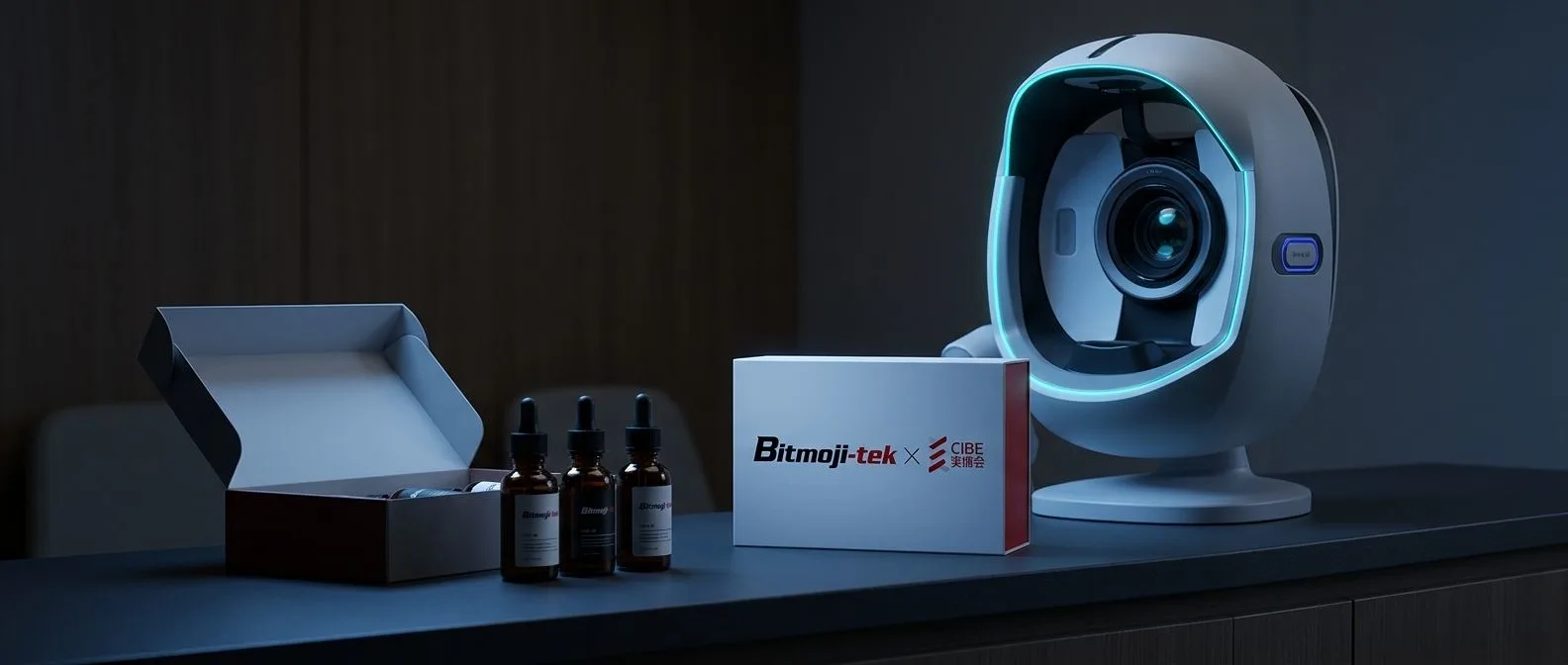
Clinical beauty retail is dropping the subjective guesswork. Bitmoji-tek has unveiled a multi-camera AI skin diagnostic system powered by 3D facial panoramic reconstruction. Built for high-traffic clinical beauty environments, this hardware-software integration moves consultations past quick surface scans and into precise, sub-surface mapping.
For Indian cosmetic brand owners, R&D chemists, and contract development and manufacturing organisations (CDMOs), this technology provides the hard data needed to drive precise, modular formulation strategies.
Optical Physics and Sub-Surface Biomarker Precision
The hardware captures full 3D facial geometry across four spectra—RGB, Cross-Polarized, Parallel-Polarized, and UV/NIR—mapping four distinct skin conditions:
Melanin Deposition and Depth: Cross-polarized filters isolate light absorption across dermal and epidermal layers. This clear separation distinguishes superficial sun spots from deep-seated dermal melasma.
Vascular Reactivity: The engine maps spectral absorption of hemoglobin to quantify spatial micro-inflammation, rosacea, and stratum corneum barrier compromise.
Porphyrin Volumetrics: Short-wave UV fluorescence highlights metabolic byproducts of *Cutibacterium acnes*, flagging congested pores well before inflammatory papules break out.
Micro-Relief Topology: Parallel-polarized imaging measures micro-rugosity, pore volume, and fine line depth to map early structural skin changes.
Formulating for Algorithmic Diagnostics: Actives and Bench Reality
High-definition optical diagnostics demand equal precision at the R&D bench. When dynamic hardware identifies exact sub-surface deficits, off-the-shelf "all-in-one" creams fall short. Formulators must align active systems directly with diagnostic data:
Vascular and Barrier Restoration: To calm mapped micro-inflammation and elevated vascular density, formulas require proven barrier builders. Formulators can blend Ectoin, Madecassoside, and Niacinamide at 2% to 5% to downregulate inflammatory cascades and curb transepidermal water loss.
Sub-Surface Pigmentation Control: Tackling deep melanin scores requires multi-pathway tyrosinase inhibitors. R&D teams should pair 3% Tranexamic Acid with Alpha-Arbutin and encapsulated L-Ascorbic Acid. Bench-scale stability improves significantly when using lipid encapsulation, preventing raw L-Ascorbic Acid from oxidizing or turning gritty while keeping a smooth, premium sensory feel on application.
Follicular Micro-Cleansing: For elevated porphyrin counts, formulas need lipophilic exfoliants. Encapsulated Salicylic Acid combined with Zinc PCA reduces follicular sebum oxidation without stripping the skin's natural microbiome.
Regulatory Realities: CDSCO and DPDP Act Compliance
Deploying multi-camera AI diagnostic scanners in Indian retail stores requires clean compliance across local regulatory frameworks:
CDSCO Device Rules: Under the Medical Devices Rules (2017), non-invasive skin scanners avoid Software as a Medical Device (SaMD) registration. The key requirement? The software must output cosmetic routine suggestions rather than clinical medical diagnoses.
Claims Validation: Product recommendations generated by the system must comply with the Drugs and Cosmetics Act. Outputs should state cosmetic benefits—such as "brightens epidermal discoloration"—rather than therapeutic claims like "cures melasma."
Data Governance: Facial scanning handles sensitive biometric data. Compliance with India’s Digital Personal Data Protection (DPDP) Act 2023 is mandatory for all cloud processing, local storage, and consumer consent workflows.
Commercial Opportunities for CDMOs and Contract Manufacturers
3D panoramic diagnostics create fresh revenue streams across the Indian personal care supply chain:
Base-and-Booster Systems: Demand is surging for modular skincare lines. These feature neutral, barrier-support base formulas paired with concentrated active "boosters" prescribed dynamically at the retail counter.
Diagnostic-Grade Concentrates: CDMOs can engineer standardized, clinically backed active modules ready for white-label integration. This bridges the gap between high-end optical hardware and personalized counter sales.