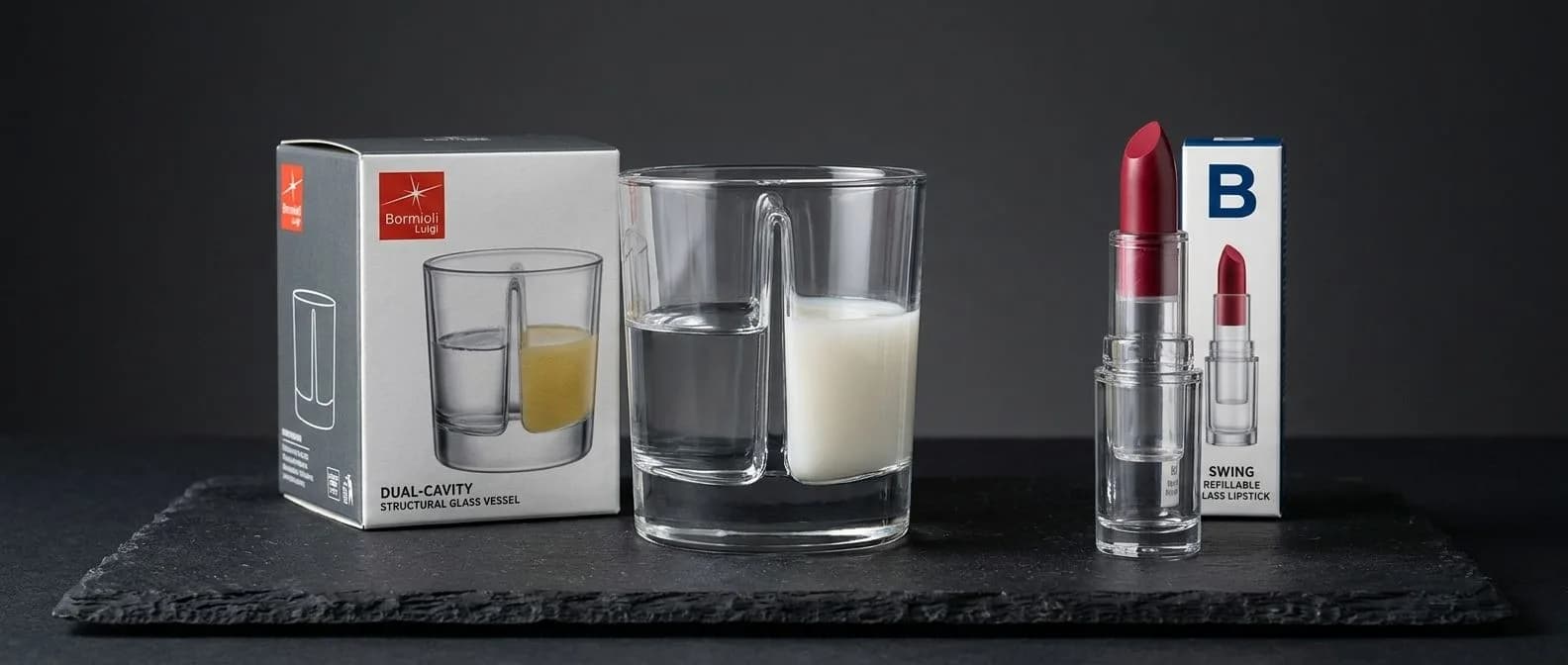
Packaging volatile lipsticks and high-potency skincare in plastic has long forced Indian beauty brands to accept frustrating trade-offs: product shrinkage, formula degradation, and heavy plastic footprints. Italian glassmaker Bormioli Luigi is addressing these exact production and shelf-life headaches by commercialising two structural glass innovations: the Swing refillable lipstick mechanism and the INDUE dual-cavity container. Built with advanced thin-wall moulding technology and integrating 15% Post-Consumer Recycled (PCR) glass, these systems offer domestic prestige brands and contract manufacturers (CDMOs) a direct path to sustainable luxury without sacrificing product performance.
Mechanical Precision: The Swing and INDUE Systems
Bormioli Luigi’s thin-wall glass process strips out excess weight while keeping the satisfying hand-feel and thermal heft consumers expect from high-end packaging. Both platforms incorporate 15% PCR glass engineered to match the optical clarity of virgin flint glass.
The Swing Refillable Mechanism
Designed for colour cosmetics, Swing uses a simple removable central ring. Users can pop out the internal plastic bullet sleeve from the outer glass casing instantly without tools. Decoupling these materials prevents stream contamination during municipal recycling, yielding a clean, mono-material sorting process at the end of the product life cycle.
The INDUE Dual-Cavity Architecture
INDUE solves a long-standing glass engineering challenge: co-moulding two isolated chambers inside a single-piece glass vessel. This dual-vessel architecture creates complete physical separation without relying on internal glues or plastic liners, eliminating fluid cross-talk entirely.
Formula Stability and Chemical Mechanics
Transitioning sensitive formulations into sustainable housing requires zero chemical interaction. Glass remains the unmatched barrier material for volatile formulas and fragile skincare actives.
Zero Vapour Loss for Anhydrous Lipsticks: Matte lip formulas rely on volatile carrier fluids like isododecane and low-viscosity dimethicones. In standard plastic tubes, these solvents gradually evaporate, leaving lipsticks shrunken, dry, and off-color. Glass completely stops vapour migration, locking in shade, texture, and fragrance over extended retail shelf lives.
Active Ingredient Separation in INDUE: The dual-chamber system resolves major R&D stability conflicts. Chemists can isolate reactive ingredients—like L-Ascorbic Acid and Retinol, or AHAs and sensitive peptides—until the moment of application. It also lets formulators create stable serum-in-oil products without adding heavy emulsifiers that disrupt the skin barrier.
Navigating BIS Standards and EPR Compliance
Bringing recycled glass into Indian cosmetic lines requires strict adherence to safety and environmental mandates.
Heavy Metal Leaching and Contact Standards
Under Central Drugs Standard Control Organisation (CDSCO) guidelines, any primary packaging with recycled content must pass stringent safety screens. Bormioli’s 15% PCR glass complies with Bureau of Indian Standards mandates, specifically IS 10171 (materials in contact with cosmetics) and IS 2828 (heavy metal leaching tests). Because glass is chemically inert, leaching levels for Lead (≤ 20 ppm) and Cadmium (≤ 5 ppm) remain comfortably below statutory limits.
Plastic Waste Management (PWM) & EPR Realities
Swapping bulky virgin plastic outer shells for recyclable glass directly reduces a brand’s plastic burden under India’s Extended Producer Responsibility (EPR) mandates within the Plastic Waste Management (PWM) Rules. Lowering polymer mass per SKU simplifies annual compliance filing and cuts overall packaging tax liabilities.
CDMO Integration and Strategic Value
For Indian CDMOs, standardized mechanisms like Swing remove major capital expenditure hurdles. The removable inner cartridges fit onto standard automated filling lines with minimal tooling tweaks. This plug-and-play compatibility allows contract manufacturers to offer turnkey refillable options to brand partners almost immediately.
By combining zero-permeation protection, dual-active isolation, and easy end-of-life recycling, Bormioli Luigi’s new platforms give Indian cosmetic engineers a practical, high-performance upgrade for modern prestige packaging.