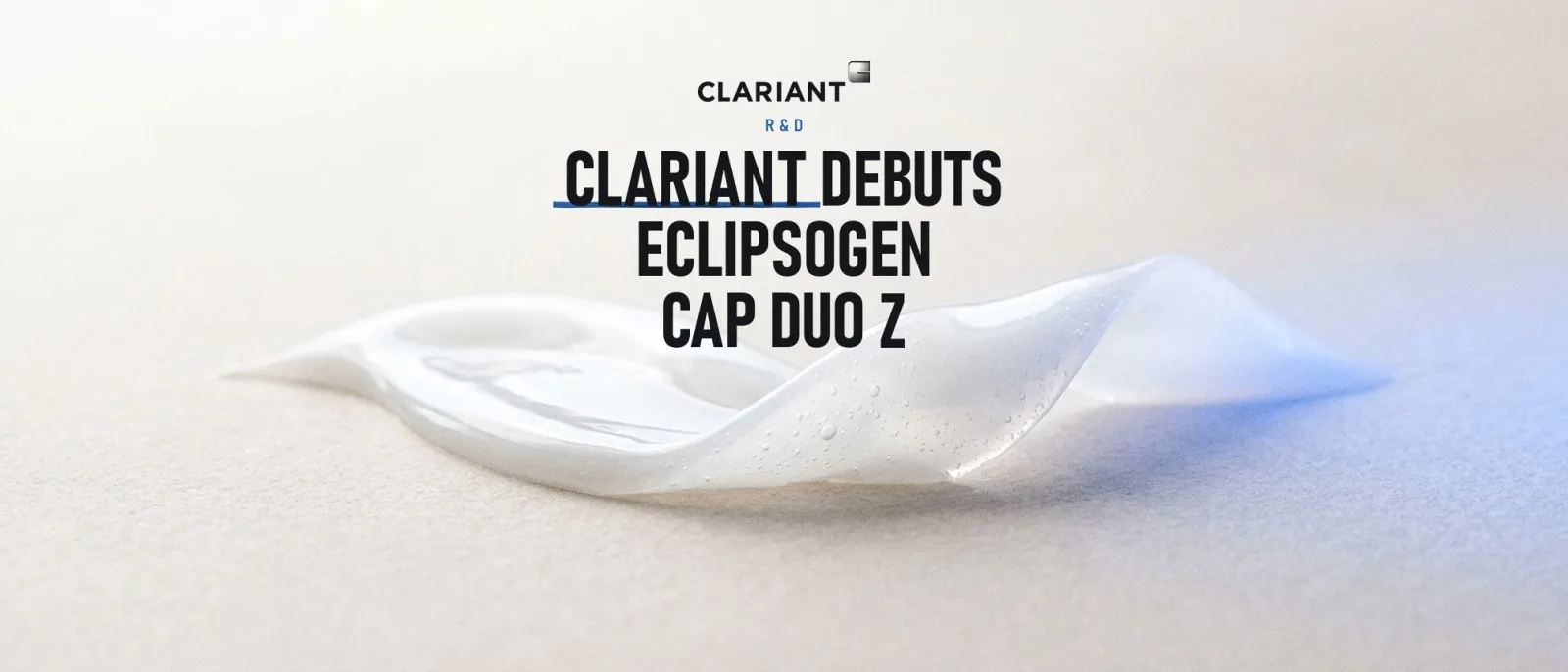
Swiss specialty chemical producer Clariant launched Eclipsogen CAP Duo Z, a cold-processable hybrid UV dispersion system, at the in-cosmetics Asia trade exhibition in Bangkok in November 2026. The encapsulated ingredient system, which blends organic filters with inorganic Zinc Oxide, achieved an *in vitro* benchmark sun protection factor (SPF) of 82.5, compared to 67.8 for traditional formulations.
Cold Processing Meets Hybrid Photoprotection
Combining organic absorbers and inorganic physical blockers within a single sunscreen product has long presented stability and aesthetic hurdles for cosmetic formulators. Traditional hybrid formulations frequently suffer from emulsion breakdown, phase separation, and the characteristic chalky white cast associated with inorganic Zinc Oxide filters.
Clariant’s Eclipsogen CAP Duo Z relies on encapsulation technology to combine three organic filters—Diethylamino Hydroxybenzoyl Hexyl Benzoate (DHHB), Ethylhexyl Triazone (EHT), and Bis-Ethylhexyloxyphenol Methoxyphenyl Triazine (BEMT)—alongside inorganic Zinc Oxide into a single dispersion.
By encapsulating these UV filters into a unified system, the ingredient can be incorporated into personal care formulations via cold processing without high-heat manufacturing steps. Eliminating thermal processing reduces energy consumption during batch production while protecting heat-sensitive functional active ingredients in the final formulation. Clariant stated that the system allows formulators to achieve elevated, stable SPF levels while simultaneously resolving the aesthetic white-cast issues traditionally tied to inorganic mineral filters.
The Race for High-SPF Efficiency
The commercial launch places Clariant squarely within an ongoing technical race among global specialty ingredient suppliers to simplify complex sun-care formulations. Clariant competes directly with chemical majors including BASF—which manufactures the established Tinosorb UV filter line—as well as DSM-Firmenich and Symrise.
Demand for cold-processable hybrid UV systems reflects broader structural pressures across beauty manufacturing. Personal care brands face rising corporate pressure to lower production temperatures and energy consumption, even as consumer demand for broad-spectrum, high-SPF sun protection continues to rise globally.
By engineering a pre-dispersed hybrid system, Clariant is positioning encapsulation technology as a mechanism to achieve higher photoprotection without adding thermal processing costs to manufacturing lines.
Regulatory Hurdles and Commercial Scale
Despite the performance metrics presented at in-cosmetics Asia, several commercial parameters remain undisclosed by Clariant. The company has not detailed the pricing structure for Eclipsogen CAP Duo Z relative to standard UV dispersions, nor has it published a definitive schedule for global commercial delivery.
The international adoption of the system will depend heavily on regional regulatory frameworks. Because UV filters are subject to strict and divergent regional regulatory classifications, commercial rollouts will require explicit approvals across target jurisdictions, including the European Union, the US Food and Drug Administration (FDA), and India's Bureau of Indian Standards (BIS) for Asian markets.
Formulators will also require secondary data on real-world sensory metrics that fall outside preliminary laboratory testing. Key technical factors still to be evaluated in commercial trials include skin feel upon application, dry-down characteristics, water resistance, and long-term physical compatibility with other cosmetic active ingredients inside final formulations.
Clariant now faces a direct competitive test against BASF and DSM-Firmenich as sunscreen brands evaluate whether encapsulated hybrid dispersions offer enough operational savings to justify shifting away from conventional UV filter blends. The primary milestone to watch is how rapidly personal care manufacturers integrate the cold-processable dispersion into commercial production lines, and whether rival suppliers introduce equivalent encapsulated hybrid technologies to defend their market share in broad-spectrum sun care.