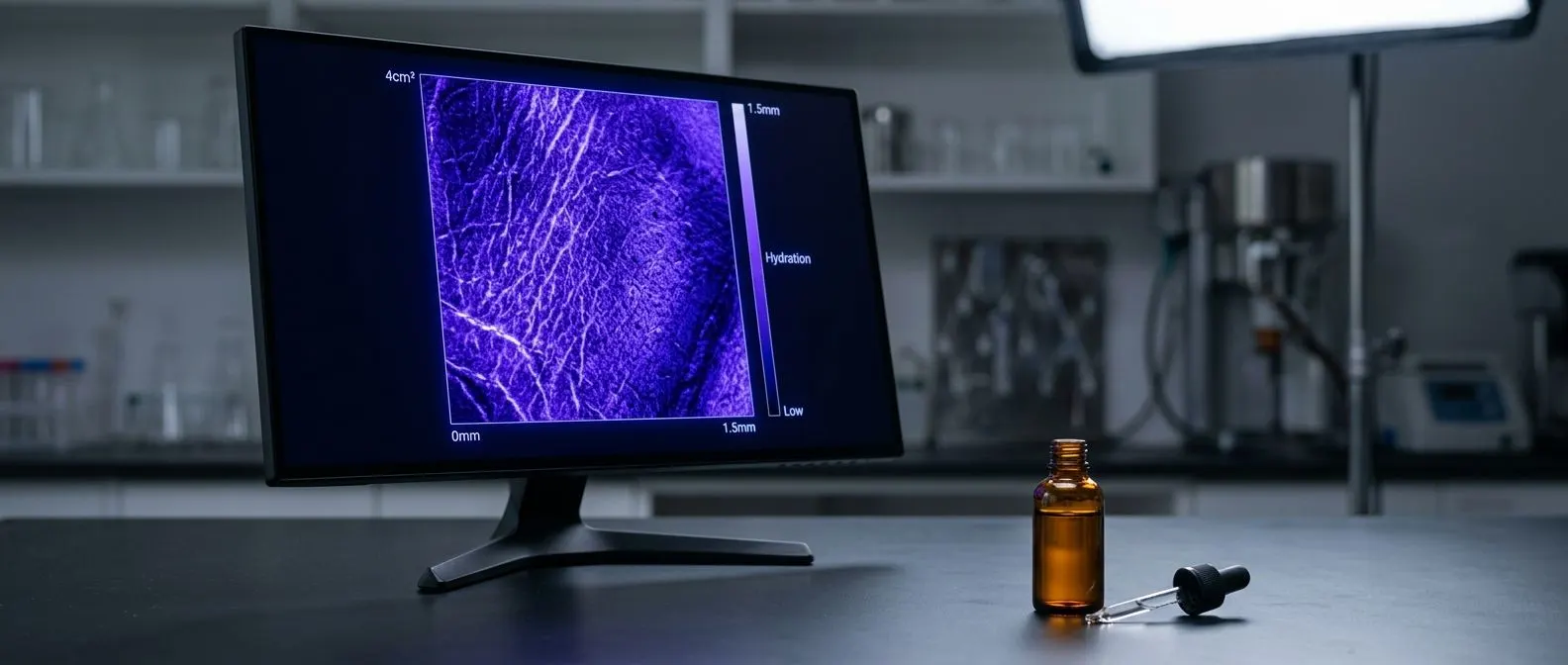
The integration of high-resolution visual diagnostics and automated ingredient matching is altering how Indian cosmetic retail operates. Dermaself’s B2B AI Beauty Agent Engine links high-resolution optical scans directly to active ingredient selection. For brand owners, formulators, and Contract Development and Manufacturing Organisations (CDMOs), this setup turns point-of-sale diagnostics into immediate, targeted product recommendations.
Biomarker-to-Active Mechanism Mapping
Algorithmic visual diagnostics do far more than assign basic skin types. By parsing surface optical data—captured across visible light and polarized spectra—into discrete visual biomarkers, the engine dynamically pairs observed skin states with proven biochemical pathways:
Hydration and TEWL: For compromised skin barrier function and elevated transepidermal water loss (TEWL), the engine routes recommendations to Ectoin and Polyglutamic Acid. This combination up-regulates Aquaporin-3 expression while building a protective hydration matrix over the stratum corneum.
Vascular Redness: When micro-vascular erythema appears on camera, the system triggers Palmitoyl Tripeptide-8 and Madecassoside. This pairing inhibits TRPV1 receptor activation and suppresses neurogenic inflammatory cascade markers, specifically Interleukin-6 (IL-6) and Interleukin-8 (IL-8).
Pore Architecture and Sebum Production: For excess sebum and enlarged pores, the algorithm maps Capryloyl Salicylic Acid (LHA) alongside Zinc PCA to target lipophilic desquamation inside the pore canal while delivering targeted 5-alpha reductase inhibition to regulate sebum synthesis.
Hyperpigmentation: When scanning epidermal melanin clustering, the engine prescribes 2% to 3% Tranexamic Acid combined with Hexylresorcinol. This dual mechanism interrupts plasmin-mediated melanogenesis and provides dual-site tyrosinase inhibition to prevent melanosome transfer.
Navigating CDSCO and IS 4707 Regulatory Boundaries
Deploying AI diagnostic engines across Indian retail requires precise positioning under the Drugs and Cosmetics Act (1940) and the Medical Devices Rules (2017).
The regulatory line here is sharp: software interfaces must strictly distinguish aesthetic skin evaluation from clinical medical diagnosis.
If an engine flags clinical pathologies—like explicitly diagnosing "melasma" or "rosacea"—it risks reclassification as Software as a Medical Device (SaMD). That shift triggers mandatory Class A or Class B medical device registration, forcing brands into costly clinical validation cycles that choke commercial expansion. Smart platforms keep their user interface outputs grounded in aesthetic descriptors like "uneven tone" or "surface redness."
At the same time, the engine's ingredient decoders must continuously cross-reference product suggestions against Indian Standard IS 4707 (Part 1 and 2). The underlying algorithms enforce restricted substance limits and maximum concentration thresholds before presenting any curated skincare routine to the consumer.
Strategic Manufacturing and Phygital Retail Optimisation
Deploying real-time AI engines at retail counters changes the operational playbook for Indian contract manufacturers and CDMOs:
Modular SKU Matrices: Formulators are moving toward modular, single-biomarker SKU systems. By standardising formulations around specific active mechanisms, manufacturers make it easy for AI engines to parse live inventory and assemble personalized, multi-step routines on the fly.
Frictionless Conversion: In phygital retail stores, converting an optical scan into a scientifically backed ingredient regimen removes buyer skepticism. The result is higher basket sizes and stronger repeat purchase rates for B2B cosmetic brands.