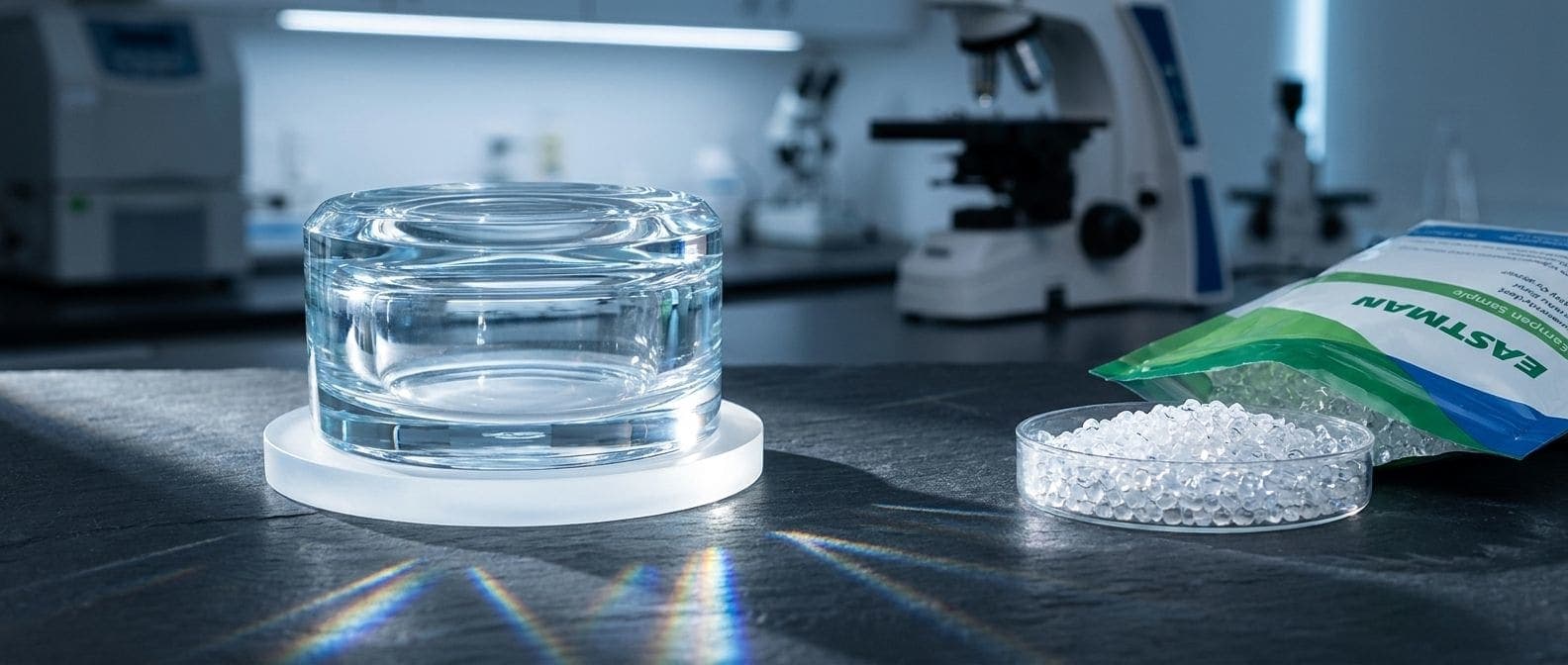
Premium skincare packaging faces a tough technical balancing act: achieving the heavy, glass-like aesthetics consumers expect without failing increasingly strict circular economy mandates. Kanebo’s recent switch to Eastman Cristal™ One IM812 PET resin for its new prestige overcap line offers a practical workaround for Indian brand owners and contract manufacturing organizations (CMOs) looking to ditch non-recyclable materials.
Polymer Kinetics and Optical Performance
Molding crystal-clear closures thicker than 4 mm has traditionally forced packagers to rely on non-recyclable polymers like polymethyl methacrylate (PMMA/acrylic), styrene-acrylonitrile (SAN), or glycol-modified PET (PETG). Standard PET resins fail in heavy geometries because uncontrolled crystallization during cooling creates severe optical haze, micro-voids, and stress-whitening.
Eastman engineered Cristal One IM812—a specialty Resin Identification Code 1 (RIC 1) PET—specifically to bypass these physical bottlenecks. Modifying polymer chain orientation during cooling keeps the resin amorphous even through heavy cross-sections.
Floor test data demonstrates:
Optical Clarity: Total luminous transmittance above 90% with haze values under 1.0% on 4 mm plaques.
Tactile Mass: A high-density profile that replicates the cold-touch feel and substantial weight consumers expect from luxury skincare.
Impact Strength: Superior toughness over brittle acrylics, preventing stress-cracking under high torque during automated capping operations.
Regulatory Alignment: CDSCO, BIS, and PWM Mandates
For Indian brand owners and packaging engineers, resin selection is directly linked to compliance costs. India’s Plastic Waste Management (PWM) rules impose aggressive Extended Producer Responsibility (EPR) targets, levying steep fees on hard-to-recycle rigid plastics.
Shifting overcaps to RIC 1 PET provides clear operational advantages:
Lower EPR Liabilities: RIC 1 PET routes directly into existing municipal and industrial post-consumer recycling streams, avoiding the punitive fees attached to SAN or PMMA.
Correct BIS Compliance: The resin satisfies IS 12252 (PET for cosmetics and food contact) and IS 14534 (plastics recycling guidelines), replacing misapplied standards like IS 10146 (which governs polyethylene, not PET).
Zero Migration Risk: The chemically inert PET matrix prevents volatile botanical extracts, essential oils, and active terpenes from crazing or softening the overcap’s inner wall.
CMO Implementation and Floor Parameters
On the factory floor, adopting IM812 doesn't require throwing out existing tooling. The material functions as a drop-in solution for standard single- and two-stage injection molding equipment across Indian CDMO facilities, provided shop-floor technicians dial in precise processing parameters.
Key floor specs for seamless implementation:
Moisture Control: Pre-dry resin at 150°C–160°C for 4 hours using a desiccant dryer with a dew point of -40°C. This drops moisture below 0.005%, preventing hydrolytic degradation that destroys clarity and impact resistance.
Thermal Parameters: Maintain melt temperatures between 270°C and 285°C. Set mold core temperatures at 15°C to 25°C to chill thick sections rapidly and freeze the amorphous polymer state.
Cycle Efficiency: Uniform melt rheology enables lower injection shear stress, keeping target cycle times under 28 seconds for a 4.5 mm wall section while cutting kilowatt-hour energy consumption per unit.