In the Indian dermocosmetics sector, biomimetic peptides are among the highest-value active ingredients in anti-aging formulation. Synthetic sequences like Copper Tripeptide-1, Palmitoyl Pentapeptide-4, and Acetyl Hexapeptide-8 mirror native signaling molecules to trigger extracellular matrix synthesis. Yet unencapsulated peptides hit a physical wall. Their hydrophilic profile and molecular weights far exceeding the 500-Dalton limit prevent passive diffusion across the lipophilic stratum corneum. At the same time, native proteolytic enzymes in the upper epidermis break down naked peptide chains before they can reach target cells.
To work around these physical limits, formulators use micro- and nano-encapsulation architectures. These carrier systems guard active payloads while delivering them directly across the skin barrier.
Advanced Carrier Systems for Dermal Delivery
Encapsulation shields fragile peptide chains against hydrolytic and enzymatic degradation while controlling skin penetration rates. Three primary vehicle platforms lead modern anti-aging emulsion development:
Liposomes: Fusing directly with epidermal lipid matrices, phospholipid bilayers transport water-soluble peptides across hydrophobic skin boundaries.
Nanostructured Lipid Carriers (NLCs): Encasing active molecules within solid and liquid lipid matrices, NLCs prevent premature payload release while improving active stability.
PLGA Polymeric Shells: Degrading at predictable temporal intervals, Poly(lactic-co-glycolic acid) nanoparticles provide sustained, controlled release deeper within the skin architecture.
Once past the stratum corneum, these engineered vectors deposit intact peptides at the Dermo-Epidermal Junction (DEJ). Here, the molecules bind to specific fibroblast receptors, upregulating Collagen I, Collagen IV, and Laminin-5 synthesis. This targeted activity delivers measurable improvements in skin density, elasticity, and wrinkle depth.
Processing Parameters and Scale-Up Controls
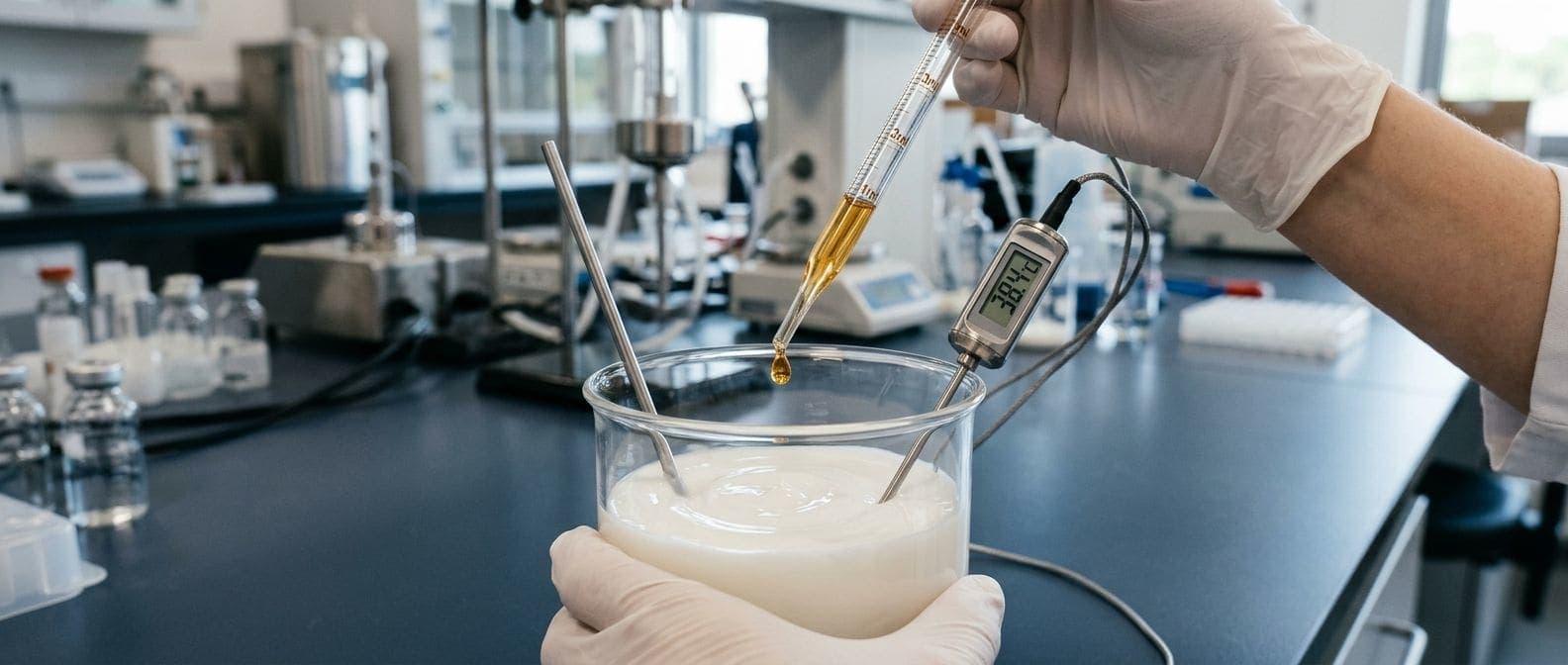
Translating encapsulated peptide formulas to commercial scale requires strict operational controls. High thermal energy and aggressive mechanical shear rupture liposomal walls and lipid matrices, triggering payload leakage and rapid peptide hydrolysis.
Batch production must follow three core processing rules:
Cold-Process Addition: Add encapsulated peptide complexes exclusively during the cool-down phase, keeping processing temperatures strictly below 40°C.
Low-Shear Mixing: Use low-shear side-sweep or planetary mixing once vesicles enter the batch. High-shear homogenisation post-addition destroys carrier integrity.
pH Optimisation: Maintain the aqueous phase between pH 5.0 and 6.5 to preserve carrier vesicle charge and prevent structural breakdown.
Regulatory Compliance and Claim Boundaries Under CDSCO
Formulating encapsulated actives under India's Central Drugs Standard Control Organisation (CDSCO) demands clear compliance strategies. All finished formulations must conform to the *Cosmetics Rules, 2020* and IS 4707 technical standards.
Managing Operational Claim Boundaries
Keep marketing and regulatory claims strictly focused on topical outcomes to avoid CDSCO drug reclassification:
Permissible Cosmetic Claims: Frame benefits around visible surface outcomes: "improves skin elasticity," "reduces the appearance of fine lines," "enhances firmness," and "supports skin hydration."
Prohibited Therapeutic Claims: Eliminate drug-tier claims such as "rebuilds cellular matrix," "reverses cellular senescence," "repairs structural tissue," or any phrase implying systemic physiological changes.
Safety Dossier Compliance
Regulatory submissions for commercial filings require technical dossiers showing local dermal retention without systemic transdermal absorption. Formulators must also document trace impurity limits, ensuring zero harmful residual solvent carries over from polymeric synthesis and heavy metals remain strictly within limits: Lead at or below 20 ppm and Arsenic at or below 2 ppm.
Commercial Rationale for Indian CDMOs
For Indian dermocosmetic brands and contract manufacturers, switching to encapsulated biomimetic peptides is an operational upgrade that improves formula stability and product longevity. Stabilising volatile actives extends finished shelf-life, protects batch consistency during scale-up, and ensures predictable consumer outcomes. Mastering these delivery parameters allows CDMOs to convert standard emulsion lines into high-margin anti-aging products that pass regulatory scrutiny and deliver reliable clinical performance.