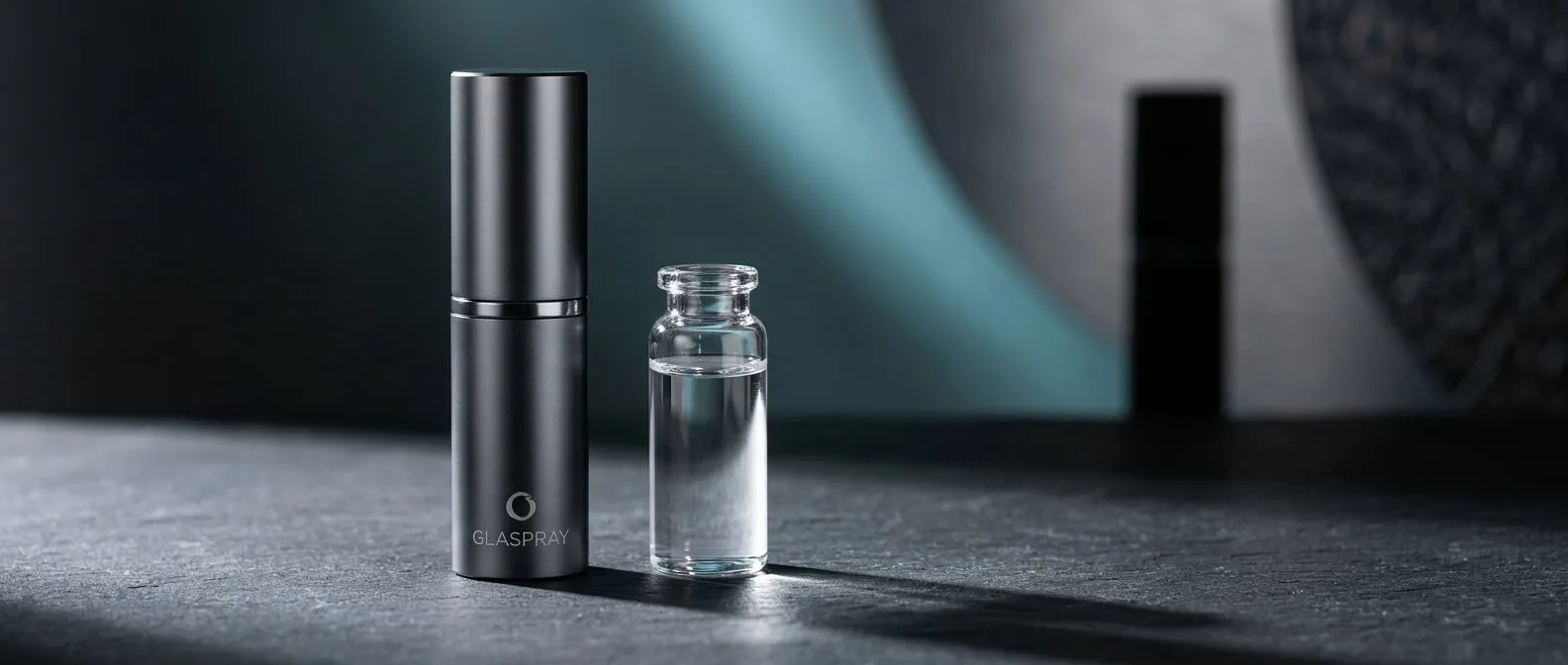
As high-potency cosmeceuticals dominate Indian beauty aisles, product developers face a brutal reality: fragile formulations degrade fast. Active serums containing unstable L-Ascorbic Acid, pure unencapsulated Retinol, or shear-sensitive bio-peptides frequently suffer photolytic breakdown, volatile evaporation, or solvent permeation when housed in standard plastic containers. Glaspray’s TUD-ROMA modular packaging architecture solves these stability challenges by pairing a structural anodised aluminum outer canister with a replaceable, chemically inert inner glass vessel.
Field-Tested Stability and Thermal Shielding
Engineers managing high-speed liquid filling lines know that low-viscosity, active-rich formulations react poorly to plastic contact surfaces and ambient temperature spikes. The TUD-ROMA design uses a removable inner cartridge crafted from USP Type I or Type III glass. This creates a completely non-reactive surface that stops volatile solvent loss and chemical leaching dead in its tracks.
While the inner glass pod handles liquid integrity, the anodised aluminum outer chassis acts as an armor casing. It blockades 100% of UV and visible light—eliminating photolytic degradation entirely. By suspending the inner glass pod inside a shock-absorbing metal shell, the system shields fragile glass from drop-induced micro-fractures, shipping vibrations, and intense thermal shocks common across Indian logistics corridors.
Streamlining CDSCO Filings and EPR Obligations
Navigating India’s regulatory landscape requires proactive packaging design rather than post-production fixes. Under the Drugs and Cosmetics Rules (2020), the Central Drugs Standard Control Organisation (CDSCO) demands rigorous proof of container-content compatibility. Because USP-grade glass serves as the sole product contact layer, brands can radically simplify Extractables and Leachables (E&L) testing protocols, accelerating stability approvals.
On the environmental side, compliance with India’s Plastic Waste Management Rules for Extended Producer Responsibility (EPR) often stalls when dealing with complex composite materials. TUD-ROMA solves this with an intuitive, tool-free release mechanism. Consumers easily separate the mono-material aluminum shell from the glass pod, allowing both components to enter existing municipal recycling streams without cross-contamination.
Line-Speed Efficiency and Refill Logistics
For Contract Development and Manufacturing Organisations (CDMOs), frequent line re-tooling eats into operational margins. Glaspray’s modular framework allows factory managers to standardise one outer aluminum chassis dimension across an entire product portfolio. Production lines fill and seal uniform inner glass cartridges at top speed, drastically reducing downtime, change-part capital expenditure, and batch-turnaround friction.
The economic advantages extend directly into post-sale logistics. Shipping compact glass refill cartridges instead of fully assembled heavy units significantly reduces freight volume and shipping weight per order. For direct-to-consumer (D2C) and omnichannel Indian beauty brands, these transport savings turn refill subscription programs into viable revenue engines while lowering long-term customer acquisition costs.
Final Takeaway
Decoupling structural protection from liquid containment yields a practical packaging option for modern beauty brands. By pairing pharmaceutical-grade barrier security with simple CDSCO compliance and true circularity, the Glaspray TUD-ROMA hybrid system allows Indian CDMOs and brand owners to optimize production efficiency while preserving formulation potency from the factory floor to the consumer's vanity.