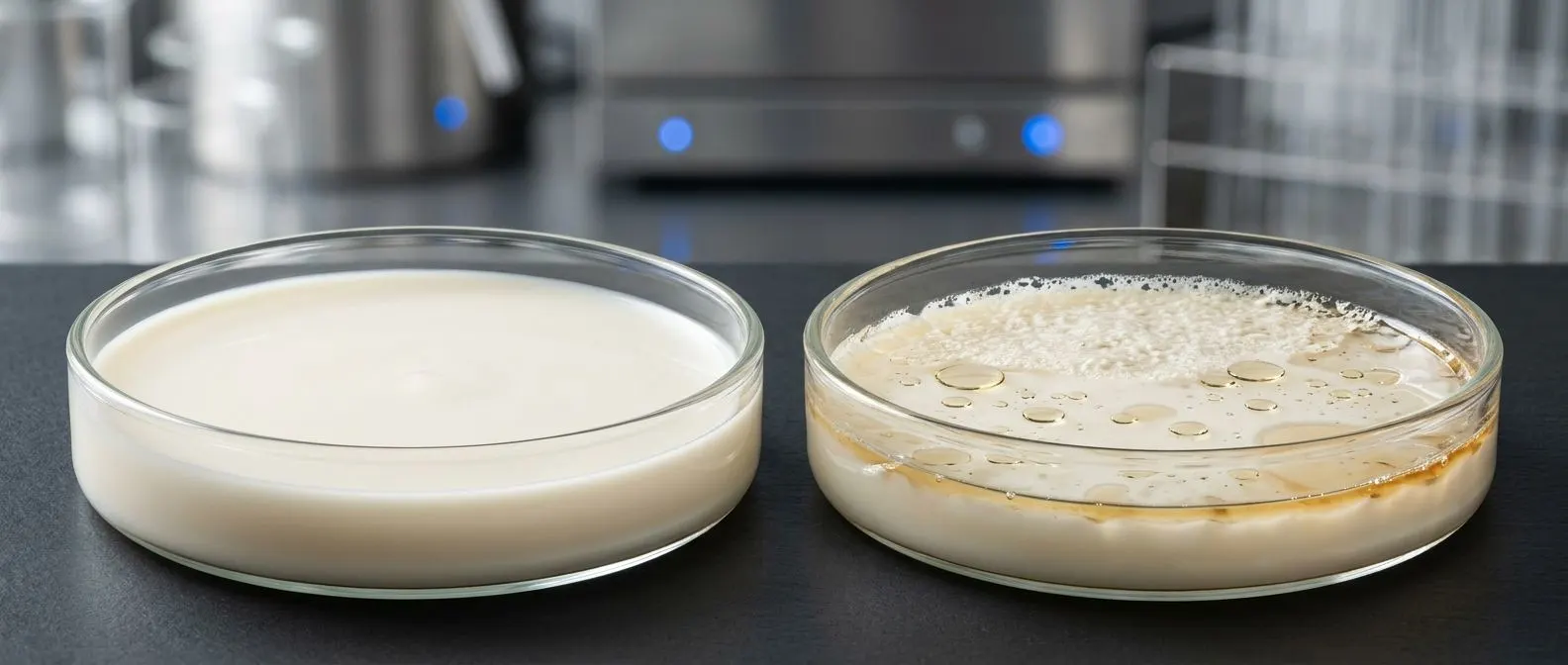
At the IFSCC 2026 congress, researchers presented a computational breakthrough that could change how cosmetic labs test product stability. For decades, formulators have relied on traditional stress testing—cooking bench samples in high-temperature incubators, running freeze-thaw cycles, and spinning tubes in centrifuges over three to six agonizing months.
This new physics-informed machine learning framework fundamentally changes how formulators approach development. By moving from reactive trial-and-error to predictive modeling, it offers clear technical, commercial, and regulatory advantages for Indian beauty brand owners, R&D labs, and contract development and manufacturing organisations (CDMOs).
The Physics-AI Advantage in the Lab
Unlike basic statistical models that merely guess based on historical data, this framework combines physics-informed machine learning with real-time physicochemical parameter mapping. Before a formulator even touches a beaker, the software evaluates key inputs:
Hydrophilic-Lipophilic Balance (HLB) values and interfacial tension dynamics
Zeta potential readings and initial droplet size distribution profiles
Rheological drift indices and viscoelastic behavior under stress
By calculating how these dynamic variables interact simultaneously, the algorithm flags potential macro- and micro-instabilities months before a batch actually separates, creams, or undergoes Ostwald ripening.
Solving Barrier-Repair Formulation Headaches
This predictive accuracy is a game-changer for complex dermo-cosmetic products. In the lab, getting thermodynamics right by hand when combining delicate lipophilic lipids (Ceramides NP, EOP, and AP, alongside Phytosphingosine and Cholesterol) with polar water-soluble actives (Niacinamide, Hyaluronic Acid) usually means dealing with unexpected crystal growth or phase inversion three weeks into stability testing.
The engine catches these latent chemical incompatibilities and interfacial stress points early. Formulators can tweak emulsifier ratios (*Polyglyceryl esters, Lecithin*) *in silico*, fixing thermodynamic flaws before committing to expensive physical pilot runs.
Accelerating Launch Timelines for Indian CDMOs
For commercial directors and CDMO executives, predictive stability validation tackles the biggest cost centers in product development:
Fewer Physical Iterations: Computational screening cuts lab bench iteration cycles by 40% to 60%.
Raw Material Savings: Fewer failed lab batches means less wasted raw materials—especially expensive synthetic ceramides and specialty bio-emulsifiers.
Margin Protection for CDMOs: Indian contract manufacturers can pitch computational validation as a premium value-add. Spotting scale-up failures before going to pilot scale protects margins and keeps fast-scaling skincare clients on schedule.
Smarter CDSCO Compliance Strategy
Under India's Cosmetics Rules 2020, securing regulatory sign-offs demands solid proof of safety and shelf life. While computational models do not replace physical stability testing outright, they provide strong supporting evidence that slashes physical accelerated testing bottlenecks under IS 15000 / ISO 22716 (GMP).
Faster Regulatory Dossiers: In silico stability data generates clear predictive curves that support mandatory Safety Data Sheets (SDS) and accelerated stability documentation.
Shorter Review Cycles: Submitting validated computational data alongside physical testing reduces back-and-forth queries from the CDSCO. This speeds up registration throughput for imported finished goods (Form COS-2) and domestic manufacturing approvals (Form COS-8).
Strategic Outlook for the Indian Market
As the Indian skincare market pivots rapidly toward active-led, barrier-focused products, the margin for formulation failure is shrinking. The ML framework showcased at IFSCC 2026 establishes a practical new benchmark for stability verification. Forward-thinking Indian formulators and contract manufacturers that integrate physics-AI into their early-stage workflow will secure a decisive edge in speed-to-market, cost control, and regulatory approval.