When the Biggest Beauty Conglomerate Builds a Cross-Brand AI Advisor
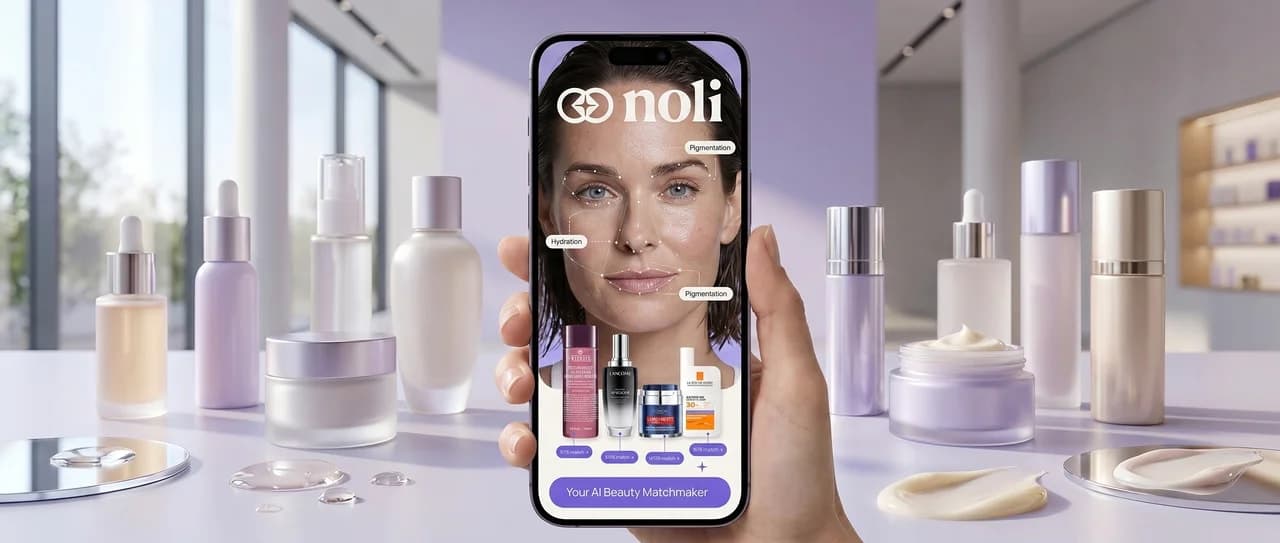
Noli, backed by L'Oréal, is an AI-powered skincare advisor designed to match consumers with products based on their skin's actual needs rather than what is trending. Users can either chat through their concerns — dullness, breakouts, sensitivity — or upload a face scan, which is analysed using Noli's proprietary BeautyDNA™ algorithm, looking at over 80 different criteria to build a tailored routine.
What makes Noli strategically distinct from prior AI face-scanning tools is its scope. The platform includes mainstream and prestige brands ranging from drugstore picks to higher-end serums — L'Oréal Paris Bright Reveal, SkinCeuticals Discoloration Defense, Aesop's In Two Minds Facial Hydrator, CeraVe, Kiehl's, and La Roche-Posay among them. Several of these are L'Oréal-owned brands; several — CeraVe, Kiehl's — are not directly L'Oréal's, though CeraVe sits under L'Oréal's portfolio while Kiehl's is also L'Oréal-owned. The critical point is that Noli is positioned as a cross-brand discovery layer, not a single-brand recommendation engine — and that structural choice has significant implications for every manufacturer whose product could appear, or fail to appear, in its recommendations.
How the Technology Actually Works
Noli claims its algorithms are informed by more than a million face scans and an archive of thousands of product formulas, anchored to what it calls "over 100 years of skin science." That combination aims to move users out of repetitive trial-and-error — what the company calls a "discovery loop" — into an efficient, evidence-oriented shopping experience.
The AI-powered face scan identifies dark circles, redness, oiliness, or other conditions, using a laptop or phone camera with the technology guiding the user to the correct capture angle. Users then select their top skin concerns and answer questions about fragrance preference, preferred moisturiser texture, current routine, and pricing preferences. Recommendations are presented with emphasis on ingredients and intended benefit, not just packaging, and the platform pairs guidance with an integrated shopping experience so users can move from assessment to checkout quickly.
This is a meaningfully more sophisticated approach than earlier face-scanning tools like Neutrogena's Skin360, which scored skin against six factors and recommended only Neutrogena-family products. Skin360 scans a user's selfie and scores skin health based on six key factors such as dark spots, wrinkles, and smoothness — useful, but a single-brand engagement tool, not a discovery and purchase platform spanning the broader market.
The Manufacturer Implication: Discoverability Is Becoming Algorithmic
For product manufacturers, brand owners, and R&D teams, Noli's emergence signals a structural shift already underway across the beauty industry: product discovery is increasingly mediated by AI matching systems that evaluate ingredients and claims data, not shelf placement or brand marketing alone.
This has several concrete implications.
Ingredient and claim data structuring becomes a discoverability requirement. If Noli's BeautyDNA algorithm is matching against "over 80 different criteria" using "an archive of thousands of product formulas," the products that surface most accurately in recommendations will likely be those with the most complete, structured, and well-documented ingredient and efficacy data. Manufacturers and brands that have invested in clear INCI documentation, clinical substantiation, and structured claims data have a discoverability advantage in this new layer — independent of marketing spend.
The competitive set a brand faces shifts from category shelf-mates to algorithmic peers. A serum's competitive set within Noli is determined by which ingredients and claims match a given skin concern profile — not by retail proximity or price-tier positioning. A premium serum and a mass-market serum addressing the same concern with similar active ingredients become direct competitors in the recommendation algorithm in a way they would never be on a physical shelf.
Cross-brand platforms reduce the moat of brand loyalty for routine-level decisions. When a consumer trusts an AI advisor more than brand affiliation for product selection, brand loyalty shifts from "which brand do I buy" to "which advisor do I trust." This elevates the importance of being represented well within trusted advisor platforms over traditional brand-building activities for the specific job of routine assembly.
What This Means for Manufacturers Considering Their Own Tools
Several beauty conglomerates and brands have built proprietary AI skin diagnostic tools — Neutrogena's Skin360 (built with Perfect Corp), various L'Oréal Group AR/diagnostic tools, and others. The spread of AI face scanners across cosmetics companies reflects a broader push toward personalised skin care. Noli represents a different strategic choice: rather than building a single-brand tool to drive loyalty within L'Oréal's own portfolio, L'Oréal has backed a cross-brand advisor that includes competitor products.
This is a notable strategic bet. It suggests L'Oréal's calculation is that owning the trusted advisor layer — even if it occasionally recommends a competitor's product — generates more long-term value than maximising single-brand conversion through a closed-loop tool. For manufacturers and brand owners, this raises a direct strategic question: should you build a closed, brand-specific diagnostic tool, or position your products for strong performance within open, cross-brand AI advisors that are likely to proliferate?
For most mid-sized and challenger brands — including the majority of Indian BPC manufacturers — building a competitive closed-loop AI diagnostic tool requires data and engineering investment that is difficult to justify. The more achievable and arguably more valuable investment is ensuring your product data is structured, accurate, and complete enough to perform well when evaluated by third-party AI advisors like Noli, Perfect Corp's underlying technology, or future entrants in this space.
The India Opportunity and Readiness Gap
India's skincare e-commerce ecosystem — Nykaa, Tira, Purplle, Myntra Beauty — has not yet deployed a cross-brand AI advisor with the sophistication of Noli's BeautyDNA approach, though single-brand virtual consultation tools exist at various retailers. This represents both an opportunity and a readiness question for Indian manufacturers.
The opportunity is that whichever Indian platform builds or licenses comparable AI advisory technology first will materially reshape how Indian consumers discover and purchase skincare — moving discovery from influencer-led and retail-merchandised models toward algorithmic, ingredient-led matching. Given the scale of misinformation and trend-chasing currently driving Indian skincare purchase decisions, an accurate AI advisor addresses a genuine consumer need.
The readiness question is whether Indian brands have the structured ingredient and efficacy data necessary to perform well within such a system if and when it arrives. Many Indian D2C brands market on positioning and aesthetic rather than structured clinical or ingredient-mechanism data. Brands that begin building this data discipline now — clear INCI listings, documented usage levels, in vitro or clinical substantiation where available — will be positioned advantageously whenever an AI advisor platform reaches scale in the Indian market.
What Manufacturers and R&D Teams Should Do Now
Three priorities deserve evaluation.
Audit your product data completeness against an AI-matching standard. Review whether your products have structured, accessible data on active ingredients, usage levels, claimed benefits, and any available substantiation — the inputs an AI advisor needs to recommend accurately. Gaps here are increasingly a discoverability risk, not just a regulatory compliance question.
Treat ingredient transparency as a competitive requirement, not just a consumer trend. AI advisors built on ingredient-and-mechanism matching favour brands that document precisely what their products do and why. Vague positioning language performs poorly in algorithmic matching regardless of how well it performs in traditional marketing.
Monitor the Indian platform landscape for emerging AI advisory tools. Whichever Indian e-commerce or beauty retail platform builds or licenses Noli-equivalent technology first will reshape discovery dynamics for every brand on that platform. Early engagement and data readiness will determine which brands benefit from the transition and which are disadvantaged by it.
Noli is one platform, backed by one conglomerate, addressing one market. The structural shift it represents — AI-mediated, ingredient-led product discovery that crosses brand boundaries — is the development manufacturers and R&D teams should be planning for, regardless of when an equivalent tool arrives in India specifically.