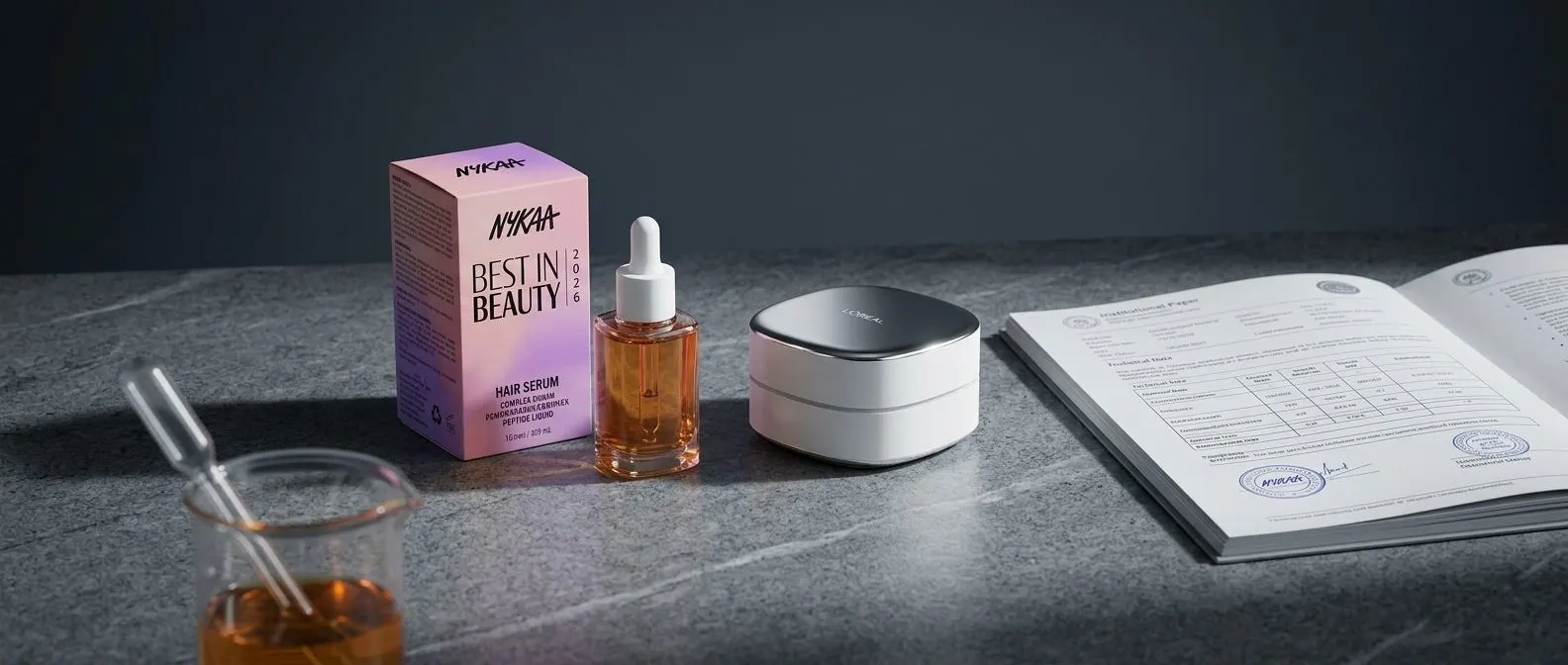
When L’Oréal’s corporate venture fund, BOLD, backed Nykaa’s distribution engine, the message to India's beauty and personal care (BPC) market was unmissable: the era of quick-turn direct-to-consumer brands is over. Performance marketing alone no longer cuts it. Capital is shifting away from social ad burn and straight into clinical efficacy, supply chain compliance, and operational discipline.
For brand founders, R&D labs, and contract manufacturers, this alliance signals a clear shift in how Indian BPC brands scale. Securing institutional growth equity and holding prime physical shelf space now demands an operational overhaul across three non-negotiable pillars.
1. Technical & Formulation Evolution: Transitioning to Clinical Grade
To meet L’Oréal’s global R&D benchmarks and maintain velocity across Nykaa’s retail doors, labs are ditching superficial marketing claims for bio-available, shelf-stable active chemistry:
Stabilized L-Ascorbic Acid: Formulators are swapping raw L-ascorbic acid for anhydrous, pH-stabilized systems that don't turn amber or degrade on warm retail shelves.
Biomimetic Peptides: R&D teams are specifying bio-engineered signal and carrier peptides under 500 Daltons to guarantee deep epidermal penetration and active tissue remodeling, rather than surface conditioning.
Micro-Encapsulated Retinoids: Chemists are deploying liposomal and polymeric encapsulation to control active release kinetics. This minimizes cutaneous irritation while protecting delicate actives from photo-degradation in India’s humid climate.
Fermented Postbiotics: Formulators are incorporating bio-fermented postbiotic lysates into daily skin barrier lines to maintain microflora balance and reduce transepidermal water loss (TEWL).
2. CDSCO Compliance & Regulatory Timelines
Institutional backing requires strict compliance under India’s Cosmetics Rules 2020. Regulatory approval is no longer a post-R&D formality; it dictates launch calendars and manufacturing workflows:
Audit-Ready Product Information Files (PIF): Brands must assemble comprehensive PIFs featuring full raw material safety data sheets (MSDS), toxicological risk assessments, and batch manufacturing records before production starts.
COS-2 & COS-8 Filing Lead Times: Operational timelines must factor in realistic filing windows. Securing a Form COS-8 domestic manufacturing grant requires 60 to 90 days of facility verification, while Form COS-2 import approvals can freeze inventory if raw material origin documents lack trace-element testing.
BIS Safety Parameters: Testing protocols must verify that finished batches pass IS 14299 parameters—confirming Lead (Pb) stays below 20 ppm, Arsenic (As) under 2 ppm, and Mercury (Hg) under 1 ppm, alongside strict microbial load limits.
Clinical Validation: Efficacy claims like "barrier repair" or "hyperpigmentation reduction" now require quantitative in-vivo clinical trials. Subjective consumer perception panels no longer satisfy institutional diligence.
3. B2B CDMO Infrastructure & Supply Chain Stability
Omnichannel expansion across Nykaa's digital and retail doors places immense strain on contract development and manufacturing organizations (CDMOs). Success depends on backend execution:
cGMP & ISO 22716 Scale-Up: CDMO facilities must prove they can scale from 100 kg pilot batches to multi-ton commercial runs without batch-to-batch variation or phase separation.
Accelerated Shelf-Life Stress Testing: Formulations must endure 12 to 24 weeks of accelerated stability testing at 40°C and 75% Relative Humidity. Formulas that separate or degrade in transit will face immediate retail delisting.
Oxidative Barrier Packaging: Premium active formulas require airless pumps and UV-opaque packaging. CDMOs must run early compatibility testing to prevent active degradation or container leaching during warehouse storage.
The Strategic Outlook
The math has changed for Indian beauty founders. Growth is no longer about throwing venture capital at customer acquisition costs. High-growth brands are putting capital back into chemical formulation, compliant CDMO capacity, and verifiable clinical claims. For suppliers and manufacturing partners across India, mastering these technical standards is the baseline for long-term growth.