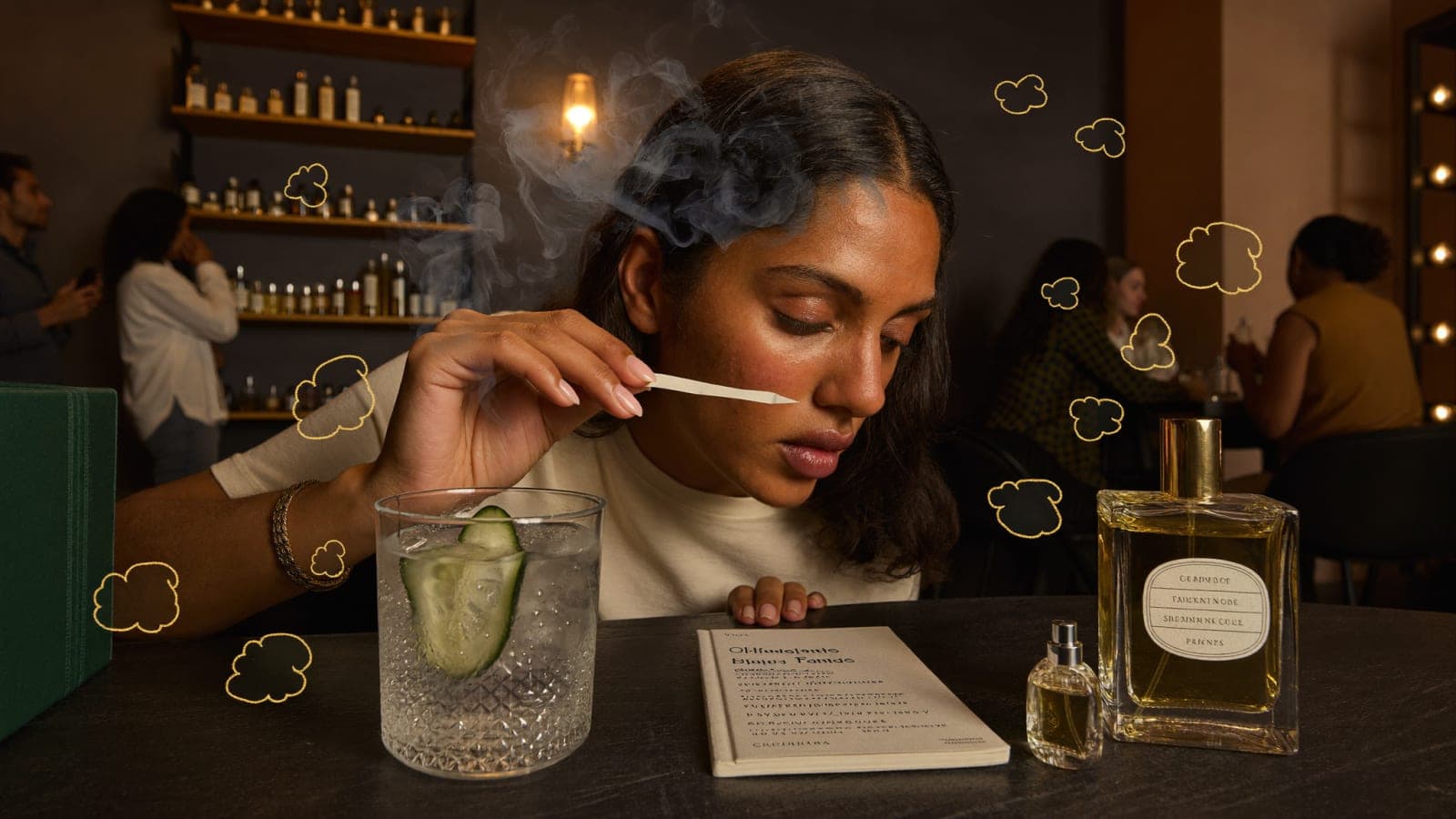
A fragrance launch in Shanghai increasingly resembles a supper club rather than a counter visit. Across China, consumers now gather for smelling sessions, swap decants, and sip fragrance-inspired cocktails inside a new wave of perfume clubs and boutique scent houses. A new fragrance retail ecosystem is emerging, turning scent into social currency and creating a new entry point for niche and luxury fragrance brands. The implications travel well beyond Chinese borders.
From counter to community
The mechanics are simple but commercially potent. Fragrance clubs and scent communities in China are spaces, events and social groups where consumers gather to smell, compare, swap and discuss perfume, often combining niche boutiques, workshops, scent tastings, cocktails, creators and digital conversation. Discovery no longer depends on brand visibility alone; it depends on giving a community something real to talk about.
This is not an isolated Chinese quirk. Perfume clubs have surfaced across New York, London, Lisbon and Helsinki, frequently framed as an antidote to urban loneliness, with scent swaps, friendships and creative partnerships forming around events. The common thread is a generation that wants to learn a sensory vocabulary socially, the way others gather for book clubs or dinners.
For B2B professionals, the signal matters because it changes the unit of value. The bottle is no longer the whole product; the language, memory, staging and sense of belonging around it carry equal weight. In a category where personal recommendation drives conversion, that reframing has direct commercial consequences.
Why the experiential model converts
Fragrance has always resisted pure e-commerce. You cannot smell a product page, and in-store sensory evaluation can deliver roughly a 15% higher purchase conversion rate compared with online-only introductions. Experiential spaces close that gap by letting consumers test, compare and discuss before committing.
They also solve a discovery problem. With thousands of SKUs competing for attention, guided olfactory experiences help consumers narrow choices and build confidence, reducing the returns and buyer's remorse that plague blind online fragrance purchases.
Critically, these formats manufacture content. A smelling session or a scent-paired cocktail evening is inherently shareable, feeding the social loops that now precede most sales. The buying path has inverted: consumers first encounter content, form an impression of the product, decide to purchase, and only then experience the actual scent.
What this means for India's fragrance boom
India offers fertile ground for the same playbook, and the timing is striking. India's fragrance market, valued at around $2 billion, is projected to reach $4.08 billion by 2030, with the user base expected to grow to 120.7 million by 2029.
Capital is already chasing the opportunity. Indore-based House of EM5, backed by boAt cofounder Aman Gupta, scaled from just 900 online orders in its first year to more than 2,000 orders a day. Elsewhere, Delhi's Fraganotes raised $1 million from Rukam Capital, while Bengaluru's HIRA Fragrances secured a $6 million pre-Series A round.
Yet most of this growth has been digital-first and transaction-led. EY notes that India's per-capita fragrance consumption remains significantly lower than developed markets, with the category transitioning from a niche luxury into a broader lifestyle segment as consumers own different perfumes for work, casual settings, weather and occasions. That transition is exactly where experiential discovery earns its keep, converting occasion-led first-timers into ritual-led repeat buyers.
The quick-commerce blind spot
India's discovery infrastructure is racing toward speed. Online channels are expected to account for approximately 30% of total fragrance sales by 2026, and quick-commerce now delivers perfume in minutes. Convenience, however, does not teach taste.
Herein lies the opening. Fast delivery wins the repeat purchase a consumer already knows they want; it does little for the high-margin niche and luxury discovery that depends on smelling before buying. Indian brands that build physical, social touchpoints can own the discovery layer that quick-commerce structurally cannot.
Building a participation architecture
For manufacturers and brand owners, the China signal converts into a clear sequence of moves. Start with a defined sensory territory, a scent identity precise enough that creators, retail partners and consumers can describe it in their own words. Vague positioning cannot be socialised.
Next, create reasons to gather. Pop-up displays in salons, boutiques or co-working spaces typically run between ₹5,000 and ₹40,000 per event, a fraction of a national ad spend yet capable of generating disproportionate content and loyalty. Lifestyle venues in Tier-I and fast-growing Tier-II cities offer ready-made hosts.
Equip the community to talk. Provide a shared vocabulary, discovery sets and decants so newcomers can participate without intimidation, the same accessibility that has kept global perfume clubs welcoming rather than insular.
Finally, treat experience as measurable. Track which sessions drive sampling, which decants convert to full bottles, and which creators move the right audiences. The winning brands do not only sell a juice; they build rituals of discovery.
The window for Indian players
The strategic logic is sharpest for India's emerging premium houses. With penetration still low and gifting, weather-led and occasion-based usage expanding, the market rewards brands that convert curiosity into community early.
Imported labels and mass deodorants long dominated Indian shelves; the experiential model hands homegrown niche brands a structural advantage that distribution-led incumbents are slow to copy authentically. Scent swaps and smelling sessions are inexpensive to run and difficult for a giant to replicate with credibility.
The lesson from Shanghai is not that India needs cocktails and clubs imported wholesale. It is that fragrance discovery is becoming a social act, and the brands that build the rooms where that discovery happens will own the relationships that follow.