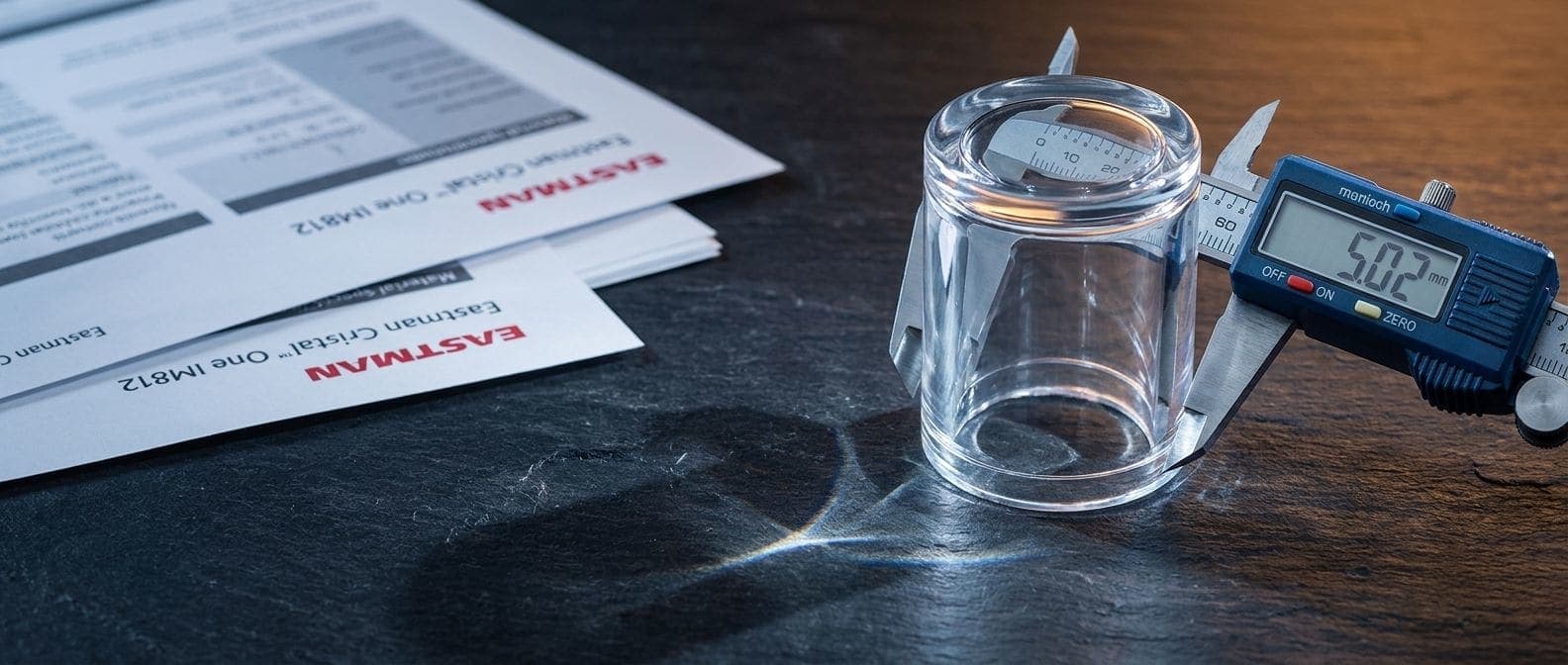
For decades, prestige beauty brands ran into a hard thermal barrier: molding thick overcaps with cross-sections over 3 mm to 5 mm required non-recyclable polymers. Legacy materials like Styrene Acrylonitrile (SAN), Polymethyl Methacrylate (PMMA), or PCTG were the standard choices to avoid thermal voiding and haze during slow core-cooling. While these resins delivered a heavy aesthetic, they broke municipal recycling streams.
KANEBO’s commercial adoption of Eastman Cristal™ One IM812 overcaps changes that production equation. By deploying an RIC 1-compatible PET copolyester, the brand achieves a glass-like hand-feel and high haze-resistance without sacrificing circular end-of-life options.
Material Science: Suppressing Crystallization in 5mm+ Wall Cross-Sections
Standard PET turns cloudy and forms internal shrinkage voids when injection-molded into thick profiles. Slow cooling allows polymer chains to realign into light-scattering micro-crystals, forcing packaging engineers back to SAN or acrylics.
Eastman Cristal™ One IM812 alters this molecular behavior:
Prevents core haze: A modified copolyester backbone slows polymer chain alignment during extended cooling cycles, maintaining high optical transparency across wall thicknesses exceeding 5 mm.
Absorbs transit shock: The resin delivers higher drop-impact strength than brittle PMMA, reducing factory-to-shelf damage on heavy secondary closures.
Protects recycling streams: Unlike PCTG or styrenic compounds, IM812 processes directly through standard RIC 1 rigid PET recycling streams without causing optical contamination or melt-viscosity spikes in wash-and-float operations.
Regulatory Compliance: Indian PWM, BIS, and EU Export Readiness
For Indian brand owners and formulation chemists, migrating heavy-wall components to RIC 1 PET solves immediate regulatory friction.
Domestic Safety and EPR Targets
IM812 meets Bureau of Indian Standards criteria (IS 12252 / IS 10146) and Central Drugs Standard Control Organisation safety benchmarks for cosmetic contact packaging. It releases zero extractables, maintaining chemical inertness alongside high clarity. Under India’s Plastic Waste Management (PWM) Amendment Rules, shifting secondary overcaps to mono-material Category 1 rigid plastic allows brand owners to meet Extended Producer Responsibility (EPR) targets without reducing component weight or visual presence.
Global Market Access
For domestic Contract Development and Manufacturing Organisations (CDMOs) exporting finished goods to Europe, this resin aligns with incoming EU Packaging and Packaging Waste Regulation (PPWR) Design-for-Recycling mandates. It eliminates problematic styrenic and acrylic resins before legislative import penalties take effect.
Tooling Adaptability and Shop-Floor Execution for CDMOs
Sustainable material conversions fail when they demand capital-intensive tooling overhauls. Cristal™ One IM812 eliminates this barrier by acting as a drop-in resin replacement for existing PMMA and SAN injection molds.
For contract manufacturers, running IM812 requires targeted process tuning rather than new mold steel. Shop-floor engineers should audit core cooling channels to manage thermal gradient build-up across heavy cross-sections. You may need to tweak gate locations slightly to optimize hold-pressure distribution and eliminate sink marks near internal ribbing. Expect a minor cycle time trade-off—adding roughly 2 to 4 seconds of dwell time to fully freeze the core without inducing internal stress whitening. However, bypassing complete tool re-engineering allows CDMOs to transition legacy luxury components rapidly while keeping unit costs within margin targets.