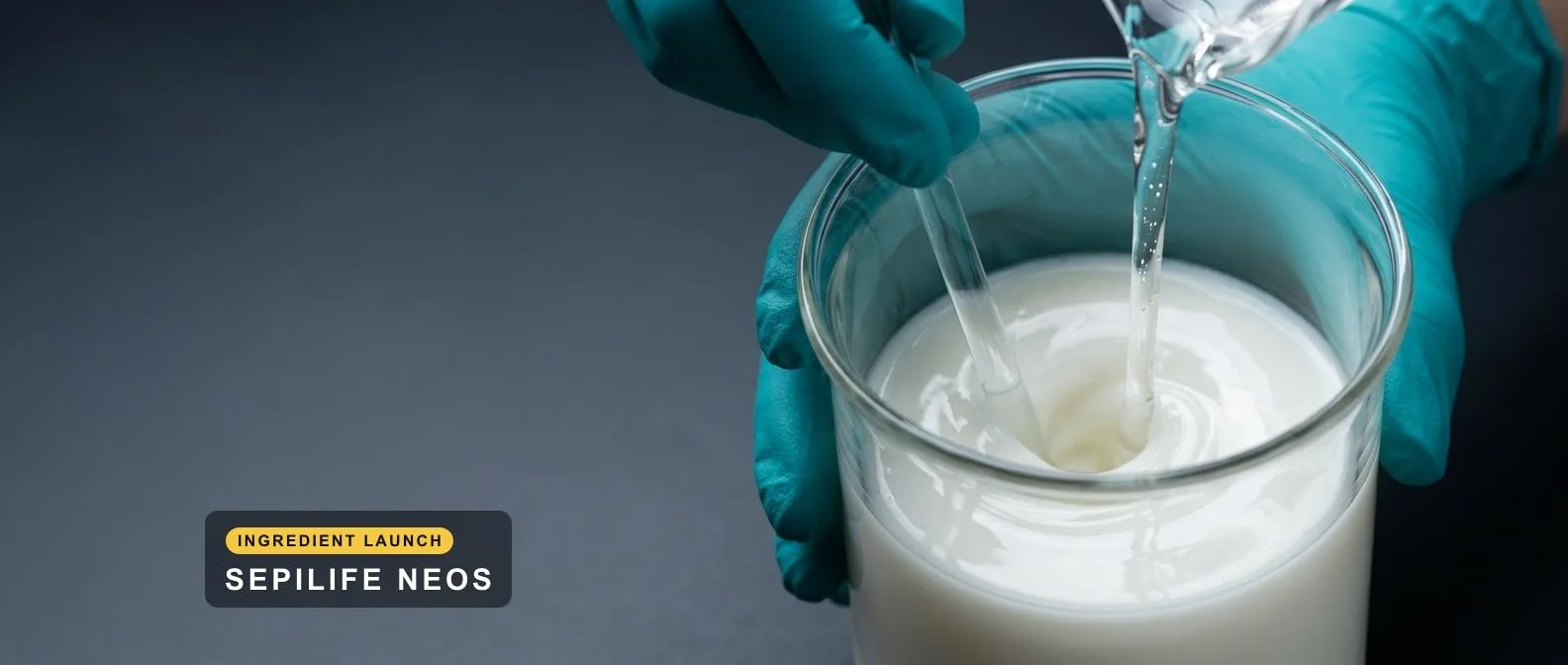
For cosmetic R&D managers and contract manufacturing organizations (CMOs) operating across the Indian personal care sector, loading up to 35% oil phase into a cold-process emulsion usually creates a tough technical tradeoff: phase separation, sticky textures, or polymer collapse once active ingredients enter the mixing vessel. Turning to traditional hot-process emulsification solves long-term stability, but it locks manufacturing plants into lengthy heating and cooling cycles, driving up factory energy costs and dragging down batch turnaround times per shift. Seppic addresses this persistent formulation challenge with Sepilife NEOS, a patented, pre-neutralized, ethylene oxide (EO)-free liquid hybrid polymer designed to stabilize high-oil systems through efficient cold processing.
At a molecular level, Sepilife NEOS bridges functional polymer chemistry with skin barrier benefits. Carrying a 65% natural-origin index under ISO 16128 standards, the liquid polymer features natural-origin squalane directly embedded within its matrix backbone. Rather than requiring secondary traditional emulsifiers, the ingredient builds a resilient three-dimensional network across the emulsion interface using a dual mechanism of steric stabilization and electrostatic repulsion. This structural strength allows formulation teams to lock down both polar and non-polar oil phases up to a 35% load without applying heat.
On the skin, the polymer delivers a distinct shear-thinning sensory profile. Under rub-in shear stress, the polymer network undergoes a rapid conformational shift, triggering a clean "quick-break" phase release. This physical action instantly deposits skin-identical squalane onto the stratum corneum, creating a fast-absorbing, light finish without the heavy, tacky residue typically associated with high-lipid formulas.
From a plant operations perspective, switching from hot emulsification to a cold-process workflow yields immediate efficiency gains. Manufacturing facilities facing high energy costs can bypass thermal cycles entirely, slashing power consumption and accelerating tank turnover between batches. Because Sepilife NEOS arrives fully pre-neutralized, compounding teams eliminate secondary neutralization steps with triethanolamine or sodium hydroxide, shortening overall batching times and removing process variability across production runs. Furthermore, the polymer demonstrates strong chemical resilience in demanding environments, maintaining viscosity in electrolyte-dense formulas and staying stable in low-pH systems carrying active alpha-hydroxy acid (AHA) and beta-hydroxy acid (BHA) complexes.
Integrating regulatory compliance directly into raw material selection saves critical time during commercial scale-up. Built on an EO-free polymer architecture, Sepilife NEOS eliminates the risk of trace 1,4-dioxane contamination. This clean purity profile simplifies technical safety documentation for domestic Central Drugs Standard Control Organisation (CDSCO) filings under the Drugs and Cosmetics Rules (2020) and Indian Standard IS 4707. Additionally, its classification as a non-microplastic ingredient helps brand owners future-proof their product lines against tightening domestic and export eco-standards.
For CDMOs and ambitious skincare brands, Sepilife NEOS offers a practical route to high-potency barrier repair creams, lightweight body oils, and active facial serums. By enabling high oil loading inside a streamlined cold-process framework, formulators can deliver dermatological performance and tactile elegance while cutting operational expenditure and expanding daily plant throughput.