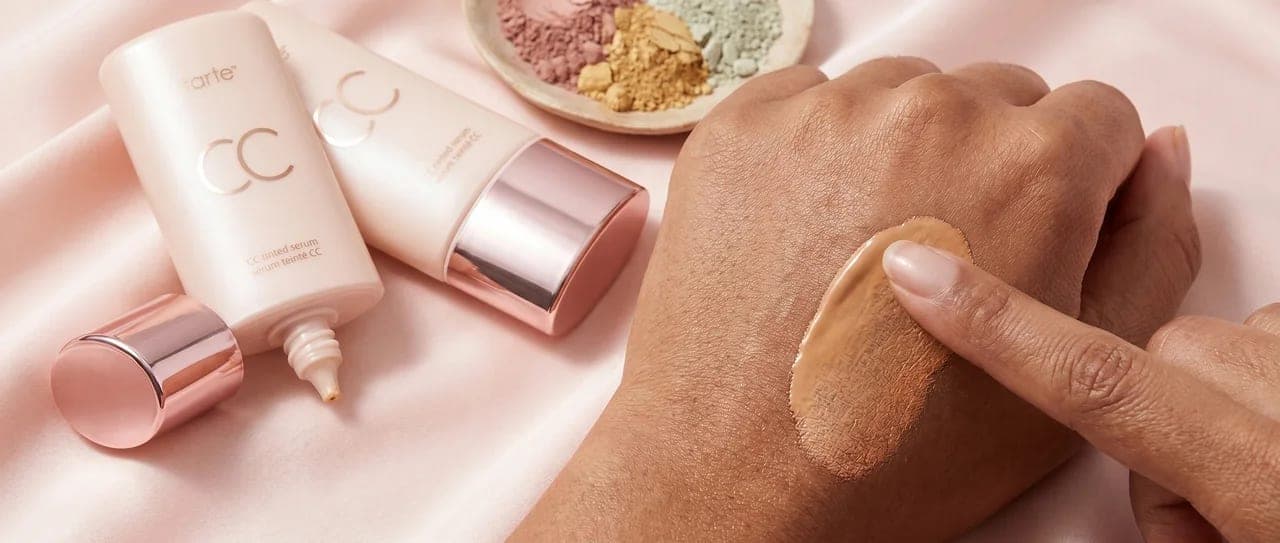
A Six-Shade Range That Claims to Fit Every Skin Tone
Tarte Cosmetics has introduced a new complexion product set to reshape the tinted serum category. CC Color-Correcting Tinted Serum is, according to the beauty brand, "unlike anything you have tried before," offering buildable light-to-medium coverage through a skin care-first formulation. The star of the product is the inclusion of encapsulated pigments through the brand's "adaptisphere" technology, which sees the pigments adapt as they are blended into the skin — allowing shades to flex across a range of skin tones despite the product launching with only six shades in its range.
Tarte claims that 100% of users said it adapts to their skin tone and is a "perfect shade match." For Indian colour cosmetics formulators and product developers, this launch deserves close technical attention because it represents a credible attempt to solve one of the category's most persistent and expensive problems — building an adequately inclusive shade range — through formulation chemistry rather than simply expanding the number of SKUs.
The Encapsulation Mechanism Behind "Adaptisphere"
CC Color-Correcting Tinted Serum is powered by encapsulated smart pigments that burst and adapt as you blend, with the pigments adjusting to complement the wearer's skin tone to create a seamless match. The concept relies on a serum-weight formula with encapsulated pigments that literally adapt to the wearer's skin tone as it is blended, described by the brand as a deliberately distinct concept from both conventional foundation and skin tint formats.
From a formulation chemistry perspective, this mechanism almost certainly relies on a microencapsulation system containing differentiated pigment payloads that are released progressively as the encapsulating shell ruptures under the mechanical shear and pressure of finger-applied blending. Tarte Cosmetics specifically recommends the product be blended into skin with fingers rather than brushes or tools, noting that this method is "what activates the smart pigments for your perfect match" — confirming that the application technique itself is a deliberate, specified part of the formulation's functional design, not a generic usage suggestion.
For Indian formulators, this is the critical technical takeaway: encapsulation-based adaptive technology requires the application method to be engineered as part of the product specification, not left to consumer discretion. A formulation relying on shear-activated pigment release must be developed alongside explicit, tested usage instructions, and brand communication must reinforce the correct application technique consistently, since incorrect application (using a brush instead of fingers, for example) may fail to activate the intended adaptive mechanism.
The Five-Clay Colour Correction System
Colour correction in the formula comes from Tarte's Smart Clay Complex, which uses five Amazonia coloured clays to perfect skin: rose clay evens out skin tone, gold clay brightens, light green clay balances, with the addition of red and white clays to nourish and soften skin respectively. This multi-clay system functions as a parallel colour-correction mechanism operating alongside the adaptive pigment encapsulation technology — addressing tone, brightness, and balance through complementary colour theory (green to counteract redness, for instance) rather than relying solely on the adaptive pigments for correction.
This dual-mechanism approach — encapsulated adaptive pigments for shade matching, plus a multi-clay complementary colour system for correction — is a useful formulation architecture for Indian developers to study. Rather than relying on a single sophisticated technology to solve both shade-matching and colour-correction simultaneously, Tarte's formula separates the two functions into distinct, independently-engineered systems that work in combination.
The Active Ingredient Stack
Beyond the colour technology, the formula is loaded with established skincare actives: niacinamide to help brighten and minimise the appearance of pores, caffeine for energising and de-puffing effects, plumping peptides, and maracuja (passionfruit) oil. This formula is hydrating, weightless, and waterproof, available across a shade range from Light to Espresso.
For Indian formulators, this active stack is entirely accessible domestically — niacinamide, caffeine, and peptide actives are well-established in Indian cosmetic formulation, and maracuja oil is sourceable through established botanical oil suppliers. The formulation lesson is less about ingredient novelty and more about integration discipline: combining a sophisticated colour-technology system with a credible, evidence-based active stack within a single lightweight, serum-weight base requires careful emulsion and stability engineering to ensure neither the colour technology nor the active ingredients compromise the other's performance.
The Shade-Range Reduction Opportunity for India
The most commercially significant implication of this technology for Indian colour cosmetics manufacturers is the potential to reduce the shade-range complexity required to serve India's exceptionally diverse skin tone spectrum without sacrificing genuine inclusivity. India's population spans an unusually wide range of skin tones across regions, and Indian colour cosmetics brands have historically faced a difficult commercial choice between expensive, complex 20-40 shade ranges (with corresponding inventory, manufacturing, and retail shelf-space costs) or inadequate, narrow ranges that fail meaningful portions of the consumer base.
Adaptive pigment technology, if genuinely effective, offers a third path: a smaller, more commercially manageable shade range (Tarte's six shades) that adapts within each shade to accommodate tonal variation, rather than requiring a discrete SKU for every tonal increment. For Indian colour cosmetics brands evaluating shade-range strategy, this technology category — whether licensed, developed independently, or sourced through ingredient suppliers offering comparable encapsulation systems — deserves serious formulation R&D evaluation given India's specific shade-inclusivity challenge and cost pressures.
What Indian Formulators and Brand Teams Should Do Now
Evaluate microencapsulation suppliers offering comparable adaptive pigment or shear-activated release technology. Several global ingredient and technology suppliers offer microencapsulation platforms; Indian formulators should assess whether comparable shade-adaptive systems are accessible for domestic formulation development, potentially reducing the shade-range cost burden that currently constrains many Indian colour cosmetics brands.
Build application-technique specification into the product development process for any encapsulation-dependent formula. If pursuing comparable adaptive technology, specify and validate the exact application method (finger-blending, specific pressure, timing) required to activate the encapsulation mechanism, and ensure consumer-facing instructions reinforce this consistently rather than leaving technique to consumer interpretation.
Consider separating shade-adaptation and colour-correction into distinct formulation systems, as Tarte has done. Rather than over-engineering a single mechanism to solve multiple colour challenges simultaneously, evaluate whether a combination of simpler, independently-validated systems (an adaptive pigment base plus a complementary-colour clay or pigment complex) produces a more robust and commercially achievable result.
Treat shade-range reduction through adaptive technology as a genuine commercial opportunity for the Indian market specifically, given India's combination of exceptional skin tone diversity and cost-sensitive shade-range economics — a market context where adaptive technology's commercial case may be even stronger than in markets with narrower tonal ranges.
Tarte's CC Color-Correcting Tinted Serum demonstrates that encapsulation-based adaptive colour technology has moved from concept to commercially validated, consumer-tested product. For Indian colour cosmetics formulators navigating the cost and complexity of serving India's genuinely diverse skin tone spectrum, this technology category deserves serious evaluation as a credible alternative to continuously expanding shade ranges.