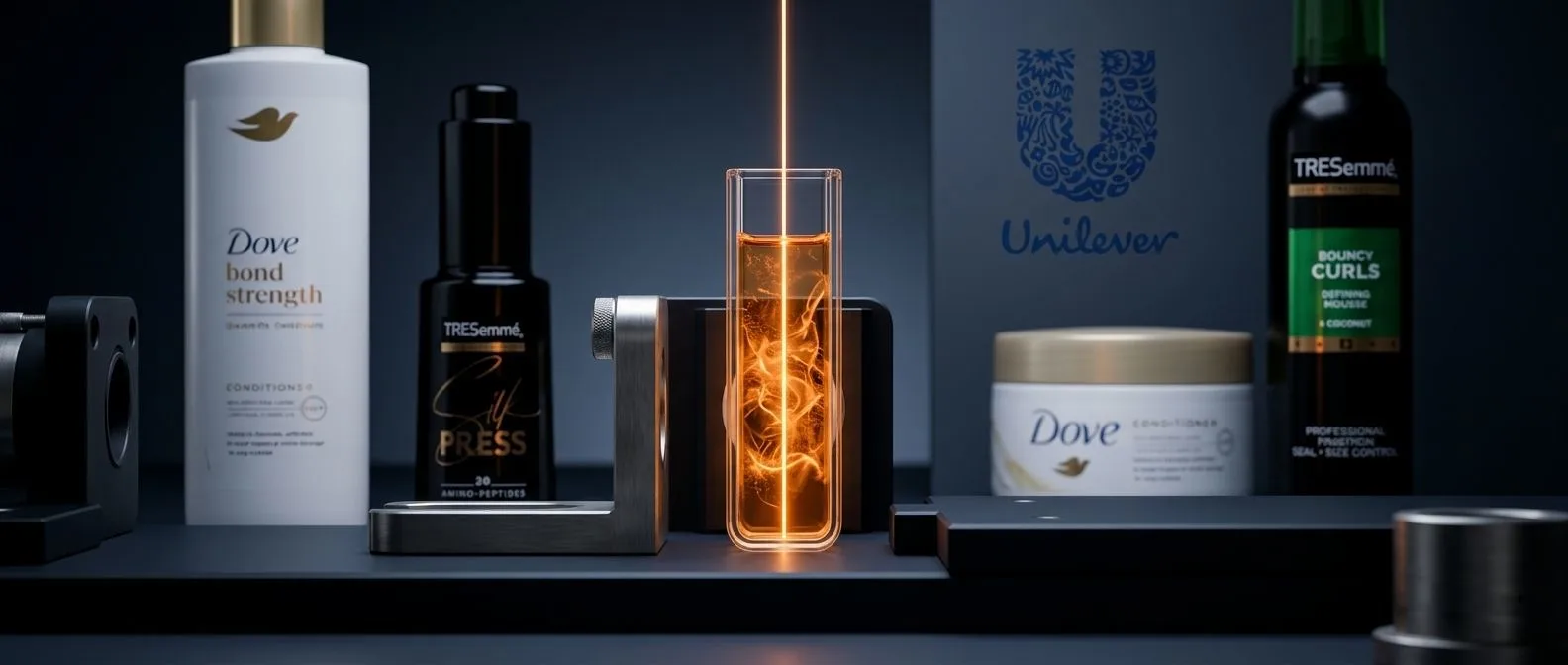
Unilever R&D’s recent quantification of ultraviolet (UV)-induced protein loss highlights a clear formulation challenge: ambient solar radiation degrades cortical keratin at four times the rate of high-temperature thermal styling tools. While the Indian hair care market historically focused on heat protectants and heavy post-damage oils, ambient UVA and UVB exposure drives continuous, irreversible structural breakdown within the hair fiber.
UV exposure drives reactive oxygen species (ROS) formation directly inside the cuticle and cortex. This photolytic stress cleaves vital disulfide bonds and oxidizes critical amino acid residues—specifically tryptophan and cysteine. The resulting structural decay shows up as split ends, reduced tensile strength, elevated porosity, and accelerated color fading. To halt this degradation pathway, Unilever R&D engineered a dual-active Hair Protection Factor (HPF) complex pairing ferulic acid with citric acid.
Dual-Action Photoprotective Mechanism
The complex interrupts oxidative degradation through two distinct chemical pathways within the hair shaft:
#### 1. Radical Scavenging via Ferulic Acid
As a potent phenolic antioxidant, ferulic acid quenches free radicals generated by ambient UV exposure. It donates an electron from its phenolic hydroxyl group to neutralize ROS before they attack cortical proteins. Resonance delocalization across its conjugated aromatic ring system stabilizes the resulting ferulate radical, terminating lipid and protein oxidation cascades without generating secondary reactive species.
#### 2. Transition Metal Chelation via Citric Acid
Ambient solar radiation accelerates keratin breakdown when trace catalytic transition metals accumulate on hair from hard water washing and urban dust. Citric acid functions as a sequestering agent that chelates multivalent cations—specifically ferrous (Fe2+) and copper (Cu2+) ions. By binding these metals, citric acid suppresses Fenton-reaction generation of hyper-reactive hydroxyl radicals at the fiber surface.
Together, this synergistic blend establishes a measurable Hair Protection Factor (HPF), preserving internal tensile strength and curbing protein leaching under solar radiation.
Regulatory Landscape: CDSCO and BIS Alignment
For Indian brand owners and contract development and manufacturing organizations (CDMOs), deploying this complex requires precise regulatory positioning:
Classification & Standards: Formulations combining citric and ferulic acid fall under the Drugs and Cosmetics Rules, 2020. Both raw materials hold non-restricted cosmetic status under Bureau of Indian Standards (BIS) specifications, conforming to IS 14649 and IS 7123 requirements.
Claim Validation Requirements: Supporting claims like "Hair Protection Factor (HPF)," "UV Shield," or "Photolytic Defense" under ASCI codes and CDSCO oversight requires non-clinical endpoint substantiation.
Analytical Testing Protocols: Hair photoprotection requires specialized quantitative assays rather than standard skin SPF protocols:
*FTIR Spectroscopy:* Measures cysteic acid formation to quantify disulfide bond preservation.
*Protein Leaching Assays:* Tracks soluble protein fragments washed out of hair tresses following controlled UV irradiation.
Commercial Scalability and Formulation Dynamics
Replacing heavy, oil-soluble synthetic UV filters with an aqueous citric-ferulic system offers concrete formulation advantages for high-volume production across Indian CDMO manufacturing networks:
Cold-Process Compatibility: Water and glycol solubility allows formulators to integrate the complex directly into cold-processed leave-in mists, daily hair serums, and scalp tonics without energy-intensive heat cycles.
Cost-per-Dose Optimization: The system delivers measurable photo-defense at low active inclusion rates, avoiding the supply chain costs and emulsion stability risks associated with oil-soluble organic UV absorbers.
Aesthetic Superiority: Operating within a clear, pH-stable aqueous phase, the complex preserves formula viscosity and leaves no greasy residue, enabling clean-label positioning across high-frequency leave-on formats.