VivaTech 2026: Beauty's Shift to Agentic AI Explained
VivaTech 2026, held in Paris this June, marked a specific inflection point for the beauty industry's relationship with artificial intelligence. The announcements from L'Oréal and LVMH at this year's event were not conceptual roadmaps — they were live deployments, confirmed partnerships, and functioning products. The central theme was the transition from generative AI (creating content and responses) to agentic AI (autonomous systems that execute multi-step tasks without human intermediation). For brand owners, R&D heads, and beauty product manufacturers who have been watching AI from a distance, VivaTech 2026 is the event that closes that option.
L'Oréal's "Beauty Odyssey" and the OpenAI Partnership
Marking its tenth anniversary at VivaTech, L'Oréal unveiled what it is calling its "Beauty Odyssey" strategy — a systematic integration of AI across consumer experience, R&D acceleration, and brand discovery. The centrepiece was a confirmed, operational partnership with OpenAI, positioning the group as one of the first beauty conglomerates to embed foundation model technology at enterprise scale across its portfolio.
The consumer-facing implications are already live. ModiFace — L'Oréal's augmented reality try-on technology — has been integrated directly into ChatGPT, enabling users to perform virtual makeup try-ons through conversational interaction. Under the Maybelline New York brand, users can experiment with colour products within the chat interface without leaving the AI environment. This is not an add-on feature; it is an early implementation of what L'Oréal explicitly describes as agentic commerce — where AI agents manage the entire consumer journey from discovery through to purchase, without requiring the consumer to navigate to a brand site or retail platform.
The strategic logic is direct: if LLMs are becoming the primary research interface for beauty consumers — and usage data suggests they are displacing both search engines and social media for discovery in certain demographics — then being present and authoritative within that interface is a distribution question, not merely a marketing one. L'Oréal is addressing this through Generative Engine Optimisation (GEO), ensuring that brands including Lancôme and Kérastase are surfaced accurately and prominently in AI-driven search results. For brands not yet thinking about GEO, the structural risk is being invisible in the channel that is growing fastest.
GPT-Rosalind and the Acceleration of R&D
The most technically significant announcement for R&D professionals was GPT-Rosalind — an AI model developed in partnership with OpenAI's life sciences reasoning capabilities to map the skin microbiome and accelerate ingredient and product discovery. The initial deployment is under La Roche-Posay, one of L'Oréal's highest-credibility dermatological brands. The model's function is to process and pattern-match across complex biological datasets — microbiome composition, skin condition correlations, formulation efficacy data — at a speed and scale that conventional research pipelines cannot approach.
This matters for manufacturers beyond the L'Oréal ecosystem because it establishes a new competitive benchmark for what "evidence-based" means in dermatological and microbiome-adjacent skincare. When a leading brand's ingredient claims are underwritten by AI-assisted microbiome mapping, the evidence standard against which competing claims are evaluated shifts upward.
L'Oréal has also confirmed the use of in-silico prediction for formulation development, in partnership with NVIDIA and IBM. Rather than physically testing the billions of potential formulation combinations that any new product development brief implies, custom AI models predict performance properties — texture, stability, efficacy, sensoriality — from the formulation architecture. This compresses development timelines and reduces the cost of discovery, particularly for sustainable raw material alternatives where physical testing programmes are resource-intensive.
The Hair Digital Twin technology is a parallel application of the same logic: a virtual modelling environment that predicts how new active ingredients will behave on a range of hair types, reducing the need for extensive in-salon or in-lab testing rounds before advancing to clinical study.
Lancôme Cell BioPrint: Biomarker Diagnostics at Retail
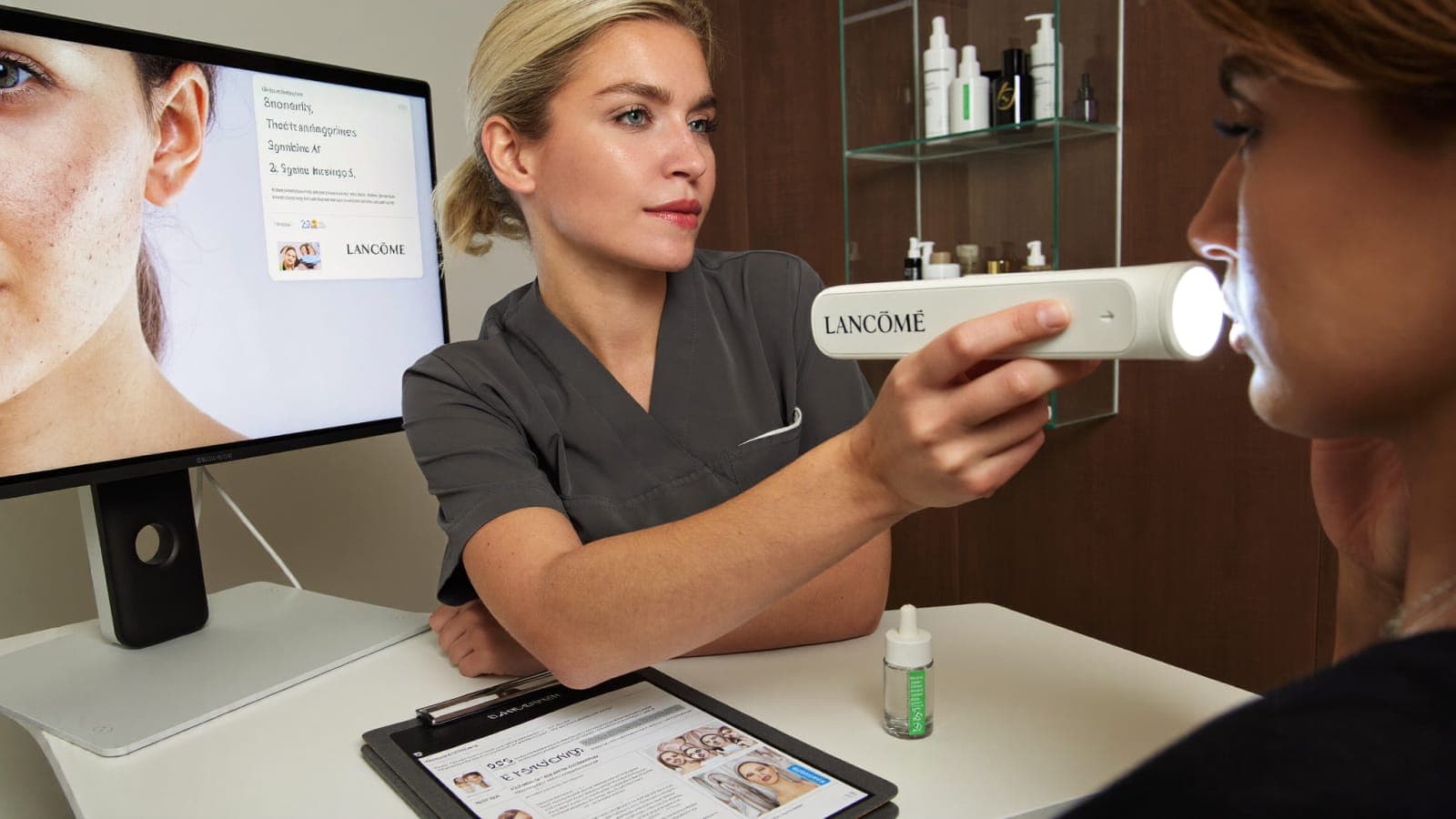
Lancôme's Cell BioPrint device represents a distinct category of innovation — consumer-facing diagnostic technology using lab-on-a-chip principles to analyse skin surface biomarkers in a retail or clinic setting. The device estimates biological skin age — distinct from chronological age — and generates a personalised skincare routine recommendation based on the biomarker profile of the individual consumer.
The commercial implication is twofold. First, it shifts the skincare consultation from a subjective, advisor-led interaction to an objective, biomarker-grounded one. Second, it creates a data relationship between the brand and the consumer that persists through the routine recommendation — a mechanism for repeat engagement that is structurally more durable than loyalty programmes or promotional offers.
For manufacturers supplying to premium and dermatological skin care brands, the Cell BioPrint model signals that diagnostic hardware integration is becoming a brand differentiator in premium retail. Formulations that are developed with specific biomarker targets in mind — rather than general efficacy categories — become the natural companion product to diagnostic devices.
LVMH: Sephora's Conversational Commerce and Dior's Agentic Appointments
LVMH's DreamGallery at VivaTech showcased 12 AI projects from 11 Maisons. The most commercially immediate was Sephora's conversational commerce integration, embedding the retailer's product catalogue and purchase functionality directly into LLM interfaces including ChatGPT and Gemini. The mechanism is straightforward: a user types "Add Sephora" within a conversational AI interface and receives product recommendations, reviews, and a checkout pathway without leaving the chat environment.
Dior demonstrated an AI agent for personalised in-store appointment booking, while Céline introduced an internal AI assistant ("Maya") to support retail staff with expert product knowledge in real time. Together, these deployments illustrate that agentic AI in beauty is being applied simultaneously at the consumer touchpoint, in-store operations, and in the manufacturing and formulation pipeline — not as three separate technology programmes but as a unified infrastructure investment.
What Manufacturers and Brand Teams Should Prioritise
The distance between what was demonstrated at VivaTech 2026 and what most beauty manufacturers and emerging brands have deployed is significant. The strategic priorities that follow from this gap are specific:
- Audit your AI discovery presence now. If your brand cannot be accurately described, recommended, or purchased through a major LLM interface, you are not present in the channel that is absorbing beauty research intent. Begin a GEO programme — understand how your brand and products are represented in ChatGPT, Gemini, and Perplexity responses, and invest in structured data and authoritative content that improves that representation.
- Commission in-silico capability assessment. For manufacturers with active R&D pipelines, identify where computational prediction — formulation modelling, ingredient compatibility screening, sensory prediction — can reduce physical testing rounds without compromising data quality.
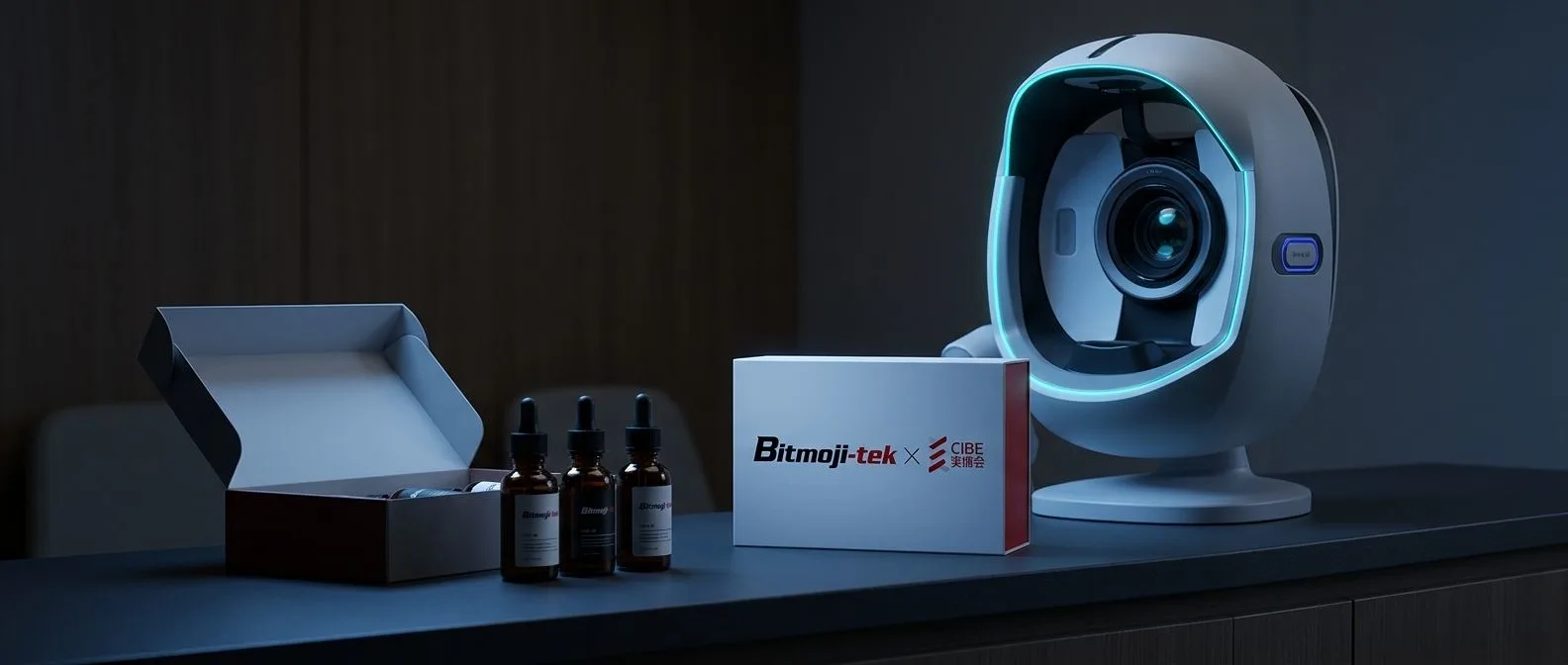
- Brief diagnostics into your consumer journey. Cell BioPrint and K-Scan are category-level signals. The question for brand teams is whether your consumer engagement model includes any objective diagnostic touchpoint, and if not, what the minimum viable equivalent is — whether AI skin analysis via app, selfie-based diagnostic tools, or clinical partnership programmes.
- Develop a GLP-1 and microbiome ingredient narrative. GPT-Rosalind is being deployed for microbiome mapping starting with La Roche-Posay. If your brand operates in the dermatological or microbiome-adjacent skincare space, your ingredient claims need to be defensible against the emerging evidence standard that AI-assisted science will set.
VivaTech 2026 did not preview the future of beauty AI — it confirmed its present. The response window for brands and manufacturers is narrower than most current planning cycles assume.