A Familiar Claim, an Unfamiliar Level of Scrutiny
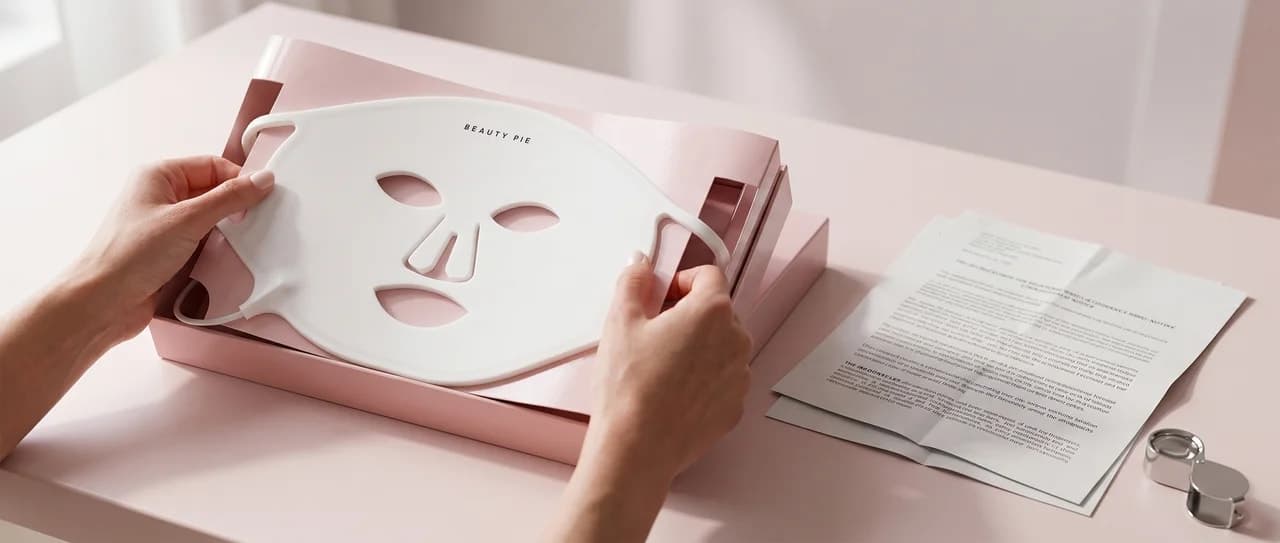
The UK's Advertising Standards Authority (ASA) has banned a poster by Beauty Pie for misleading claims when marketing the C-Wave Light Facial LED mask. The advert, promoted within London's Underground transport network on 17 December 2025, featured an individual wearing the LED mask alongside the headline text: "Skin tech that's light years ahead […] C-Wave Facial LED treatment mask […] clinically proven to reduce wrinkles in 4 weeks." Smaller text towards the bottom of the poster read: "Results from a 4-week study of 28 people aged 30-65."
For Indian beauty device manufacturers, brand owners, and regulatory managers, the specific reasoning behind this ban is more instructive than the headline outcome. The ASA's ruling, published on 10 June 2026, identifies precise evidentiary gaps that frequently appear in beauty device and skincare clinical substantiation worldwide — including in claims made by Indian brands marketing comparable devices and actives domestically.
The Specific Study Design Failures the ASA Identified
Beauty Pie provided two product-specific clinical studies on the C-Wave device (also referred to in the ruling as the FaceLITE device), alongside six additional peer-reviewed studies on what it considered equivalent LED technology. According to the company, after four weeks, 92% of testers either agreed or strongly agreed with the statement that their "fine lines appear less visible" — a result the company characterised as showing "a significant reduction in wrinkles."
The ASA's rejection of this evidence rested on several specific, identifiable methodological weaknesses, each directly relevant to how Indian device and cosmetic brands should structure their own clinical claim substantiation.
Sample size was deemed insufficient. The ASA said this was a "relatively small" sample size for the strength of claim being made — 28 participants is a common scale for early-stage cosmetic device testing, but the ASA's ruling confirms this is inadequate to support a definitive "clinically proven" claim communicated to a mass consumer audience.
No placebo or control group was used. The ASA said the way the testing was conducted "was a significant limitation" as there was no placebo group. Without a control arm, the study cannot distinguish genuine device efficacy from natural skin variation, expectation bias, or the effect of any co-administered products.
Confounding co-products undermined attribution to the device alone. The ASA noted in its ruling that testers were asked to use an exfoliating product and a hydrogel, neither of which are sold with the mask. The product listing on Beauty Pie's website says the mask should be used "on a clean, dry face" — directly contradicting the test protocol. The ASA concluded the reported improvements in the appearance of wrinkles could not be attributed to the mask alone.
Supplementary studies on "equivalent" technology were rejected as insufficiently comparable. The regulator also determined that the supplementary studies examined different devices, treatment protocols, and usage conditions, making them insufficient to support claims about the advertised product specifically. This is a critical lesson: citing published literature on a broadly similar technology category does not substitute for product-specific substantiation.
The Regulatory Classification Detail Worth Noting
Beauty Pie told the ASA that the mask was marketed exclusively for cosmetic purposes and was therefore not required to carry a UKCA medical device conformity marking. This classification detail is directly relevant for Indian device manufacturers: a product marketed for cosmetic, non-therapeutic purposes faces different regulatory obligations than one classified as a medical device — but, as this ruling demonstrates, that distinction does not exempt the product from rigorous evidentiary standards when "clinically proven" language is used in advertising.
The ruling does not ban Beauty Pie's LED mask from sale; it specifically prohibits the unsubstantiated "clinically proven to reduce wrinkles in 4 weeks" claim in future advertising unless adequate evidence is provided. The ASA told Beauty Pie not to state the C-Wave Facial LED treatment mask was "clinically proven to reduce wrinkles in 4 weeks" unless they held adequate substantiation to support the claim.
Why This Matters Beyond the UK
This ruling sits within a broader pattern of intensifying advertising regulatory scrutiny on clinical-sounding skincare and beauty device claims. The same UK regulator has separately ruled against L'Oréal's Garnier over misleading hyperpigmentation claims, banned a Sanex advert for suggesting "white skin superior to black skin," and clamped down on Boots TV adverts for "flippant" sun safety remarks — confirming the ASA is applying heightened scrutiny across the cosmetics advertising category broadly, not isolating LED devices specifically.
LED technology is commonly used in medical settings to treat eczema, acne, psoriasis, and sun damage, but at-home LED devices are becoming increasingly popular, with the at-home LED market projected to reach £600 million globally by 2032. Dermatologists have told the BBC there have not been clinical trials with large enough sample sizes to fully validate at-home LED device claims at the scale many brands currently advertise — a structural evidentiary gap across the entire at-home LED device category, not unique to Beauty Pie.
The Direct Relevance for Indian Beauty Device and Skincare Brands
India's beauty device market — covered extensively in recent industry coverage of LED masks, microcurrent tools, and at-home aesthetic devices — is scaling rapidly, and Indian brands making efficacy claims face comparable scrutiny risk under domestic advertising standards.
ASCI (Advertising Standards Council of India) applies broadly comparable evidentiary principles to cosmetic and beauty device claims, requiring that "clinically proven" or comparable scientific language be backed by adequate, product-specific substantiation. Indian brands using such language without rigorous, controlled clinical evidence carry equivalent regulatory and reputational exposure to what Beauty Pie now faces.
The specific evidentiary gaps identified in this ruling — small sample size, no control group, confounding co-products, non-equivalent supplementary studies — are a practical checklist Indian beauty device and skincare brands should apply to their own current clinical claim documentation before any advertising campaign using "clinically proven" or similar language goes live.
What Indian Beauty Device and Skincare Brands Should Do Now
Audit current "clinically proven" or comparable claims against this specific evidentiary checklist. For any product currently marketed with definitive efficacy language, verify the underlying study used an adequate sample size, included a genuine placebo or control group, tested the product in isolation (without confounding co-products contrary to actual use instructions), and used product-specific rather than category-equivalent data.
Ensure test protocols match actual product use instructions exactly. Beauty Pie's downfall partly stemmed from testing the device alongside an exfoliant and hydrogel that contradicted its own "use on a clean, dry face" instructions. Indian brands should verify their clinical test protocols precisely mirror the instructions communicated to consumers, with no unstated co-product use during testing.
Distinguish cosmetic-purpose classification from advertising evidentiary obligations. A product correctly classified as cosmetic rather than medical device under CDSCO or comparable frameworks is not thereby exempt from rigorous substantiation requirements when making "clinically proven" or equivalent claims in marketing.
Treat ASCI scrutiny on beauty device and skincare claims as an active, current risk, not a hypothetical one. As India's beauty device market scales and consumer ingredient and claims literacy rises, Indian regulatory bodies are likely to apply increasing scrutiny to exactly this category of efficacy claim — brands should get ahead of this by strengthening substantiation now rather than after a complaint triggers review.