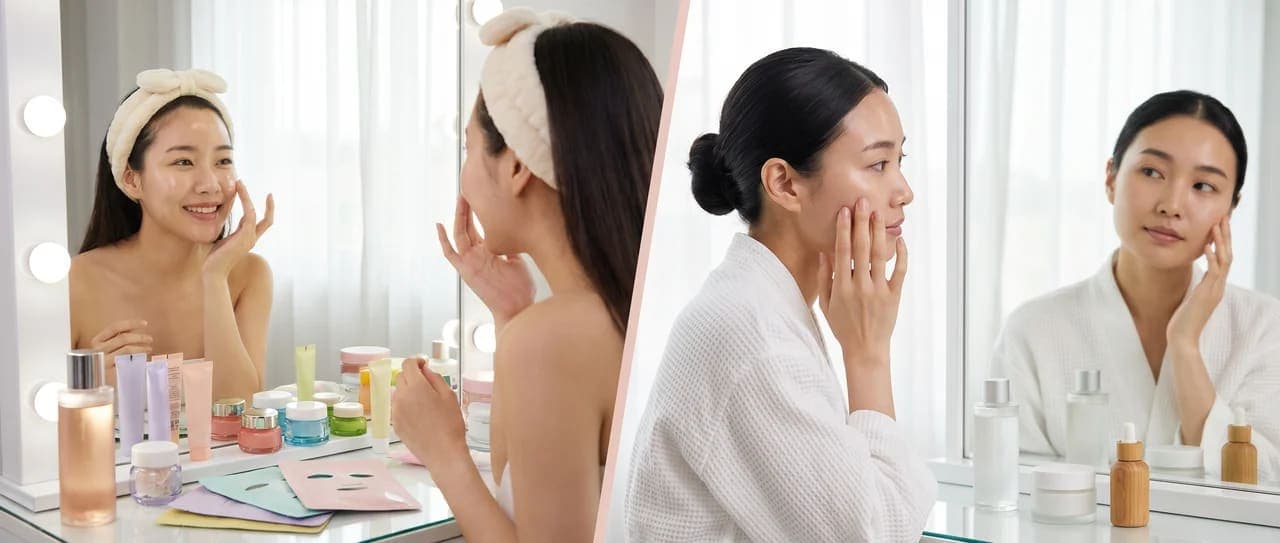
The Quiet Pivot: Why J-Beauty Is Gaining Ground as K-Beauty Plateaus
For nearly a decade, K-beauty dominated the premium and masstige skincare conversation globally — and in India, it shaped consumer expectations around routine length, sensory novelty, and ingredient transparency. That dominance is now softening. J-beauty — built on restraint, fermentation science, and a heritage-led narrative — is increasingly the reference point for premium brand teams and formulators rethinking their pipelines.
In India specifically, this is not a wholesale replacement but a measurable repositioning. Nykaa, Tira, and Sephora India have all expanded their J-beauty assortments through 2025 and into 2026. SK-II, Hada Labo, Shiseido, DHC, and Tatcha have visibly stronger shelf presence. The Indian premium consumer's appetite for ten-step routines has flattened — and her interest in fewer, scientifically denser products has grown.
What the Global Shift Actually Reflects
Globally, the K-to-J shift correlates with three converging consumer behaviours: routine fatigue, a preference for clinical credibility over novelty, and a renewed interest in heritage and craftsmanship as quality signals. J-beauty addresses all three. Its formulation philosophy prioritises a smaller number of well-substantiated actives, often built on decades of in-house research at Japanese conglomerates like Shiseido, Kao, and Kosé.
The technical advantage J-beauty carries is significant. Japan's biotechnology investment in cosmetic fermentation, anti-pollution actives, and next-generation UV filters has consistently outpaced K-beauty's faster but shorter-cycle innovation. For formulators, this translates to ingredients with deeper clinical dossiers and a longer functional shelf life in product roadmaps.
Hero Actives Worth Building Into Indian Formulation Briefs
Fermentation-Derived Actives
The most identifiable J-beauty signature is fermentation. Galactomyces ferment filtrate — popularised through SK-II's Pitera — contains amino acids, organic acids, vitamins, and minerals, and has supporting data for barrier function, radiance, and pore appearance. Typical use levels run between 5% and 95% of the formulation depending on positioning, with most premium products using it at 30–80% as an essence base.
Bifida ferment lysate, rice ferment filtrate (sake kasu extract), and kojic acid (a tyrosinase inhibitor derived from rice koji) are also core to the category. Kojic acid is used at 0.5–2% for brightening applications and is permissible under Indian cosmetic regulations, though formulators should monitor stability — it oxidises readily and benefits from pairing with antioxidants like ferulic acid.
Botanical Heritage Actives
Camellia japonica seed oil (Tsubaki oil), green tea catechins, yuzu extract, and hatomugi (Adlay/Job's tears) extract form the botanical signature of J-beauty. Hatomugi in particular — at use levels of 1–5% — has emerging data for sebum regulation and gentle exfoliation through its coixenolide content. Camellia oil at 2–10% delivers oleic acid-rich emolliency without the comedogenic risk of heavier oils.
Pearl, Rice Bran, and Squalane
Hydrolysed pearl extract, rice bran oil, and Japanese-sourced olive squalane complete the typical J-beauty ingredient stack. Squalane is widely available in India through specialty distributors and is regulatory-clean under BIS and CDSCO frameworks. Rice bran derivatives have additional appeal for Indian formulators given local supply availability.
The Technology Layer: Why J-Beauty's Edge Is Substantive
The formulation difference between J-beauty and K-beauty is not aesthetic alone. Japan's regulatory framework allows several UV filters — including Uvinul A Plus, Tinosorb S, and Uvinul T 150 — that are restricted or unapproved in the US. India's CDSCO framework permits a broader UV filter palette than the FDA, which makes Japanese-style broad-spectrum, high-PA rated sunscreens technically viable for Indian formulation. Brands like Anessa and Biore UV have built category leadership on this technical superiority.
Encapsulation technology is another differentiator. Japanese suppliers — particularly Nikko Chemicals, Nikkol Group, and Nippon Fine Chemical — produce some of the most refined liposomal, niosomal, and polymer-encapsulated delivery systems available. These are accessible to Indian formulators through Asian distributor networks and can elevate finished product performance without changing the active itself.
Mochi skin texture finishing, water-light essences, and layering science with smaller molecular-weight humectants are formulation hallmarks Indian R&D teams can study and adapt directly.
The Marketing Architecture: Quiet Luxury Replaces Maximalism
J-beauty's brand language is structurally different from K-beauty's. Where K-beauty leans into colour, packaging novelty, and viral hero products, J-beauty positions around omotenashi (hospitality), monozukuri (craftsmanship), and wabi-sabi (refined imperfection). This translates commercially into neutral palettes, single-product hero builds, founder or heritage storytelling, and decades-long ingredient narratives.
For Indian premium brands, this marketing template is in many ways more aligned with the cultural inclination toward heritage, ritual, and considered consumption than K-beauty's faster trend cycles. Brands like Forest Essentials and Kama Ayurveda already operate within an adjacent storytelling tradition. The J-beauty marketing approach offers Indian dermo-cosmetic and clean luxury brands a coherent template — heritage-led but scientifically substantiated — that the Indian consumer is increasingly receptive to.
The Indian Sourcing and Regulatory Reality
Most J-beauty hero actives — Galactomyces ferment filtrate, Bifida ferment lysate, kojic acid, hatomugi extract, camellia oil — are accessible to Indian formulators through established specialty ingredient distributors. Lead times from Japanese suppliers typically run 8–12 weeks, though Indian or Korean-sourced equivalents of fermentation actives can shorten this materially.
Under the Drugs and Cosmetics Act, 1940 and BIS IS 4707, all the major J-beauty active categories are permissible. Sunscreens carrying Japanese-style high PA ratings (PA++++) require BIS-aligned UV filter labelling and SPF substantiation through in vivo testing — formulators planning this category should engage with accredited testing partners early.
Where Indian Brand Teams Should Act
The opportunity is not to clone J-beauty but to extract what works for the Indian premium consumer: fewer steps, denser actives, longer ingredient stories. R&D teams can begin by introducing a fermentation-derived essence into existing skincare lines as a single SKU pilot. Brand teams can test heritage-led storytelling structures in their next product launch narrative. Sunscreen-focused brands have the clearest near-term opportunity given India's UV exposure profile and the regulatory headroom for advanced filters.
The K-to-J shift in India will not be sudden. But the brands that align their formulation, packaging, and storytelling with this evolution through 2026 will be better positioned in the premium segment than those that continue to optimise around a K-beauty playbook that the market is already moving past.