L'Oréal's Mass Beauty Pivot: What Brand Leaders Must Learn
L'Oréal's Consumer Products Division (CPD) — the group's largest division and home to L'Oréal Paris, Garnier, Maybelline New York, and NYX Professional Makeup — has been consistently outperforming the global mass beauty market in 2025–26. This is not a coincidence. It is the result of deliberate strategic choices that are instructive for any brand operating in the mass or masstige segment, whether at the scale of a multinational or a growing domestic challenger.
Understanding what L'Oréal has changed, and why, is more useful than simply noting that it is winning.
The Mass Market Has Changed Faster Than Most Brands Have Noticed
The mass beauty consumer of 2026 is not the same archetype brands built their portfolios around five years ago. She researches ingredients, follows clinical content creators, compares efficacy claims across categories, and holds mass products to rising evidence standards once reserved for dermatologist-recommended brands. The "good enough for the price" proposition no longer reliably closes a purchase.
L'Oréal's CPD read this shift early. The division's strategic response has been built on three interconnected pillars: premiumisation of the mass offer, simplification of marketing messaging, and technology-enabled personalisation at scale. Each of these has direct implications for how competing brands — and aspiring ones — should be structured.
Bringing Prestige Science to Mass Price Points
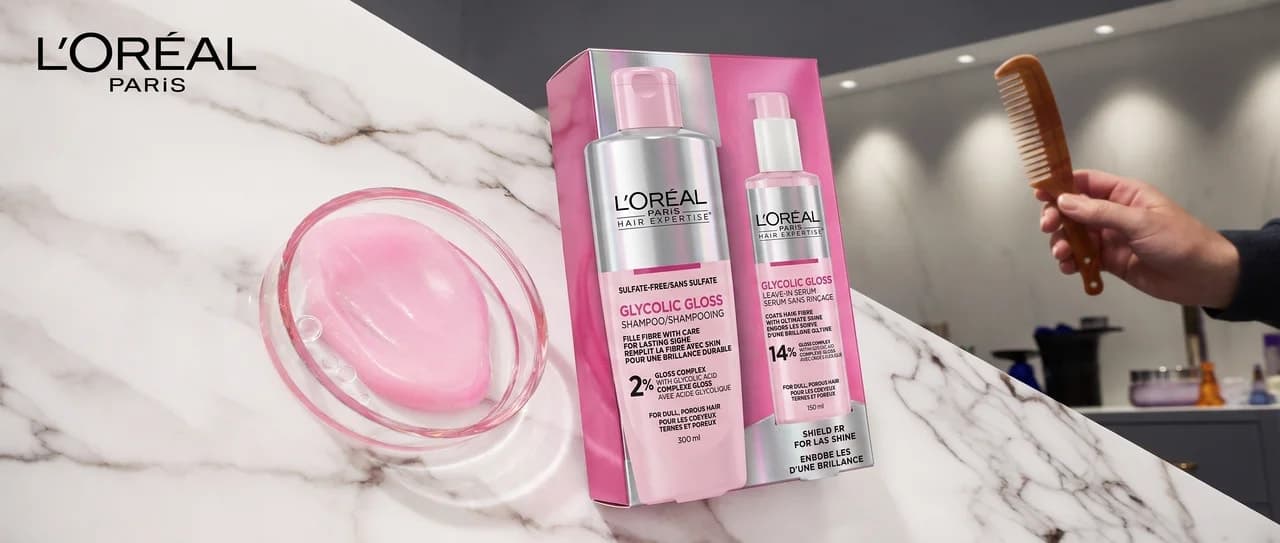
The CPD's most consequential strategic move has been the systematic transfer of high-performance ingredients and formulation technology from the group's prestige and dermatological divisions down into its mass portfolio. Glycolic acid haircare (L'Oréal Paris Glycolic Gloss), advanced skincare efficacy claims, and clinical-quality haircare performance are now appearing in products priced for drugstore shelves.
This accessible innovation model requires genuine R&D infrastructure — not label claims alone. For brand leaders, the implication is that "premiumisation" cannot be delivered through packaging upgrades and aspirational advertising. It requires actual formulation investment, meaningful active ingredient percentages, and evidence capable of withstanding consumer scrutiny. Brands that premiumise cosmetically — new bottle, same formula — will not sustain the positioning.
The Dermo-Beauty Halo Effect
L'Oréal's Dermatological Beauty Division, housing La Roche-Posay, CeraVe, and Vichy, has created a wider group-level halo that benefits the CPD. Consumers who trust the group's clinical credentials extend some of that trust to its mass portfolio when the science communication is handled credibly. This inter-divisional credibility transfer is a structural advantage — but it points to a lesson any brand can apply: clinical-adjacent positioning requires clinical-quality substance, not just clinical-sounding language.
Marketing Discipline as Competitive Advantage
One of the less-discussed but more significant elements of L'Oréal CPD's 2026 strategy is what it has removed from its marketing, not just what it has added. Amid what internal teams describe as a "loud" beauty market, the division has moved deliberately toward simpler, proof-led communication — fewer claims, more evidence, clearer consumer education.
This is a notable strategic choice for a division managing multiple global blockbuster brands simultaneously. It reflects an accurate diagnosis of consumer fatigue: beauty consumers are increasingly sceptical of aspirational hyperbole and more responsive to honest, specific, substantiated communication. The brands gaining shelf trust are those that acknowledge consumer pain points directly and explain, with specificity, how their products address them.
For CMOs and brand managers, this is a calibration challenge. The instinct in competitive markets is to add — more claims, more variants, more channels, more content. L'Oréal's CPD is demonstrating that the discipline to subtract — to clarify rather than amplify — is increasingly where brand equity is built.
AI Personalisation: Infrastructure, Not a Feature
The division's integration of AI-driven personalisation into mass-market products — including real-time shade matching (Maybelline Fit Me AI), skin diagnostic tools, and digital haircare coaching — represents a structural upgrade to how mass beauty is experienced, not a marketing feature. The significance for B2B brand leaders is not the specific tools, but the underlying model: AI is being used to compress the gap between individual consumer need and mass-market product offer.
This matters because the traditional limitation of mass beauty — that it must optimise for the average consumer — is being actively dissolved. A brand that deploys AI well can serve a mass audience with something that *feels* personalised, without the cost structure of true customisation. Brands that do not invest in this infrastructure risk being outcompeted not on product quality, but on consumer experience.
The Universalisation Model and Emerging Market Relevance
L'Oréal's long-standing universalisation strategy — building global brand architectures that local teams can adapt with genuine autonomy — has become more, not less, relevant as emerging markets increase their share of global beauty growth. The CPD has been particularly active in refining its organisational structures and product lineups for SAPMENA-SSA markets (South Asia, Pacific, Middle East, North Africa, Sub-Saharan Africa), recognising that generic global rollouts underperform against locally responsive formulation and communication.
For brand teams in India and other emerging markets, this global-local model is a direct competitor benchmark. It means that the primary international brands entering or deepening their presence in your market are not deploying generic product lines — they are investing in local insight and deploying adapted offers. Competing with that requires a comparable level of consumer and category specificity in your own brand strategy.
What Brand Leaders Should Reassess Now
L'Oréal CPD's strategy offers a set of concrete strategic lenses for any mass or masstige beauty brand:
- Audit your premiumisation evidence. Is the performance difference of your premium-positioned SKUs provable and communicable? If not, reformulate before you reposition.
- Review your messaging architecture for noise. Count the number of claims on your primary communication. If you cannot explain your product's core benefit in one sentence, you have a clarity problem, not a communication problem.
- Map your AI touchpoints. Where in your consumer journey — from discovery to repeat purchase — could personalisation reduce friction or improve conversion? This does not require building proprietary AI; it requires identifying where third-party tools or platform capabilities can be integrated.
- Assess your local specificity. If you are operating in a single market but competing against globalised brands with local adaptation programmes, the question is not whether to localise — it is how deeply your formulation, packaging, and communication reflect genuine local consumer insight.
- Separate portfolio premiumisation from brand premiumisation. Launching a premium line while your core range stagnates is not a strategy — it is a hedge. L'Oréal CPD is premiumising the mass core, not just adding a prestige tier.
The CPD's 2026 performance is a useful reminder that at scale, strategy and execution are inseparable. The choices L'Oréal has made are not inaccessible to smaller brands — many of the underlying principles translate regardless of portfolio size. What matters is the rigour with which they are applied.