A Property Portal Walks Into a Beauty Market
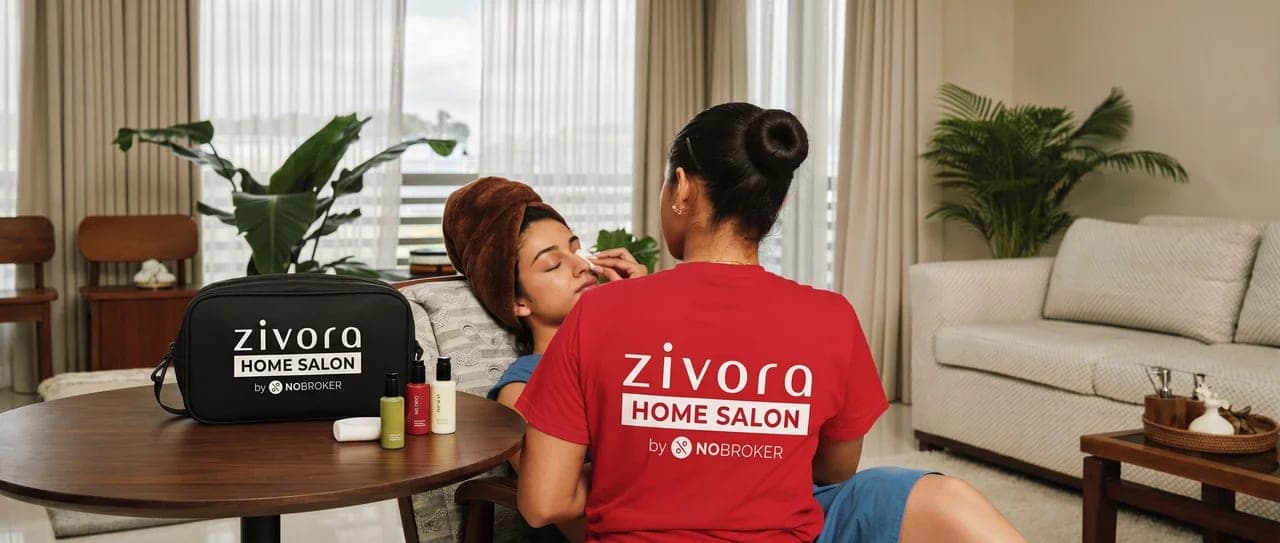
NoBroker.com, India's largest property marketplace and a unicorn valued at over $1 billion, has launched Zivora, an at-home salon and beauty services platform — adding itself to an already crowded and fast-moving competitive field. The move brings NoBroker into direct competition with Urban Company, Snabbit, Yes Madam, and funded challenger DAZZL in a category that has attracted significant venture capital, intense operational experimentation, and growing consumer adoption across India's metros.
On the surface, a property marketplace launching beauty services might seem disconnected. In practice, it follows a clear internal logic: NoBroker has been building a home services division since 2018 — packing and moving, cleaning, painting, plumbing, carpentry, and interior design — serving customers at exactly the moment they most need home-adjacent services. Zivora is the first time NoBroker extends that model from services to homes and appliances into services to people — a meaningful but strategically consistent step for a platform that has already built dense urban home-service infrastructure.
The Competitive Landscape in Sharper Focus
The timing of Zivora's launch positions it within a category that is simultaneously well-funded and structurally unresolved. Each platform in this market is pursuing a different operating logic, and understanding those differences matters for B2B players choosing where to position.
Urban Company remains the category incumbent and most commercially validated business, with a proven model combining structured appointment booking, rated professional networks, and diversified service verticals. UC has already launched InstaHelp as a response to Snabbit's instant-dispatch model and Pronto as a quick-services offering — signals that it is actively defending its position rather than ceding ground.
Snabbit completed 2,000 jobs during its Sarjapur pilot and has built its proposition around 15-30 minute dispatch rather than structured appointments, applying the q-commerce density-clustering model to beauty services. Its Series A round was led by Lightspeed India.
Yes Madam, nine years old and profitable, just closed a ₹50 crore round from Info Edge Growth at a ₹750 crore valuation — representing one of the very few at-home salon businesses in India with demonstrated, sustained profitability rather than a growth-at-cost model.
DAZZL raised a $3.2 million seed round at the start of 2026, adding another well-capitalised challenger to the field.
Each of these companies, when they win customers, creates a managed professional network with an approved product kit. That is where the B2B opportunity for Indian professional beauty product brands sits — and it is intensifying precisely because the number of platforms is growing, not shrinking.
What NoBroker Brings That Others Don't
NoBroker's structural advantage over pure-play beauty services startups is its existing last-mile urban infrastructure. The platform has completed over 15 lakh packing and moving jobs, 10 lakh cleaning sessions, 5 lakh painting jobs, and 30,000+ interior design projects. That operational density — built city-block by city-block across Indian metros — is not replicable by a salon-only startup at equivalent speed or cost.
The specific infrastructure advantage is dispatch logistics: knowing which vendor, technician, or professional is closest to which address at any given time, and routing them efficiently. For at-home beauty services, where professional dispatch time is a critical consumer satisfaction variable, this existing logistical capability is a genuine competitive asset that Zivora inherits on day one — rather than building from scratch as Snabbit and others have had to.
However, providing services to homes and appliances is structurally different from providing services to people. Zivora will need to develop the professional-network management, quality assurance, and consumer trust systems specific to personal beauty services — areas where Urban Company and Yes Madam carry a significant head start.
The B2B Opportunity in a Royal Rumble
The proliferation of competing at-home salon platforms is, from a professional beauty product and BPC supplier perspective, a positive short-term signal — more platforms means more approved-vendor conversations to engage in simultaneously. But the longer-term market structure will almost certainly consolidate toward two or three dominant players.
For Indian professional beauty product brands — wax systems, facial kits, threading consumables, nail products, hair treatment ranges — the critical strategic consideration is which platforms will win, or more precisely, which platform architecture (instant-dispatch versus appointment-led versus home-services-embedded) generates the highest-volume, most consistent professional repeat-usage of a fixed approved kit.
The economics of platform at-home services consistently favour economies of scope — platforms offering multiple service categories (haircare, skincare, nail, body) to the same acquired consumer base generate better unit economics per customer than single-category operators. Urban Company has validated this as a public business. Yes Madam is expanding into private label and devices, indicating it is moving in the same direction. NoBroker, with its multi-service home-services history, is structurally positioned for this model from the outset.
The platform that eventually wins this category will likely be the one that combines strong professional-network depth in beauty-specific services with the multi-category retention economics that make customer acquisition costs sustainable. Urban Company and Yes Madam currently lead on the former; NoBroker has structural advantages on the latter.
What Indian BPC Brands and Distributors Should Do Now
Initiate vendor conversations with Zivora and DAZZL now, before approved product lists are locked. The pattern is consistent across every at-home services platform: vendor lists are established early, and brands that engage during the pilot and launch phase have more commercial influence over product specification than those who approach after scale has been achieved.
Build product formats suited to multi-platform supply. Professional at-home service platforms share common requirements — single-use or travel-safe formats, consistent dosing, spill-proof packaging, formulations that perform outside a controlled salon environment. Indian professional product brands investing in this format engineering now serve all platforms simultaneously rather than being platform-specific.
Track the consolidation trajectory closely. Most of the current six or seven funded at-home salon platforms will not survive independently beyond 2027. The B2B channel that matters is whichever three or four emerge with durable consumer bases. Distributing sales dependency evenly across all current platforms is lower-risk than concentrating on any single one, but brands should be monitoring market share signals quarterly to adjust accordingly.
Consider private label readiness as a medium-term play. Yes Madam's explicit private label announcement, Nykaa's House of Nykaa trajectory, and Urban Company's product-line extension all signal that platform winners will increasingly try to capture their own professional-product supply chain. Indian CMOs that demonstrate manufacturing capability and quality compliance now are positioning for preferred supplier status before that demand arrives.