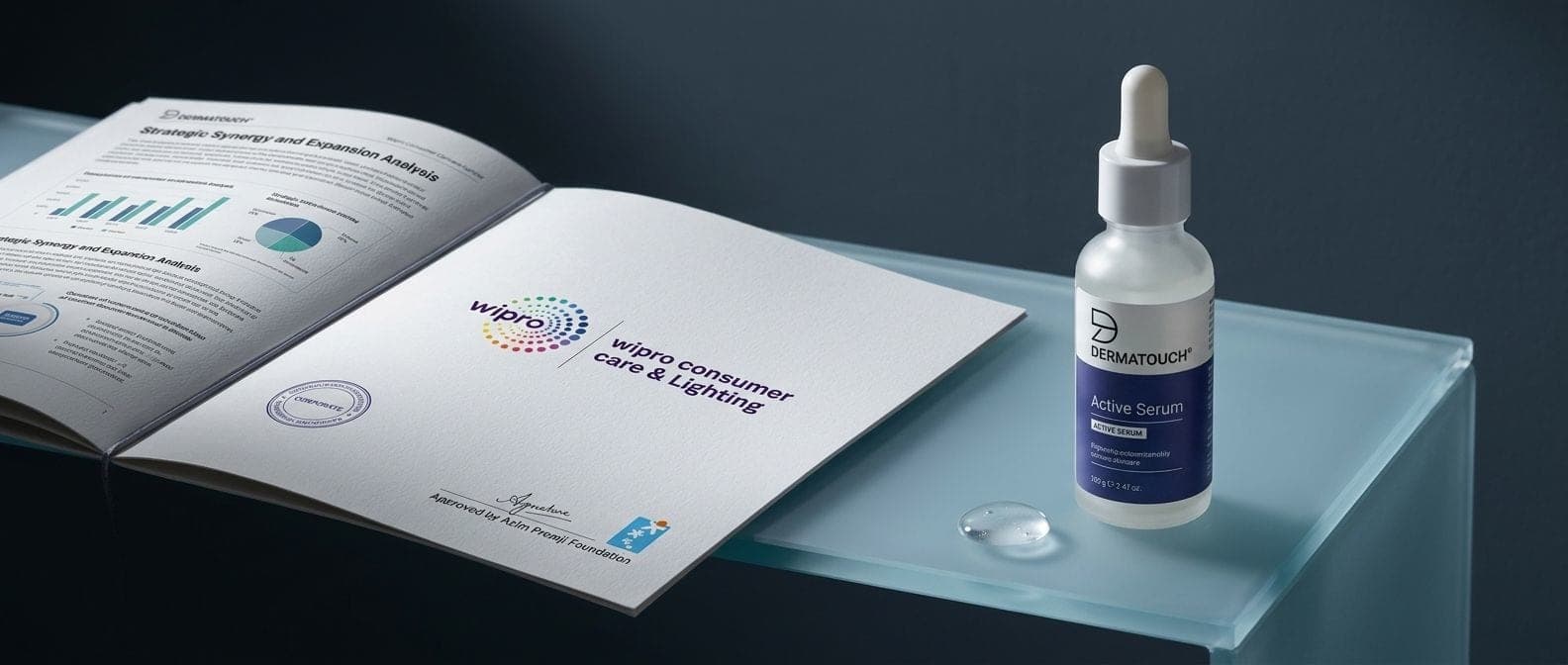
The M&A Signal: Legacy FMCG Captures Clinical Active Skincare
Wipro Consumer Care & Lighting’s ₹387.5 crore acquisition of Dermatouch sends a clear message to the Indian beauty industry: legacy FMCG giants are done waiting on slow internal R&D cycles. By acquiring a fast-growing, digital-native active skincare player, Wipro bypasses years of product development to instantly capture high-margin market share.
Yet, moving a D2C brand from direct-to-door shipping into thousands of physical retail doors presents immediate technical hurdles. For Wipro, retaining Dermatouch’s brand equity requires making sure these clinical formulations perform identically on a humid retail shelf in Chennai as they do fresh out of an e-commerce fulfillment center.
The true enterprise value of active skincare sits inside the bottle. Acquiring conglomerates must evaluate three core chemical pathways during integration:
Melanogenesis Inhibition
Hyperpigmentation products rely on target-specific actives. Alpha-Arbutin and Kojic Acid Dipalmitate act as competitive tyrosinase inhibitors, stopping the conversion of L-tyrosine into dopaquinone. Formulators pair these with 2% to 5% Niacinamide, which blocks melanosome transfer to epidermal keratinocytes, achieving brightened skin tone without cytotoxic side effects.
Keratolysis and Follicular Clearance
Acne treatments depend heavily on Salicylic Acid. As a lipophilic beta-hydroxy acid (BHA), it cuts through pore-clogging sebum to hydrolyse desmosomal proteins, clearing follicular impactions and driving controlled exfoliation.
Stratum Corneum Repair
Exfoliation must be offset by lipid replenishment. Multi-lamellar emulsions containing Ceramides NP, AP, and EOP mimic the natural intercellular matrix. Paired with multi-molecular-weight Hyaluronic Acid, these barrier-repair systems lock in superficial and deep epidermal hydration while curbing transepidermal water loss.
CDSCO Regulatory Framework and Claim Differentiation
Commercializing these biochemical formulas at scale requires navigating India’s regulatory landscape. Under the CDSCO Cosmetics Rules (2020) managed through the Sugam portal, products must comply strictly with IS 4707 standards. For instance, leave-on Salicylic Acid formulations cannot exceed a 2% concentration limit.
Marketing teams must also maintain tight boundaries between cosmetic and therapeutic claims:
Permitted Cosmetic Claims: Phrasing like "reduces the appearance of dark spots" or "smooths skin texture" is allowed, provided the claims are backed by Human Repeated Insult Patch Testing (HRIPT) and dermatologist-supervised trials.
Prohibited Drug Claims: Promising to "cure melasma" or "eliminate acne scars" instantly reclassifies the product as a Drug, triggering pharmaceutical regulatory oversight that halts high-velocity retail rollouts.
CDMO Implications: Stabilisation and Omnichannel Scale
The operational weight ultimately lands on Contract Development and Manufacturing Organisations (CDMOs). Transitioning active skincare to mass retail requires advanced manufacturing strategies:
Delivery System Stabilisation: Unstable actives like L-Ascorbic Acid and Retinoids degrade rapidly when exposed to ambient light, oxygen, and heat. CDMOs must deploy liposomal encapsulation or microemulsion technologies to preserve chemical efficacy across long distribution networks.
Enterprise Quality Control: CDMO facilities must operate under ISO 22716 (cGMP) standards, executing real-time degradation profiling to guarantee batch-to-batch active uniformity.
Wipro’s takeover of Dermatouch underlines a new reality in Indian personal care: mastering the chemistry behind active skincare is just as vital as securing the deal itself.